Marital harmony restored at a bargain non-marine price
Issue 105 : Nov/Dec 2015
After our first summer in our Benford 40 schooner, one of the items high on the refit list was upgrading the control for the windlass. Although raising the anchor with the electric windlass was luxurious compared to hauling it manually, the only control for it was a switch located beside the companionway inside the pilothouse. I hardly need say that the road to marital bliss is not paved by trying to communicate, along the entire length of the boat, the intricacies of lowering just the right amount of rode.
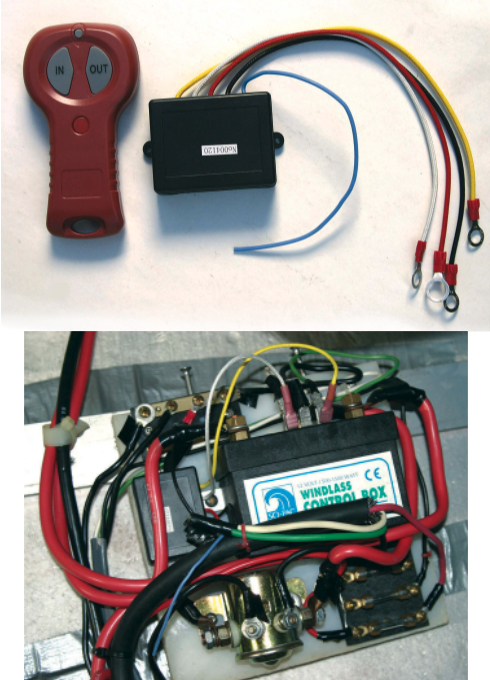
Foot-operated switches or a remote control both looked like viable options for controlling the windlass from the bow of the boat. Because every hole in the deck is another place where water will eventually get in, I favored a remote control over deck-mounted buttons or a hand-held remote that plugs in. Recovering from sticker shock after looking at the remote controls offered by the manufacturer of our windlass, I wondered if the remote controls sold for use with truck winches might also do the job. After an evening of searching online, I ordered a remote designed for off-road trucks that was waterproof, had a recessed on/off switch, was compatible with 12- to 36-volt power, had 50-foot range and was one twentyfifth the cost of the units designed for marine use.
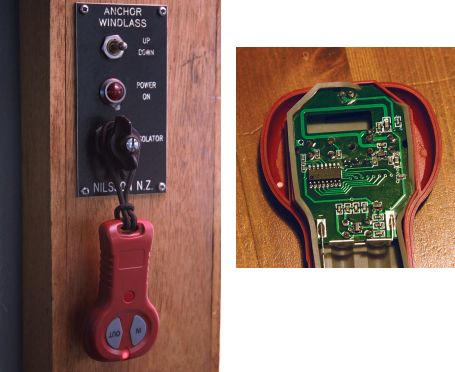
Installing the remote took no more than 20 minutes, including the time I spent searching for tools to replace two ring connectors with spade connectors to match my windlass control box. I connected the ground wire to an existing negative bus, the positive wire to a 3-amp fuse on the positive bus, and the two control wires to the windlass control box in parallel with the existing wires from the companionway control switch. I matched the “in” wire from the remote box to the “up” wire for the windlass. When I tested the remote control, it functioned exactly as the switch in the pilothouse had, but I could now stand anywhere on the boat and operate the windlass.
Float test
The remote controls offered by windlass manufacturers float, so I decided to test mine and also see if it was waterproof as claimed. Although the remote did float, it was not waterproof. Opening the unit revealed that it leaked because it had been assembled improperly. After thoroughly drying the circuit board, I reassembled the unit and added a drop of Goop glue on each of the two screws that secure the case (the gasket was very narrow around the screw holes). The remote passed my home-brew waterproof test of leaving it floating (mostly submerged) in water for 15 minutes.
For very little cost and effort this remote has given us a lot of flexibility in how we control our windlass. The remotes I looked at from windlass vendors were waterproof up to 1 meter during a 30-minute test. I doubt this remote would pass such a test or continue to do so reliably after every battery change. However, leading a sheltered life in the pilothouse and allowed to dry after being soaked in rain, it will, I suspect, last a very long time. Should it fail, we still have our companionway windlass switch and I could buy 24 more of these remotes before reaching the cost of a marine unit.
Darren Bos, an aquatic ecologist and stay-at-home dad, lives on the West Coast of Canada. After spending a decade exploring the Strait of Georgia aboard a Hurley 20 with his wife (and eventually two sons), he is now refitting a Benford 40 schooner as they prepare for a circumnavigation.
Thank you to Sailrite Enterprises, Inc., for providing free access to back issues of Good Old Boat through intellectual property rights. Sailrite.com