Downwind sailing with a new-tech nuance
Issue 105 : Nov/Dec 2015
Square sails have been used on sailing vessels for centuries. There is little argument that these sails, when the wind is dead astern or a few points either side, are a very efficient way to propel a boat of any size, even today. Anyone with a Bermudan rig knows how tricky it can be to keep the sails filled and to hold a steady course when running before the wind, especially when a big sea is rolling up astern. It’s often necessary to set poles and an assortment of lines to hold the sails out, whether they happen to be a boat’s basic plain sails or a spinnaker.
When sailing with poled-out downwind sails, the helmsman must keep a keen eye on the wind and the course to prevent the sails from collapsing and refilling with a crack and the accompanying stress on the sail. Another concern with most of these headsail configurations, especially twin headsails, is that they cannot easily be reefed and, as the wind picks up, someone has to go forward to deal with the situation.
With a square sail correctly braced, there is absolutely none of this. The boat becomes very stable yet the course can vary by as much as 30 to 40 degrees to either side of downwind. There’s no concern about jibing or broaching and the helmsman or autopilot will have little difficulty holding to a steady run. The boat will also roll less with a square sail set.
However, there is a significant, almost insurmountable, drawback to having a great flat sheet of canvas hanked on a yard high up a mast — furling and unfurling, not to mention reefing the darned thing! This drawback precludes the use of square sails on all but vessels with large crews, such as sail-training ships that have lots of young people able to scale the ratlines and edge out along a flimsy footrope to secure or release the canvas from the yard. Even if they’re harnessed to the yard, it’s still a dangerous, not to mention strenuous, operation.
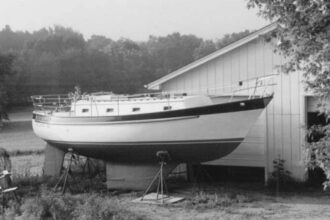
But what if you could easily furl, unfurl, and shorten a square sail from the safety of the deck or even the cockpit . . . without a single person having to go aloft? Now that would bring a completely different perspective to their use on a short-handed sailboat! I had pondered this problem ever since sailing on Sir Winston Churchill, the British Sail Training Association’s square-rigged schooner, and later on a few other square-riggers. I wanted a system that could be operated from the cockpit of my 45-foot schooner, Britannia, that would convert her to a brigantine. Incidentally, a boat doesn’t have to be a schooner to carry a square sail. One could be installed on any rig, including a sloop or ketch. But how best to do it?
Not many good choices
I have been on boats with different square sail arrangements. One hauled the sail outward from the mast along the yard on a track like curtain drapes. Another simply hoisted the sail at the outermost ends and in the middle of the yard. Both had a serious drawback in that they could not be reefed. The sails were either up or down, and lowering or brailing them was an on-deck operation, not unlike dropping a large hanked-on genoa on a run.
I considered another method using a regular headsail roller-furling system mounted horizontally in front of a yard. This does allow progressive reefing, but the point loads imposed on the ends of the yard require a heavier spar. In addition, the yard and sail add to the windage aloft and the sail remains exposed at all times.
Inspiration dawned from the relatively recent concept of in-boom roller furling. That got me thinking: why not use the same principle, except upside down, to roll a square sail up and down like a blind? Nobody sells such a thing, of course, so I set my mind to designing and making one. My concept might be called “in-yard square sail furling.”
I contacted a number of marine architects and sailmakers, but none could tell me how long the yard should be for my boat nor the stresses on the yard, sail, or indeed the mast. I finished up at the Old Naval Dockyard in Chatham, England, where I found a formula for yards and sails for a British frigate. I don’t have a crew of 300 or any cannon, but the formula was all I found to work with.
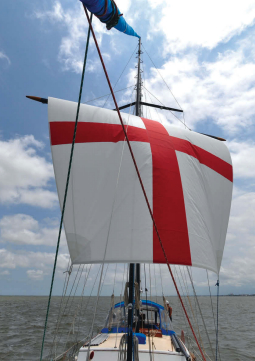
It took nearly two years and a lot of engineering and experimentation, but now Britannia has a beautiful square sail on her foremast. It’s called the fore course, being the lowest athwart sail on a ship’s mast, in my case the foremast. It has proved to be absolutely fabulous for sailing downwind. All furling and unfurling is done from the cockpit. The sail can be rolled up or down or reefed partway according to the wind strength. When completely furled, it presents little windage and the sail is protected from the elements inside the tubular yard and never gets wet, not even in the heaviest deluge.
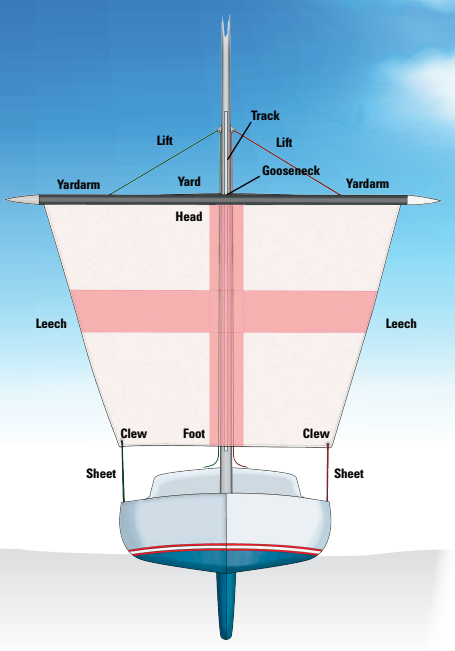
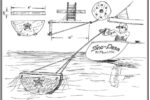
• The lines leading up from both sides of the yard to the mast are lifts.
• The yardarms are from the lifts to the ends of the yard, (not the whole yard from the mast out).
• Up the middle of the mast from near the deck is the track.
• The yard joins the track at the gooseneck, or the old term, swivel.
• A halyard up the mast attached to the center of the yard is the hoist (not shown on the drawing).
• The head is the top of the sail on the yard.
• The two sides are leeches (except when close-hauled, when the windward leech becomes the luff).
• The bottom is the foot.
• The bottom edges are clews.
• Sheets come off both clews.
First, the yard
In square sail terminology, the complete horizontal spar is the yard, the section outboard of the lifts is the yardarm, and the end of the arm is called the Flemish horse. If you have ever been out there, even in a calm sea, you know why. In heavy weather it is more like riding a wild stallion. However, nobody rides the Flemish horse on my boat nor do I have leech lines, bunt lines, bow lines, clew garnets, or tack lines, all of which are needed to handle a regular square sail. I just have a continuous line marked “sail up” and “sail down.”
Before I could begin to build my design the first question was, where to find a strong 22-foot-long aluminum tube with a continuous slot? I did all sorts of searching on the Internet, but the answer came one day as I pondered a boat’s in-mast furling system. Why not remove the front section of a roller-furling mast extrusion, leaving only the sail stowage tube with its ready-made slot?
Mast extrusions are available in many sizes, but it was also necessary to find out what diameter tube was needed to accommodate the sail when wound up inside. To achieve this I wound a 19-foot strip of sailcloth around the internal mandrel that winds the sail in and out. This resulted in 20 turns of canvas with a diameter of 5 inches.
Mast suppliers sounded surprised, if not a little nervous, when I asked how much they would charge for a mere 22-foot section. These hefty extrusions are normally supplied as masts three and four times that length. Nevertheless, Charleston-Spar, in Charlotte, North Carolina, had the right section at the right price. This suited me perfectly, as I planned to fabricate the yard at my daughter’s printing works in Hickory, North Carolina, only 50 miles from Charlotte.
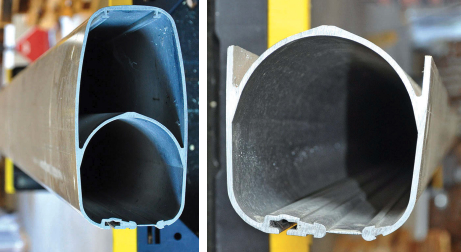
I had plenty of room to maneuver the spar in the factory warehouse, where I first sawed off the entire front using a circular saw with a 60-tooth blade.
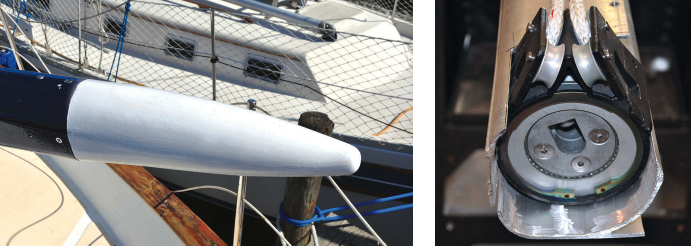
I found a local welder to attach lugs to carry lifts, hoist, braces, and fairleads. I also shaped a couple of yard ends out of cedar blocks. They are removable to give access to the mechanisms at each end.
I found a rope winch driver that normally turns the mandrel on a vertical in-mast system. After some grinding, I managed to slide the driver snugly inside the end of the tube so only the furling-line sheaves were exposed. I secured the other end of the mandrel with a large thrust bearing and nut that can be tensioned to reduce sag in the mandrel. Then, suddenly, I had my yard.
A prototype sail
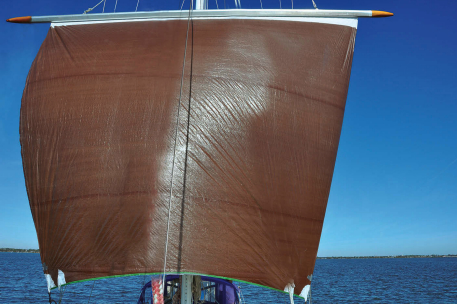
The next essential item in this experiment was a sail. I didn’t want to buy an expensive Dacron sail without first knowing if the system worked, so I fashioned one from a cheap plastic sheet and glued the edges. This produced a pretty effective test sail, except that one side was green and the other brown, making Britannia look more like the Son of Town Hall raft than a modern sailboat.
To prevent bunching at each end as it rolled up inside the yard due to the additional thickness of the leeches, the sail is not cut square. My sail is a trapezium, 20 feet wide at the head but only 14 feet wide at the foot, with a 19-foot drop. When the sail rolls up inside the yard, the leeches barber-pole and don’t overlap, so they don’t bunch up and there’s no risk of jamming.
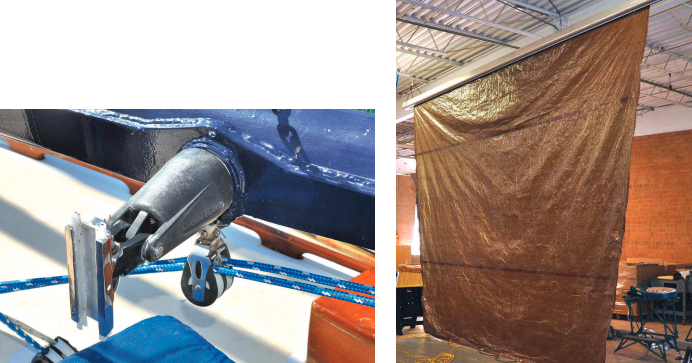
With my homemade sail rolled round the mandrel and stowed inside the yard, I was itching to test it in some wind. I had my eye on a large wooden telephone pole outside the factory, but my daughter quickly put a damper on that. “You mustn’t do that, Dad,” she said, “You’ll get me locked up!” I saw her point, but I still say that no city ordinance explicitly forbids hoisting a square sail up a telephone pole.
I settled for hoisting it on pulleys to the roof beams in the factory, and used their large electric fans to provide some wind. This worked tolerably well and we were able to wind the sail up and down quite easily. So far, so good.
I now needed a gooseneck to attach the yard to the mast. It had to be a very strong and secure connection at the center of the yard, yet it also had to be detachable in case the traveler jammed or in the case of some other emergency. It had to pivot from side to side to brace the yard left or right according to the wind, and it also had to rotate to permit the yard to cant or tilt when docking in confined marinas. It certainly would be asking for trouble to try to squeeze a boat into a normal slip with a 25-foot pole sticking out the sides. All this was achieved by modifying a spinnaker-pole end and bolting it to a traveler that slides on a track all the way up the front of the mast.
I finally transported the yard 650 miles to Britannia in Florida, strapped securely (I hoped) to the roof of my minivan on a wooden framework. I was relieved to finally get it up the mast.
After a lot of trial and error with my makeshift sail, we got Britannia sailing at 4 knots in only a light 10-knot following wind with my 11-year-old grandson steering and frequently over-steering as landlubbers often do. This would be quite unacceptable with normal fore-and-aft sails, which require skill on the part of the helmsman to keep them filled and to avoid jibing the main or mizzen.
The real thing
By this time, I was in quite deep financially, but if I was going to continue I was now faced with buying the most expensive item: a proper Dacron sail. This was not that easy either, as I couldn’t find any sailmakers who had ever made a square sail, never mind one that would roll up inside a 5 1⁄2-inch-diameter tube. Scott Lomas, with Doyle Sails in Stewart, Florida, showed the most interest. When the new sail arrived, the last stage of the grand experiment could be undertaken.
On the day of reckoning, the wind was an ideal 10 to 15 knots straight down the Intracoastal Waterway. We steamed upwind for a while, then turned around and cut the engine.
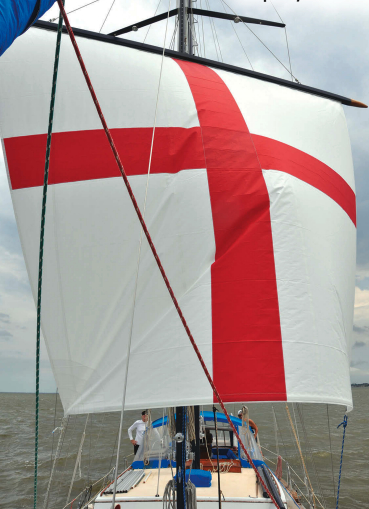
As helpers tended each sheet I hauled on the “sail down” line and the sail began to unwind from inside the yard. As the wind caught the canvas, it began to unfurl itself, but I controlled that by snubbing the “sail up” line around a cleat. I cautiously eased out more and more sail and soon the whole 340 square feet billowed majestically before us. We winched the sheets in as the boat gathered speed. Within minutes there was a small wave under the bow as we coasted downwind at 5 knots. It was a great sight to see the beautiful white sail filling so well.
Britannia did not heel or roll as she would have done under her Bermudan sails. The motion was more like a catamaran than a monohull and was so steady I felt no trepidation in steering straight through the narrow gap under the Titusville bridge. At least it seemed pretty narrow when our 14-foot-wide boat was suddenly 25 feet wide. A speedboat overtook us with people yelling “fabulous,” “great show,” and words to that effect.
Unfurling the sail was easy enough, but now came the second and more important test: would it roll back smoothly into the yard? We had experienced problems winding the plastic sheet in and out, as it sometimes overlapped itself and occasionally jammed completely. I was fairly sure this was due to the flimsiness of the material and reasoned that 8.5-ounce Dacron should be much more stable. At this moment I earnestly hoped so, otherwise we might have finished up in Miami, since you can’t just turn a square sail into the wind.
There was only one way to find out. As my crew eased the sheets and spilled some wind I hauled the “sail up” line. It was harder than unfurling, but once I got it round a winch it was easy enough, and became lighter as the sail became smaller and finally disappeared into the yard as clean as a whistle. Another milestone passed. What a relief!
Changing courses
Knowing the sail can be progressively reefed — even to the point of exposing just a few feet of canvas — will be a great reassurance as the wind pipes up. I now wanted to see how many degrees we could sail off the wind with the yard fully braced.
After motoring back to our starting point, I steered a zigzag course down-wind, bracing the yard first to port then to starboard. Amazingly, the sail never lost wind even when 3 points, that is 34 degrees, either side of the stern. This will allow a great degree of latitude when going downwind with a big following sea. It will also be less demanding on the autopilot.
All in all, the day’s trial was a successful conclusion to a lot of hard work and expense. We celebrated with a bottle of bubbly as we steamed back to the marina. And no, I did not forget to cant the yard before entering our slip.
After I’ve thoroughly tested the system in all seagoing conditions, and once I’m happy with the structural and operational components, it is my intention to build a second yard to be hoisted above the fore course and carrying a sail about half the size. This will be the fore tops’l. Britannia will then field more than 500 square feet of athwartships canvas, which will greatly add to her downwind performance. Having a combination of two square sails will provide more flexibility in the same way that a combination of sails on a ketch or schooner permits different sails to be set according to conditions.
By the way, the red cross on the white ground is the English Cross of St. George that forms part of the Union Jack. It is also the Templar’s Cross and the emblem of the Red Cross Association. But that ambiguity will just add to the mystery when my little tall ship is spotted on the horizon.
The cost
I had a stiff whiskey on hand when I added up the cost of all the equipment and parts, including sub-contractors’ fees for special jobs. Overall it came to $3,736, not counting my labor. Four pieces of equipment represented about three quarters of this. The mandrel driver was $600, the yard and mandrel $400, the gooseneck and traveler $380, and the sail $1,550. Re-rigging with heavier stainless-steel wire was included in the cost of converting the boat from a ketch to a schooner, which is another story altogether.
I have nothing with which to compare this unusual project in order to appraise whether it was expensive or not. The nearest comparison is perhaps an in-boom furling system. Even a smallish in-boom furling system, not including a sail, is more than twice the cost of my system.
Ultimately it comes down to what you want and what you are prepared to do if you can’t actually buy something ready-made. There were times when I was set to quit and my family thought I was quite nuts. But now, when I unfurl my beautiful sail that I designed and engineered . . . when I see it billowing forth, I’m pleased I persevered. My small square-rigger is unique.
All we have to do now is find a following wind, instead of having it on the nose as it is most of the time.
Roger Hughes has been sailing for nearly half a century as a professional skipper, charterer, restorer, and occasional imbiber aboard lots of boats, including square-riggers. His latest project is refurbishing Britannia, a once rundown Down East 45, and re-rigging her as a brigantine schooner with a unique roller-furling square sail on the foremast and a few other “inventions,” like his over-the-top blocks (see January 2015) and a hot tub in the owner’s head. Roger’s website is www.schooner-britannia.com.
Thank you to Sailrite Enterprises, Inc., for providing free access to back issues of Good Old Boat through intellectual property rights. Sailrite.com