Spray away and be the envy of the anchorage
Issue 41 : Mar/Apr 2005
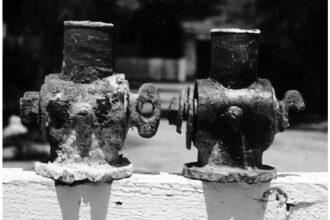
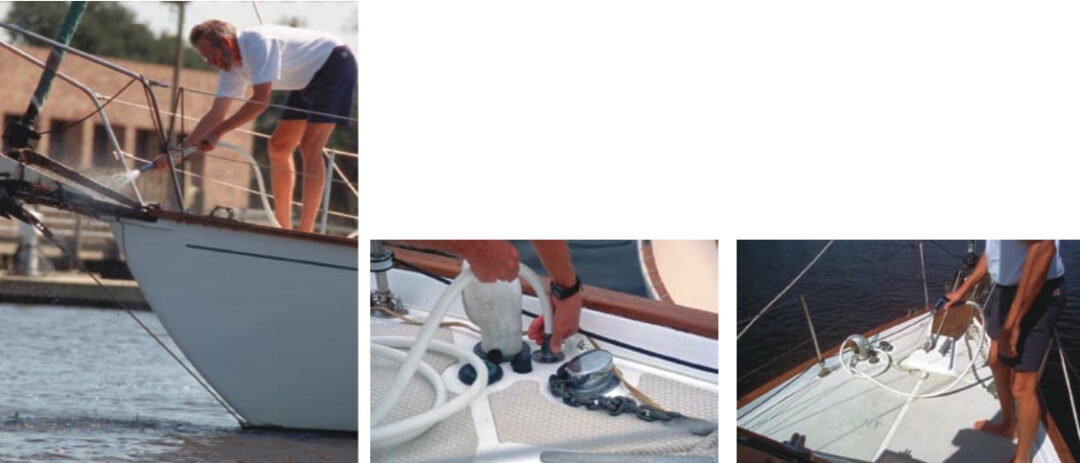
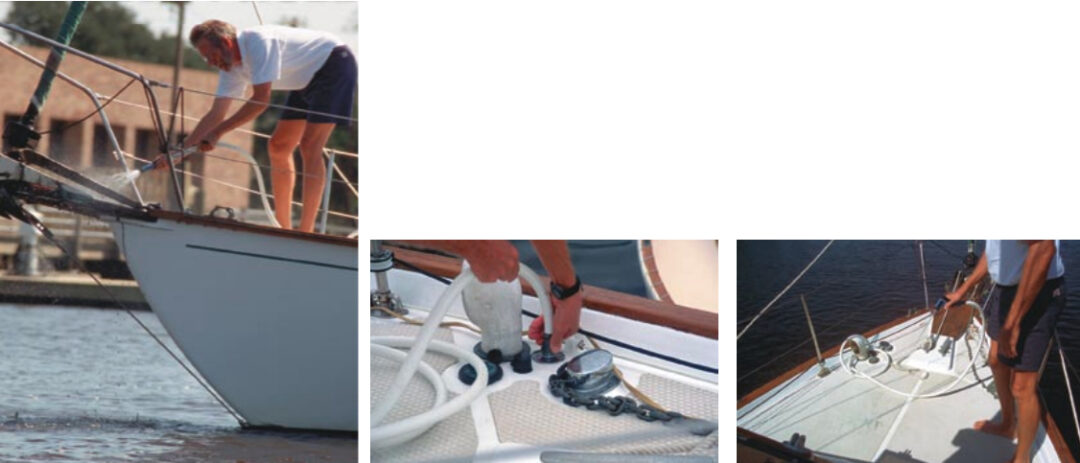
At the bow of our boat is a silver-dollar sized fitting with a screw-on cap that evokes envy from fellow sailors almost every time we put it in use. It is a male hose connector. Belowdecks it connects to a high-pressure pump plumbed to a through-hull fitting. At the flick of a switch, it spouts a powerful and virtually unlimited jet of water.
We use our deck-wash system mostly to blast clinging mud from our retrieved rodes and anchors so they come aboard clean. The bucket-on-a-rope method we used before is infinitely inferior, not only because of the physical effort required but also because the mud is already aboard. Sluicing carries it the length of the boat, invariably leaving grit in corners and crevices.
In addition to repatriating bottom muck, a high-pressure water hose is great for rinsing air- and foot-borne pollution from the deck and for expelling the slime of fishing success or conch cleaning. It can provide a bracing seawater shower. After I scrub weed from the hull (bottom painting doesn’t always happen on a calendar schedule when cruising), I typically stand in the dinghy and spray-evict sea critters that have taken refuge on my body and in my clothes.
In an emergency, a deck-wash pump can serve as an additional bilge pump. With a little ingenuity, it can even get you home when the raw-water pump on your inboard engine fails. In short, a deck-wash pump makes a fine addition to almost any boat, and equipping your boat with one is neither difficult nor expensive.
The pump
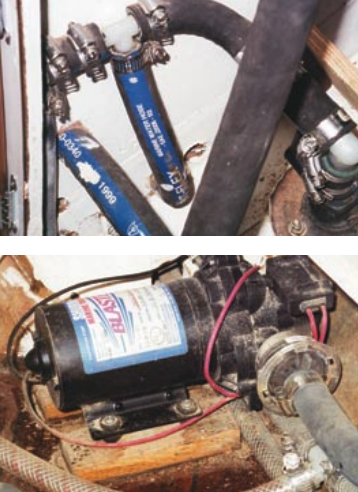
The safest course is to buy a pump marketed as a washdown pump. These will have internal components suitable for saltwater use. My preference is for a positive-displacement diaphragm pump, which tends to pass small debris without ill effect. Flexible impeller or rigid vane pumps can also serve. What you do not want is a centrifugal pump, which can move a lot of water but is not very good at lifting it. Your bilge pump is probably a centrifugal pump.
Washdown pumps include reverse-flow check valves and (typically) an internal pressure switch. Operating pressure can be up to 50 pounds per square inch (psi); the higher the pressure, the more powerful the spray. Screw-on hose barbs are usually included with a washdown pump, which simplifies plumbing. If the pump will be installed belowdecks, there is little need to pay extra for a “wet location” pump.
Mounting
Almost all deck-wash pumps have four feet with rubber grommets. Screws or bolts through the grommets fasten the pump to any rigid part of the boat. Pumps can be mounted horizontally to an appropriate platform — not directly to the hull (duh!) — or they can be mounted vertically to a bulkhead. For quieter operation, through-bolt the pump to the walls of two short lengths of heavy-duty rubber hose, then screw the hose to the boat.
In accordance with American Boat and Yacht Council (ABYC) guidelines, the recommended placement for all diaphragm pumps plumbed to a through-hull fitting is above the waterline.
Most pumps will specify how much of a lift they can deal with on the suction side. Stay well below that specification. Many washdown pumps will self-prime only a foot or less, and they may not do that as they get older. If the specific pump installation instructions allow it, mounting the pump below the waterline will avoid priming problems.
Plumbing
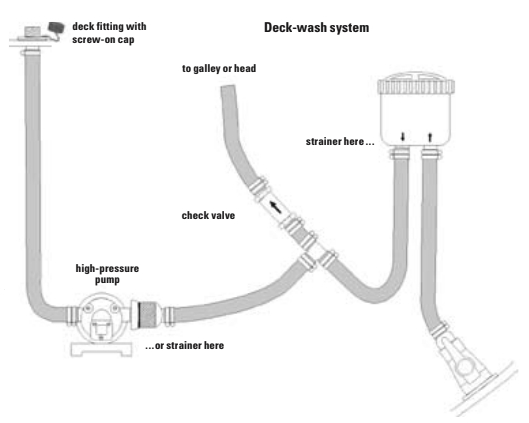
There is no need to add a through-hull fitting for a deckwash pump. Use an existing through-hull fitting for the galley or head, supplying the deck-wash pump by the insertion of a simple T-connector. Do not use the raw-water intake for the engine. This puts the engine and the washdown pump in competition for the available flow. Worse, a check-valve failure in the washdown pump could cause the engine pump to lose prime.
The hose from the T-connector to the intake side of the pump must be suction hose with spiral wire reinforcing to keep it from collapsing. On the output side you will need reinforced hose rated for at least 50 psi. You can use clear reinforced hose, but the greenhouse effect of clear hose gives rise to odiferous growth. The better choice is reinforced black water hose (automotive heater hose).
Your deck-wash pump must have a strainer in the supply line. Failure to include this essential component dooms your pump to a premature death. If the raw-water line you are tapping into already has a strainer, install the T-connector on its outlet side. Otherwise, add a small in-line strainer somewhere between the through-hull and the pump, taking care to make it accessible for occasional cleaning.
Although the washdown pump has its own check valves, if it is sharing the supply through-hull with another pump — a galley seawater pump, for example — and/or if it is mounted above the waterline, an additional check-valve close to the T-connector will help prevent prime problems. Suitable small check valves are available for around $5 from most home supply and hardware stores.
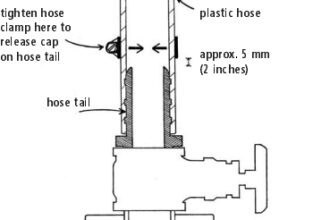
The appropriate deck fitting is a capped male hose connector. A line-and-toe-snagging spigot is not needed because water flow is normally controlled by a nozzle on a hose with the pump switched off electrically when not in use. The integral pressure switch controls the pump when the switch is on.
On cruising boats, a short hose — long enough to spray off the anchor rode — normally stays attached to the bow deck fitting. A longer hose may be stowed away for other uses. If you are so inclined, there is no reason why you cannot plumb more than one deck fitting from the same pump. An outlet aft can be most convenient for cockpit showering or fish cleaning. A T-connector on the output side, a run of hose, an additional deck fitting, and a few hose clamps are all that are required.
Wiring
Most washdown pumps are supplied with a pair of protruding insulated wires for connecting to a 12-volt power supply. The electrical connections should be unambiguous — positive (red) to positive (red) and negative (yellow or black) to negative (yellow or black). You can crimp on ring connectors and connect the two pump wires to a small terminal block mounted nearby, bringing your supply wires to the same block.
However, I favor waterproof wiring near pumps, so I recommend connecting the pump wires directly to the supply wire with crimp butt connectors. Use adhesive-lined heat-shrink waterproof butt connectors or waterproof regular connectors with lengths of heat-shrink tubing. Secure the wiring with nylon cable clamps to avoid the possibility of wire strain.
Do not pick up the power for the pump from the nearest pair of wires. The wiring for a lighting circuit is likely to be of inadequate size to supply the substantial draw of a washdown pump. This is bad for the pump and potentially dangerous for the wiring. Plan on installing a dedicated circuit for the pump with a new fuse or breaker in the main electrical panel. A breaker can also serve as the On-Off switch, or you can insert a switch into the positive side of the circuit. Mounting the switch where you can reach it from the deck — just inside the forward hatch, for example — can prove convenient.
Do not scrimp on wire size. This will reduce the water flow and shorten the life of the pump. Follow the instructions provided with the pump. These instructions should detail the fuse or breaker size, the wire gauge as a function of length of the wire, and if the fuse needs to be a slow-blow type.
Typical instructions for wire length might say: if the one-way wire distance from the electrical panel to the pump is not more than 15 feet, use 12-gauge wire for a 6-amp pump, 10-gauge if the pump draws 10 amps. If the pump is farther from the panel — up to around 30 feet — use 10- and 8-gauge wire respectively. Motors may draw three to six times their running current when they start, so the wire sizing for motors is larger than for other loads.
Keeping your boat looking her best is a lot easier with a washdown pump, particularly when you will be away from the dock for long periods.
Just the cachet of hosing the deck in the middle of the anchorage will repay the installation.
Thank you to Sailrite Enterprises, Inc., for providing free access to back issues of Good Old Boat through intellectual property rights. Sailrite.com