An author prevails against life’s headwinds
Issue 85 : Jul/Aug 2012
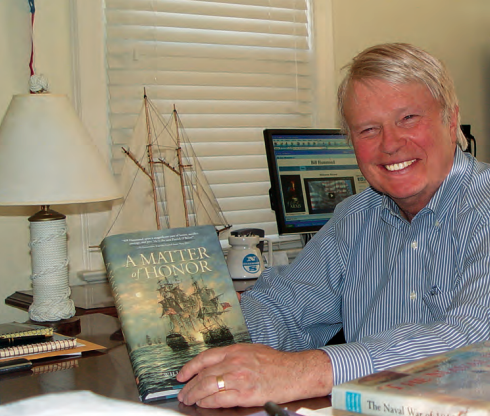
Before dawn each day, William C. Hammond makes his way to the writing studio of his rambling colonial house near downtown Minneapolis. He is as inland as he could be, yet he carries his coffee aboard a frigate or perhaps a third-rate, usually in the company of an aspiring naval officer named Richard Cutler, and puts to sea during the Age of Fighting Sail.
“Writing transports me,” Bill says. “I live in that era part of every day, immersed in the time between 1774 and 1815.” The notion won’t surprise readers of the Cutler Family Chronicles, a series of seven maritime novels that seem poised to join the canon of nautical-history fiction, but with a distinctive difference: his books focus on the American perspective rather than that of the Royal Navy, whose exploits intrigued such masters of the genre as Patrick O’Brian and C. S. Forester, as well as a raft of contemporary writers. “Readers are accustomed to tales of the Napoleonic Wars,” Bill adds. “The United States has its share of naval heroes to rival Horatio Lord Nelson, heroes most Americans don’t know much about.”
A matter of characters
His tale begins with events leading up to the Revolutionary War and continues for decades afterward, depicting the equally compelling though less familiar struggle of a fledgling country transforming itself into a seafaring power. The inaugural title, A Matter of Honor, takes readers from the daring raids of John Paul Jones to the miracle of Yorktown, the pivotal battle that turned the tide of the war. Published in October 2007, it has garnered readers from Boston to London, Peoria to Copenhagen, and earned a coveted review in Publishers Weekly, the book industry’s trade journal. Calling it a sprawling debut novel, the journal concluded its review with a clear endorsement: “Drawing on five years of historical research and a lifetime of sailing, Hammond vividly recreates an early chapter in American history.”
To deliver such a convincing story, Bill knew he needed a dynamic plot and, above all, engaging characters. He rested his aspirations upon the Cutler family, Massachusetts-based merchants with commercial interests in the Caribbean and a host of English relatives who allow Bill to illustrate political sympathies on both sides of the Atlantic. “The family is a microcosm of the times,” he says. “I feature their interpersonal relationships against the backdrop of America’s emergence on the world stage.” A Matter of Honor is driven by Richard’s angst at the death of his older brother, who has been flogged to death by the Royal Navy. Richard goes to sea to avenge him and becomes fervently involved in the quest for independence, interacting with such real-life figures as Benjamin Franklin, John Adams, and the Marquis de Lafayette.
His adventures continue in For Love of Country and The Power and the Glory, published in 2010 and 2011, respectively; a fourth volume, A Call to Arms, will appear in November. The titles are widely available in print at bookstores, libraries, and online retailers; the second and third are available as e-books. A Matter of Honor has recently been released as an audiobook (see “Hear! Hear!” page 53). Among other experiences, Richard observes the French Revolution, participates in the Quasi-War against the French Republic, and sails to Algiers to ransom the crew of a Cutler merchant brig imprisoned by Barbary pirates. In short, he bears witness to the efforts of a young United States seeking to establish itself as a sovereign nation, notably through the launch of an official Navy.
Hear! Hear!
With seven novels planned for the Cutler Family Chronicles and three in print, Bill Hammond’s story is not yet half told. So there are plenty more tales for fans to relish — and plenty of time for new readers to sign on. And now the first volume is an audiobook, with all 18 hours available for $35 as a downloadable MP3 file. Narrator Spencer King reads an unabridged and theatrical version of A Matter of Honor, adopting different voices for various characters, be they American, British, or French.
The call of duty is not all Richard encounters, however. He also contends with the lure of romance, enjoying an interlude with a Swiss aristocrat in Paris before marrying Katherine, an English friend of a cousin. She is engaged to none other than a young British sea officer named Horatio Nelson, but Richard steals her heart. Their poignant and often passionate scenes complement the many action sequences afloat, and the shifting locales permit glimpses into the hardships and entertainments of both domestic and military life.
A matter of research
Choosing to include patriotic icons — and make them engaging characters too — required extensive research and a deft imagination. Bill’s Founding Fathers are not deified heroes but a diverse lot of human beings with distinct personalities and convictions that don’t always jibe. Bringing them to life through dialogue is a profound challenge, he says. “My rule of thumb is not to try to quote exactly what a character said. Instead, I aim to convey what he or she could have said.” He studies countless historical records and biographies, scours the Internet for virtual tours of tall ships, and pores over original documents such as the log Captain Jones kept aboard Bonhomme Richard. (An excerpt featuring the ship in action appears in “I have not yet begun to read!” page 52.) He augments fact-finding from his study with museum visits; he’s toured USS Constitution at least 20 times.
“I have not yet begun to read!”
About three-quarters of the way through A Matter of Honor, Lieutenant Richard Cutler finds himself in an intense battle with the 44-gun HMS Serapis while aboard Bonhomme Richard, the merchant ship-turned-warship commanded by John Paul Jones. Even though Richard sank after British Captain Richard Pearson surrendered, the incident confirmed the French decision to back the Colonies in their fight for independence — and, in the fictional universe of Bill Hammond, it gives Cutler and Midshipman John Mayrant the opportunity to hear one of the most famous rallying cries in military history. We dare you to read this excerpt and fight off the urge to read more of Bill’s work! –Eds.
Both ships paused to reload their guns. Slowly the smoke began to clear.Through a lightening haze, dark forms of ships loomed. Again the commands of officers, again the guns vomiting orange flames, again the staggering impact, again the choking smell of burnt powder, again the screams of men struck and dismembered, again the officers’ cry for men to stand to amid the savagery and butchery of flying splinters, ricocheting grapeshot, and decks becoming unwieldy with the spilled blood of the dead and dying. Then, from Richard’s lower gun deck, came the loudest explosion of all, followed by another of equal, horrifying volume.
“What was that, sir?” Mayrant asked, his voice shaking.
Richard leaned over the rail, aft to starboard. “I can’t see,” he said, “but I’d guess that two of our eighteens have blown themselves up.” He dared not dwell on the horror in that corner of hell: hot metal exploding violently into pieces, flying in all directions, upending the other guns, ripping into ribbons the flesh of Cutting Lunt, Joseph Linthwaite, and the sixty men at their stations.
“Then we’re taking on water!” Mayrant cried, aghast.
“Probably. But that’s not our concern now. The smoke’s lifting, Midshipman Mayrant. There’s our target. She’s pulled ahead of us.”
. . . Jones maintained his westerly course and aimed Richard’s bow at the enemy’s stern. In the lackluster wind, Serapis was unable to avoid a collision. With a great thud the two ships banged together. Richard hung there listlessly, unable to bring her cannon to bear. Her topsails blocked the view of sharpshooters in her rigging; on her weather deck, French marines and Irish soldiers fell in ranks as British swivel guns and musket fire took their deadly toll.
“Have you struck [your colors]?” Pearson called over from his quarterdeck.
Richard heard the question clear enough. Pearson had shouted through a trumpet. But he could not make out what Jones said in reply through a hand cupped at his mouth. He shook his head to stop his ears ringing from the explosions of guns and asked Mayrant if he had heard the captain’s response
“I believe I did,” Mayrant rasped. He moved close to Richard. “What the captain said, I believe, sir, was that he has not yet begun to fight.”
As he drafts each manuscript, he puts it through an intense vetting process using historians and a group of trusted “beta readers.” They give feedback on narrative flow and character development, constantly on the lookout for grammatical errors, missing context, and confusing dialogue. They also help identify any inconsistencies between books or between the books and the incidents they describe. Even so, Bill occasionally exercises authorial prerogative for the sake of the plot. For example, he switched the chronology of Jones’ capture of HMS Drake and his raid on the English seaport of Whitehaven, where Cutler is taken prisoner. “It was necessary for Richard to spend time with his English relatives, who secure his release,” he explains. Creative liberties are rare; it is far more likely he’ll verify the plausibility of a scene before incorporating it. Katherine’s engagement to Lord Nelson never actually happened, but when Bill learned that Nelson had been engaged several times prior to getting married, he found himself musing, “Why not to someone like her?”
His mail suggests that readers appreciate the careful balance between authenticity and creativity. One gratifying message came from a descendent of John Mayrant, a midshipman who served with John Paul Jones. “He emailed to thank me for the accurate portrayal of his great-great- grandfather,” Bill says, noting, “I have a close relationship with my readers. I insist on writing each one back.” Some of their feedback factors into his planning. “I originally conceived the series as six novels,” he adds. “Earlier this year I decided to add a seventh, a prequel to A Matter of Honor. It helped that several readers had suggested it, which validated my instincts.”
Lieutenant Commander Eric Meyers, a Naval training officer in Newport, Rhode Island, likely speaks for many Cutler fans: “Bill writes with such a unique style that I feel like I know the Cutlers. Plus he does a fantastic job with his description of battles, ships’ rigging, all the requirements of top-notch nautical fiction. You smell the sea, you feel the wind at your back.” What sets the series apart, according to Meyers, “is Bill’s ability to capture the human elements of war, life at sea, the struggle of separation, the internal strife a commanding officer suffers daily.”
To encourage interaction with readers, Bill has established a website, a blog, and a Facebook fan page (search for “Cutler Family Chronicles”). He often ties blog posts to current-day events using historical details integrated into his novels. A February entry, for instance, presents a passage from For Love of Country to comment on the ongoing struggles between Christians and Muslims.
Of course, all authors have their critics and Bill is no exception. Critiques center around such questions as: Is it believable that one man would meet so many of the movers and shakers of his time? Are there too many romantic interludes? Why do so many characters speak so often in French? Must the text be infused with sailing terms? (To help readers with the last item, each volume contains a glossary.)
A matter of upbringing
The jargon comes naturally to Bill, who learned to sail on a nine-foot Turnabout centerboard dinghy while growing up on Cape Ann, near Boston, Massachusetts. He hauled lobster traps during the summers, becoming well-versed in the ways of the sea. “My father used to kid that I could tie a bowline before I could tie my shoes,” Bill says. “When I graduated from school, he offered to buy me a used car. I told him, ‘Not to seem ungrateful, Dad, but I’d rather have an O’Day Tempest.’ She was a 23-footer, a sweet little boat. I cruised her to visit my girlfriend.” Now he charters on Lake Superior and keeps a Cape Dory Typhoon named Quickstep on the coast of Maine.
Literature figured prominently in his childhood too. “My grandmother gave me books, saying someday I’d be bored with toy soldiers,” he recalls. “She was right. I stuttered as a child and began to express myself through the written word. When I went off to college, I could not imagine anything more satisfying in life than to write a novel and have people value it.” My father, an investment banker, told me, ‘Do what your heart tells you to do, do it well, and the money will follow.’ He went on to say, ‘There are two exceptions: the priesthood and writing.’ I figured the next best thing for me would be to go into publishing.”
Bill has enjoyed a far-ranging career since the 1970s. He held a variety of sales and sales-manager positions at Little, Brown & Company, publisher of the Horatio Hornblower series, and earned an MBA in finance and entrepreneurship, started a literary agency, and became a business and management consultant for book and magazine publishers, including Good Old Boat. Currently, he provides consulting services to aspiring authors through a Twin Cities firm called Book Architects.
Yet the longing to write never left him, and eventually he combined his interests, identifying the American naval saga as a largely untapped market niche. In the late 1990s, while employed as publisher at the Hazelden Foundation in Center City, Minnesota, Bill took the writing plunge. “I was in my late 40s and realized it was ‘now or never,’” he says. “I sat down and wrote a concept paper for the series. I showed it to my wife, Victoria, and said, ‘This is what I want to do.’ She said, ‘When you retire, right?’ I said, ‘No, I’m going to start next week.’”
A matter of fortitude
Bill knew full well how difficult it is to break in as a first-time novelist. He contacted colleagues from his professional network, acquiring an agent in Upton Brady, former executive editor of the Atlantic Monthly Press, who ultimately negotiated a publishing contract with Cumberland House in Nashville, Tennessee. The Cutler series had launched; Bill had achieved his dream.
Then Cumberland went bankrupt six weeks before the second title was set to be released, his agent died unexpectedly, and he lost his sister, Diana, who had played a crucial role in reading his first two manuscripts. (The upcoming book is dedicated to her.) Although the series underwent a three-year hiatus, Bill rebounded, securing another highly regarded agent, Richard Curtis, a self-proclaimed “frustrated sailor,” who sold the next three titles to Naval Institute Press in Annapolis, Maryland. Richard Cutler looked to be back on course, but his creator continued to endure rough seas: routine cataract surgery in both eyes led to torn retinas, an infrequent complication, leaving Bill without reliable vision, a turn of events that seemed to be his worst nightmare — until his beloved wife of 34 years died of cancer in May 2011. “Losing Victoria has been devastating beyond words,” he says. “Her heart and soul are embedded in all of my books. If I couldn’t keep writing them, I don’t know what I would do.”
Bill’s fortitude may remind some readers of his main character. Both he and Richard Cutler exhibit professional and personal courage when faced with horrendous odds. Both are men of principle and loyalty. Perhaps that’s why Bill considered it a particularly meaningful honor when the Military Writers Society of America named Richard its protagonist of the year for 2011, selecting him from among the characters in more than 400 works of fiction.
“Our country was built on the rights of man,” Bill likes to point out, “a basic human feeling about honorable conduct. A handshake promise was meant to be kept, even one by a politician. I made a conscious decision for my work to reflect that ‘lofty’ attitude.” And so, no matter what comes his way, it’s unlikely that Bill Hammond will renege on the promise he’s made — to himself, to his wife, and to his readers: to rise early each morning, board a ship or two, and finish the story of Richard Cutler, his family, and his country.
Cindy Christian Rogers is an award-winning magazine writer and former magazine editor, publisher, and launch consultant. With the captain of her heart, Randy, she has sailed everything from cutters and cats to sailboards and iceboats.
Thank you to Sailrite Enterprises, Inc., for providing free access to back issues of Good Old Boat through intellectual property rights. Sailrite.com