Tragedy underscores propane’s dark side
Issue 85 : Jul/Aug 2012
A sailing friend called with stunning news: an explosion had just destroyed a boat moored in the marina where our good old boat, Sirius, is moored. My wife, Mary Jeanne, and I immediately drove to the marina, our minds a whorl of concerns and questions.
We soon learned the explosion was caused by leaking propane. The utter devastation of this explosion brought home, in a very personal way, the dangers inherent in using propane because, like many boaters, we cook with propane on board our boat. Fortunately, events of this type are rare, but they dramatically alter lives whenever they occur.
The blast occurred about 5:30 p.m. on a Tuesday at the end of January. A local TV channel put out a breaking-news story and this, together with the sound of the explosion, which was heard for several miles, alerted many local boat owners who gathered at the marina. We arrived there a little after 7 p.m.
We were relieved to learn that the explosion had occurred well away from our boat. Members of the marina staff and the local fire department were working at the site of the explosion. We later learned their focus was on containing the diesel fuel spreading from the destroyed vessel. To speed the containment efforts, docks near the site of the spill were closed to boaters until early the next day.
Small knots of fellow boaters gathered along the walkway overlooking the marina sharing what little information they could: the boat was in slip C-35 and had been destroyed; it was owned by a liveaboard couple who were relatively new to the community; the woman had been ashore shopping for groceries and the man, who was aboard, had been pulled from the water and taken to the emergency room in a nearby town and then airlifted to a larger medical center, where he was listed as being in “stable, but critical, condition.”
Nothing but flotsam
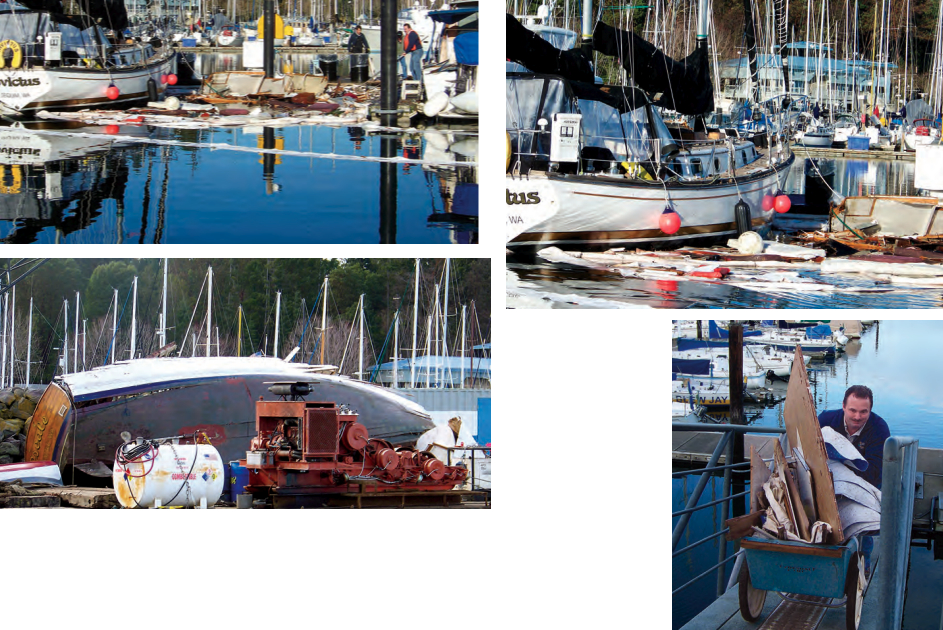
The next morning was calm and sunny. Boaters were able to walk to the area and witness for themselves the aftermath of the explosion. What had once been a lovely William Garden-designed 38-foot wooden cabin cruiser named Escale was now a debris field with nothing more than small- to medium-sized pieces of flotsam. The hull and machinery were on the bottom. A light sheen on the water outside the containment booms spoke well of the containment work done the previous night.
The flotsam from the debris field, smelling strongly of diesel fuel, was being hauled up to the parking lot one cartload at a time. It eventually filled a 30-cubic-yard dumpster.
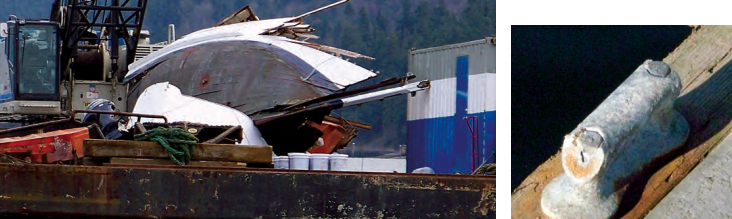
The next day, a salvage crew, using a crane mounted on a barge, hauled up the large pieces from the bottom. Photos in the local paper showed that three large pieces were hauled up: a portion of the aft cockpit, the foredeck with the windlass, and a virtually empty hull. These pieces were aboard the barge moored just outside the marina breakwater and we motored out to get a better look. The hull was severely damaged. The transom was nearly separated from the hull, planks were sprung, and the stem was split open. It was clear that the hull must have sunk rapidly after the explosion.
I later learned from harbormaster Ron Amundson that the foredeck was blown upward so violently that docklines secured to the foredeck had damaged three mooring cleats on the dock. One cleat was pulled entirely out of the dock, another was pulled partway out, and the third had its ears broken off. These offered a stark indication of the force of the blast.
The human aspect
The total destruction of the boat seemed to preclude the possibility that anyone on board could have survived, yet Keith Bryant, 78, was alive when he was removed from the water. Nearby liveaboards Julie and Cliff Houser were aboard their boat when the explosion occurred. They report being blown out of their chairs and showered with flying glass as the portlights on their boat were blown in. Once they had recovered their senses, they heard Keith’s calls for help. They pulled him out of the debris field with a boathook.
The first person on the scene with EMT experience was Jim Conachen, an active member of our local sailing fleet who, in an earlier life, was a firefighter with EMT training. He later told me about his role in this disaster.
Jim lives about half a mile from the marina and heard the explosion. When he spotted the smoke plume over the marina in the waning light of day, he realized what had happened.He arrived at the scene as the Housers were getting Keith onto the dock. Most of Keith’s hair had been burned off, as can be expected of anyone who has just been inside a fireball. Jim recalled that, in addition to a broken leg and eye injury, Keith had multiple deep lacerations on his arm, face, and head, yet he was conscious and lucid.
Jim began by gently stabilizing Keith’s head and neck, a standard procedure for first responders. Wanting to make sure Keith did not slip into shock, Jim peppered him with questions, such as, “Do you know what year this is?” and, “Do you know who the president is?” When Keith became annoyed by Jim’s trivial questions and constant pestering, Jim knew Keith was a fighter, an important attribute for recovery.
Jim said he had kept in touch with Keith’s son following his hospitalization. He later learned that Keith had also suffered a heart attack as part of his ordeal. For a time, it appeared that Keith was making a slow recovery, but he succumbed to his injuries eight days after the accident.
Collateral damage
Several nearby boats were damaged when Escale exploded. The 38-foot Shannon ketch, Invictus, immediately alongside Escale suffered surprisingly little structural damage. This is probably because she sits lower in the water and has a more rounded coachroof than the nearby trawlers and cabin cruisers that were heavily damaged.
Gordon Bilyard, the owner of Invictus, says flying debris cracked the glass in two portlights and peppered the hull to such an extent that the whole starboard side will be re-gelcoated. The running rigging was cut up and will be replaced. And the dodger, Bimini frames, and canvaswork will also be replaced. These repairs may add up to $15,000 or more on a relatively lightly damaged boat.
Two and a half weeks after the explosion, harbormaster Ron Amundson said three nearby powerboats had been declared total losses and “significant” claims were pending on at least 10 more boats. His rough estimate for the cost of damage to other boats was that it would exceed half a million dollars.
The list of expenses for which the boat owner is responsible also includes salvage, cleanup, and some repairs to the marina.
Salvage expenses include:
- A 70-foot tug with a three-man crew and a crane-barge with a four-man crew that steamed 12 hours from Seattle and back to lift out the big pieces
- A four-man dive crew to work with the crane crew
Cleanup expenses will include:
- Long hours (with overtime pay) by the marina staff and four employees of the Port Authority
- About $1,000 worth of absorbent materials
- Rent on 100 barrels to hold contaminated cleanup materials
- Replacement of a dock cart, a dock box, and three dock cleats
- Rent on a 30-yard dumpster plus a half-day rent on a mini-excavator to load the dumpster
- Long-term storage of all boat parts until final legal resolution of all outstanding claims
By late February, it seemed likely that the total liability to the boat owner could approach $600,000 to $700,000. It would be several months before the final cost could be known. Had this explosion occurred in a marina occupied by million-dollar yachts, the liability total would surely have been much higher.
What happened?
Jim Conachen learned from Keith’s son that his dad’s partner was not pleased with the nighttime temperatures aboard the boat so he was installing a propane-fired cabin-heating system. Ron Amundson believes this was to be the second propane-fired heater aboard. There were to be two propane tanks secured in the upper structure of the boat.
Ron said other boaters along the dock had seen Keith wheel a full propane tank down to his boat about one and a half hours before the explosion. Ron said the salvage divers recovered two 7.5-gallon propane tanks. One tank was full and Ron has verified that it does contain propane. While attempting to free the second tank, which was empty, from the debris, the salvage diver used a wrench to undo the hose fitting. Forgetting that it was a left-hand thread, he inadvertently tightened the fitting after about five part-turns with his wrench. Thus, it seems likely that this critical hose-to-tank fitting was loose at the time of the explosion.
It is believed that Keith was belowdecks at the time of the explosion. The nature of the ignition source is unknown. Now that Keith has died, we will probably never know the critical events leading up to the explosion.
Durkee Richards learned to sail in the Sea Scouts on the Columbia River. His first date with Mary Jeanne, his sail-mate, was on a 15-foot 6-inch Snipe. They spent nearly 40 years in the Midwest where they cruised Lake Superior on chartered boats until they bought their J/32 in 1999. After Durkee retired, they moved to the Olympic Peninsula and are now exploring the waters of Puget Sound and British Columbia.
Thank you to Sailrite Enterprises, Inc., for providing free access to back issues of Good Old Boat through intellectual property rights. Sailrite.com