Memories of pure delight in the restless Tasman Sea
Issue 45 : Nov/Dec 2005
The Navy, by custom rather than training, imbues seamen with a dread of the midwatch. That hated watch starts at midnight, and the name is short for “middle watch,” middle of the night. For seamen, those professionals paid to go to sea, being called out of a warm bunk and standing a watch in the cold and dark is akin to being keelhauled.
For sailors, those who go to sea for adventure in wind-driven vessels, the midwatch should be a magical time. Gone are the distractions of idle conversation trying to pass the hours, the never-ending maintenance chores, the shared intricacies of navigation.
The midwatch is the time for true sailors, those who love both wind and sea, to forget the routine of cruising. It is a time to get back to the basics of sailing, to savor the interaction of sail and hull with wind and waves, and to sort out memories.
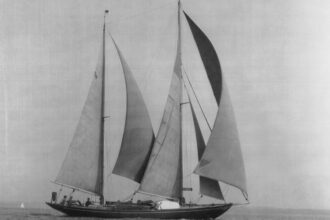
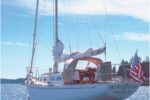
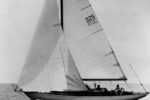
The Spirit of Australia, a 103-foot schooner, was competing in the 1988 Tall Ships’ Race that celebrated Australia’s Bicentennial. Ken, the off-going watch captain of the first watch, he of the soft Kiwi voice, called me from a deep slumber in my damp and narrow berth: “John. Time to roll out for your midwatch. It’s a beautiful night.”
Waking up at sea in a sailboat is such a joy. My body was synchronized with the hull’s loving response to the sea’s every motion. I felt the sea’s power, only inches away, gentle in its strength.
The feel is so different from that on a powerboat, where every coarse movement reflects the brute-strength struggle between the sea and hull, a constant conflict, never a loving relationship.
A big bear
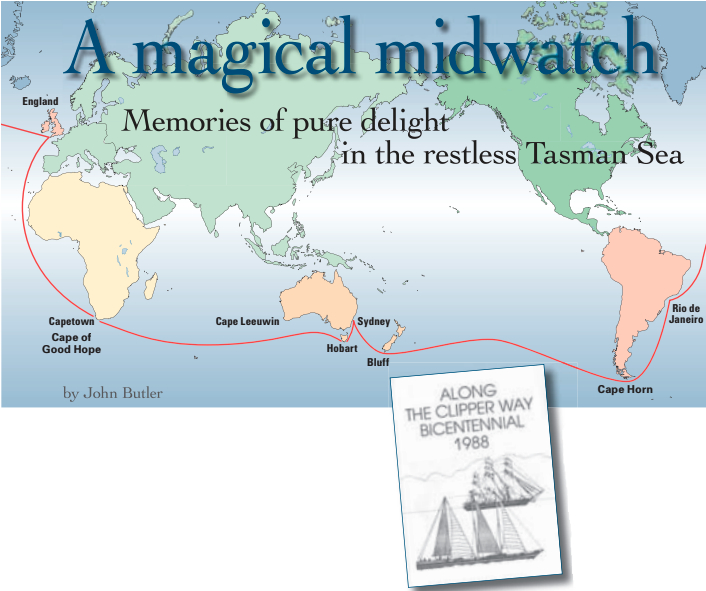
Reporting on deck, my watch captain (Ursa Major, I called him, a big bear of a man) assigned me to the helm. He instructed me on the course to steer, a description of the recent past and soon-expected weather, and which sails were being carried on the three masts. We were sailing north out of Hobart, Tasmania, three days at sea, en route to Sydney. We were out of sight of land with no other yachts in sight.
A fresh-to-strong breeze from the southwest had us sailing a Nantucket sleighride on a broad, port-tack reach, making 9 to 11 knots: summer sailing at its best on the treacherous Tasman Sea in mid-January, a sailor’s dream come true.
I relieved Pierre, the talented young adventurer from Canada, and he showed me the stars to follow to stay on course, easier than staring at the dimly lit compass just ahead of the wheel. Steering was not only easier, but the stars, brilliant in the moonless night, provided an almost atavistic link to those ancient navigators who knew those stars as we know our commute back home.
Yesterday’s punishing seas had become gentle. They picked us up in careful hands, first on crests with a panoramic view of the phosphorescent sea all about us. Then they let us slip into the troughs until the sea around us obscured the horizon.
The rhythm of the seas is found in the play of the helm: nudge the wheel to starboard as a swell picks up the stern, then back the wheel to port as the passing sea lifts the bow.
Never monotonous, each sea is as different as a snowflake, each requires a slightly different touch on the helm. The helmsman’s mind automatically integrates the feel of the wind on exposed flesh, the eyes’ input of the stars’ movements in the rigging, the inner ears’ signals of the body’s constant motion.
Savoring details
Steering becomes an autopilot-like response, so natural that the mind is free to savor the details, to store them into memory. Then other related memories are recalled: the previous morning, the wind was completely flat, but not the sea. After washing my dirty clothes in sea water, I shaved — a hazardous task as the Spirit of Australia rolled horribly in the ragged seas remaining from the gale of the day before. Then the skipper declared swim call, and all of us stripped, soaped down, and plunged into the Tasman Sea’s translucent teal. Swimming in the cool waters (some said cold) became a pleasure fixed firmly in memory.
Also remembered was getting back aboard. We were rolling too severely to use the rope boarding ladder on the side, and getting a foothold on the fixed ladder on the narrow transom was like getting a foot into the stirrup of a bucking bronco. Great memories.
Other memories drifted by. Christmas Day, with everyone seasick and recovering from the hurricane-force winds of Christmas Eve. First we had a knockdown, masts nearly flat in the water. Later that night, as I was at the helm, we turned tail and ran under bare sticks. A breaking rogue wave, seemingly higher than our three 55- foot masts, pooped us and drove my head into the wheel, splitting my lip and knocking out a tooth.
The next day, everyone was seasick except me: I walked around with a silly, gap-tooth grin on my face, loving the adventure, storing memories for long winter nights.
No running lights
And a troubling memory: just before midnight, and only a day-and-a-half into the race, we collided with another yacht. Our damages were repairable underway, but the other yacht had to drop out for repairs. Most troubling was the fact that our skipper was on watch, with no running lights on. Didn’t Thucydides say a collision at sea can ruin your whole day?
Ursa Major relieved me for a few minutes so I could go forward and watch a porpoise playing at our bow, sleek body defined by a shower of phosphorescence. God watched with me. Back at the helm, a chill shook me.
I pulled on my windbreaker, balaclava, and gloves, and soon I was warm again, steering, dreaming, enraptured. I felt a tap on my shoulder. Bill, one of the other two Americans aboard, was ready to relieve me at the helm.
Had my midwatch gone so quickly? Yes, but it will ever remain in memory, my joyous midwatch on the Tasman Sea.
Thank you to Sailrite Enterprises, Inc., for providing free access to back issues of Good Old Boat through intellectual property rights. Sailrite.com