Project Man Syndrome strikes again
Issue 13 : Jul/Aug 2000
I once had a Catalina 22. Nice little boat, but the emphasis has to be on little if you plan to do more than daysail. So when I found a really good deal on a bigger boat, I couldn’t pass it up. The San Juan 24 isn’t much bigger, but at least it has the room for a real galley and a marine head.
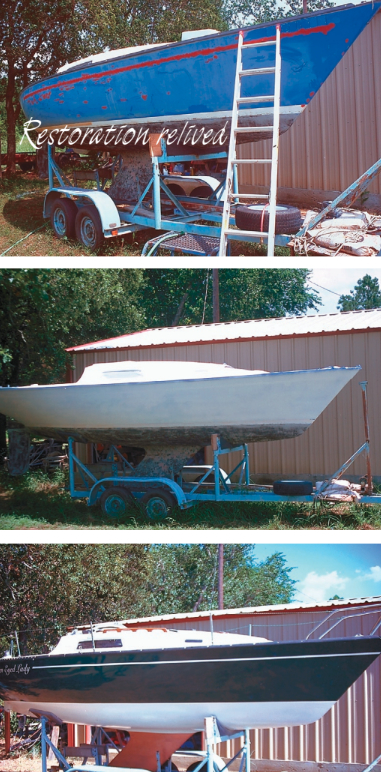
I found her in an ad that said she “needed a little work.” At $1,500 for the boat and a twin-axle trailer, I figured the ad was a bit optimistic. I was not disabused of that notion after seeing her. A 300-mile trip verified that she would still float and the twin-axle trailer had wheels. Not much more positive could be said for her condition. A little negotiation and a handshake later, I was the owner of a 1975 San Juan 24.
The first assessment was good news/bad news. The good news was that she was floating when I saw her. That meant the bottom was impervious to water. The deck, on the other hand (why is there always another hand, anyway?), was like walking on a mattress, which meant that it was not impervious to water.
The assessment was:
- The bottom was in great shape. It had a barrier coat and no blisters.
- The keel had been faired with automotive Bondo and was one solid blister.
- The deck had virtually no core and would require extensive epoxy work.
- The interior was non-existent, unless you count mildew as upholstery.
- The topsides had been painted, but the blue paint was badly faded.
- The deck had been painted so many times that the non-skid blended with the trim.
It came with two Sears outboard motors. Neither ran, and they were different models, so the parts didn’t interchange.
The plan:
- Strip the exterior of all hardware — if it goes through the deck, it comes off.
- Cut the liner out of the inside of the hull where deck rot is evident: all of the foredeck and all of the cabintop.
- Replace the deck core with foam and epoxy.
- Sand the keel, let it dry for a month or more before coating with epoxy prior to a bottom job.
- Drill all through-deck holes oversize and fill with epoxy for re-drilling prior to hardware replacement.
- Strip and sand the deck, topsides, and interior prior to painting with single-part polyurethane.
- Replace the hardware, all 3,000 bolts and screws.
- Install a marine head with holding tank.
- Put her in the water and sail her while the project continues.
Once she floated, the list of goodies would include a stereo with tape player, VHF radio, knot/depth meter, cabinetry, interior lighting, upholstery, and alcohol stove.

Why do it?
By the time the project is finished, I’ll have close to $6,000 invested in material, and my labor (even at minimum wage) is worth another $5,000. For that I could have bought a good clean 25-footer and be sailing it already. So why put myself through the pain, anguish, and expense to refit an old boat?
Obviously there is the dollar factor. I was able to buy a boat with more performance and creature comfort than my current boat offered, at a price my checkbook could cover. It will take a lot of work and a substantial investment to bring the boat up to specs, and that’s a choice I make happily. But there is more to it than just cash.
For some of us, the allure of classic lines is strong. Beauty is in the eye of the beholder, and what I beheld was more than a tired old neglected boat. I saw classic lines penned by Bruce Kirby, a designer of boats both fast and beautiful. I saw a boat that would withstand the test of time, water, and wind. I saw a beautiful sea-green boat with white trim named Green Eyed Lady from a song popular when she was new and a pet name for the love of my life.
Without being critical of modern trends, I really prefer the boats of 15 or more years ago. The trend to water ballast, while practical in so many ways, and the move to higher freeboard for increased interior space is making many cruising boats under 28 feet look somewhat like landbound motor homes.
Other extreme
New race boats seem to go to the other extreme, reducing the boat to little more than a cockpit and sail plan. Throw in the fact that the number of boat manufacturers is shrinking, and the personality of older boats becomes even more attractive to those of us bent toward refitting.
Another piece of the puzzle over refitting is what my wife, Lynn, calls “Project Man Syndrome.” She threatens to outfit me with a cape and leotards emblazoned with a large “P” on the chest. Sailors are, by nature, tinkerers. We’re always messing with something on or about our boats. Perhaps this is a trait engendered by constant sail-trim adjustments or the free time we have when the wind dies and the boat isn’t going anywhere soon. I’m not alone in this. There are people at marinas all over the world who take on large and not-so-large projects just for the sake of doing them and the sense of accomplishment they offer. There is, after all, nothing quite so worthwhile as simply messing about in boats.
In the case of an extensive refit, there is also the pride of ownership. By the time this project is over, I will have laid hands on every square inch of Green Eyed Lady. The entire exterior, interior, wiring, standing and running rigging, decks, hardware, and accessories will be, at the very least, inspected, touched, and re-assembled. This kind of intimacy brings ownership to a completely different level. It becomes a blending of personalities.
When you refit a boat and do the work yourself, you know what she’s made of and what you can expect from her. From daysailing to inland cruising to the Gulf of Mexico, I’ll take Green Eyed Lady anywhere. Our daysails are stretching into weekends, and we have plans to do more extended cruising in nearby lakes.
Who knows? Before it’s all over she may cast her green eyes on the white sands of Caribbean islands. And because I rebuilt her myself, I have no doubt she can take us there and bring us back.
Andy is a leading-edge baby boomer who could never maintain an interest in a hobby past mastering it. He was introduced to sailing and golf by a friend, about eight years ago. He found he was a better sailor than golfer, and sailing moved from the hobby category to “a way of life.”
Thank you to Sailrite Enterprises, Inc., for providing free access to back issues of Good Old Boat through intellectual property rights. Sailrite.com