A Luders 33 by any other name would sail as sweetly
Issue 23 : Mar/Apr 2002
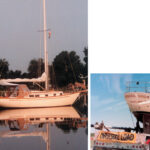
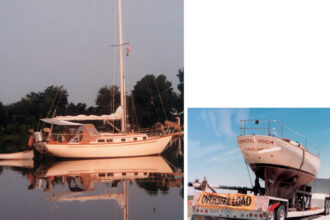
The Sea Sprite 34 in one of the few Luders auxiliaries created since 1960 that I didn’t have a hand in. On the other hand, I may have had quite a bit to do with it in a roundabout way, as I’m convinced the Sea Sprite is really a slightly modified Luders 33. I was very involved in that project in the mid-1960s.
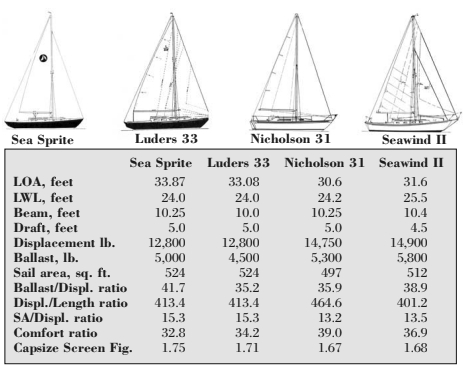
It has to be more than coincidence that the Sea Sprite 34 and Luders 33 have the same waterline length, the same draft, and the same displacement. It is obvious, to me at least, that the Sea Sprite’s added 8 inches of length was obtained by the simple expedient of increasing the angle of her transom. The Sea Sprite does claim 3 inches more beam, but that may be just advertising hyperbole, or the hull may have been given a touch more flare above water.
The only major difference in the hull is in the rudder. The Sea Sprite’s rudder has been given more rake, cutting a few square feet off the wetted surface, possibly because Bill, who had sailed the 33 extensively, felt this might give a better helm. He redesigned the sail plan also, and that may be another good reason for the rudder change as the center of effort was moved forward slightly with a shorter mainsail foot and taller luff.
Some people will say that the boats don’t look alike, but that’s easy to explain. The cabin trunk that was designed originally for the Luders 33 looked exactly like the one on the Sea Sprite. But Allied, the builder of the 33, already had a deck mold for their Seabreeze 35 so, rather than build another deck mold, they simply used what they had and made minor changes abaft the transom so it would fit.
The biggest change from the 33 is in the taller 7⁄8 rig. I do like the newer sail plan better. It appears that Bill took about 12 square feet out of the 33’s foretriangle and added it to the Sea Sprite’s mainsail so both yachts still have identical sail area. The 33’s main, with its low 2.29 luff/boom ratio, was a product of the CCA rule and the Sea Sprite’s 2.90 ratio is much more efficient. It should make the boat easier to sail for a shorthanded cruising crew also as she will handle better under main alone.
The taller rig raises the center of effort slightly but the Sea Sprite can stand up to that quite easily as she has to be considerably stiffer than the 33, thanks to an additional 500 pounds of ballast below and less weight above. Obviously, her cored hull saved enough weight over the 33’s solid glass construction that additional ballast could be fitted with no increase in the displacement.
The boats shown in the comparison chart are all ultra-heavy yachts by contemporary standards, but they were considered to be quite normal in their day. The two Luders designs, in particular, would pick up a couple of feet of waterline when heeled down in a good breeze, thanks to their long overhangs. This would reduce their displacement/length ratio (D/L) to a more reasonable 325 and, to a large degree, accounts for their good performance. Indeed, a Luders 33, with Bill at the helm, won Block Island Week, first overall, in the early 1970s against some fierce competition.
The shorter-ended Nicholson and the Seawind II would not fare quite so well and would be further disadvantaged by their low sail area/displacement ratios. These two are really best suited to bluewater sailing, where their heavy displacement will add to motion comfort, and their relatively short sail area will be easy to control and not be a great handicap to performance. This is not to say that the Luders designs are not quite capable of ocean voyaging, of course, as both are solid offshore cruisers.
With sail area/displacement ratios just above 15, the Sea Sprite 34 and the Luders 33 are somewhat undercanvassed by today’s standards. The 33, in particular, was designed when 150-percent genoas were the norm and large sail areas were heavily penalized by the CCA rating rule. The Sea Sprite’s rig is only a minor redesign with no additional area. If I had a Sea Sprite today I’d rig her with the forestay moved to the masthead. This would increase her sail area to about 555 square feet, a D/L ratio of 16.3 and allow for the use of smaller, more easily handled genoas, with no loss of performance.
Regardless of performance, the Luders 33 and her even prettier sister, the Sea Sprite, will receive admiring glances wherever they sail, whether it’s harbor hopping along the coasts or crossing the oceans of the world.
Thank you to Sailrite Enterprises, Inc., for providing free access to back issues of Good Old Boat through intellectual property rights. Sailrite.com