An ongoing do-it-yourself project
Issue 23 : Mar/Apr 2002
One big do-it-yourself project.” According to Bruce and Nancy Worster, this accurately describes their marriage, raising a family, and in particular their pursuit of happiness. After 35 years spent together figuring it out as they go, the Worsters agree that they’ve stayed together because “we still like each other.” There’s clearly an understatement in there somewhere.
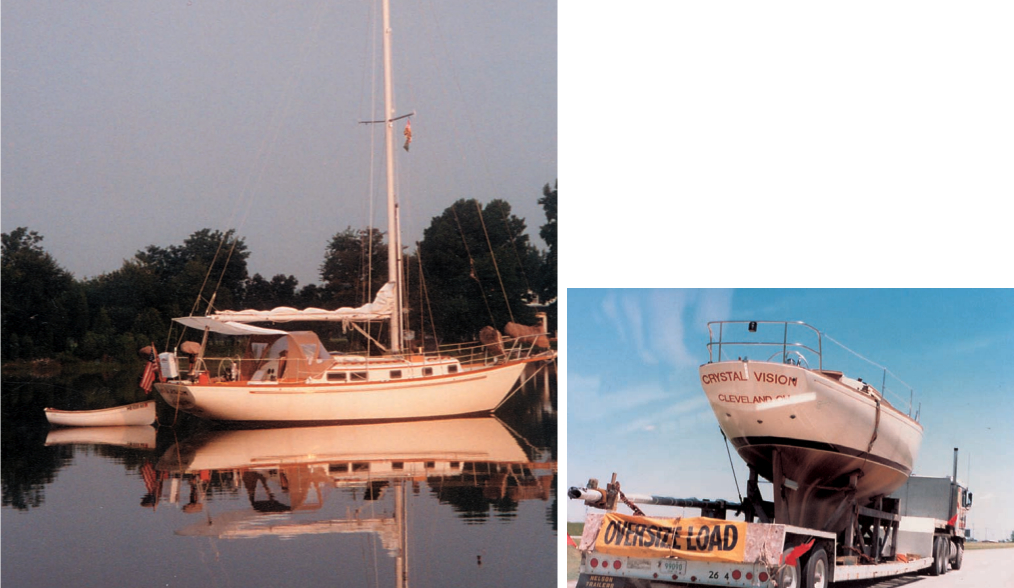
“Pursuit of happiness” has often meant sailing for the Worsters. First they learned how to sail and incorporated two young and growing girls in their sailing activities. Then they bought an unfinished Sea Sprite 34 in 1983 from C. E. Ryder in Bristol, Rhode Island, as a “Stage 3 Completion Model.” It was built to their specifications. Of the 45 to 55 Sea Sprite 34s built, #13 is cutter-rigged. She has a deck-stepped mast, a masthead rig, and a tall-profile toerail. The Worsters chose inboard shrouds as well. The variability in numbers of completed Sea Sprite 34s has to do with whom you ask and what got counted. Bruce notes that Ryder was cautious about keeping the owner-completed hulls separate from those finished by the plant, since the factory was not certain that owners would finish them to Ryder standards.
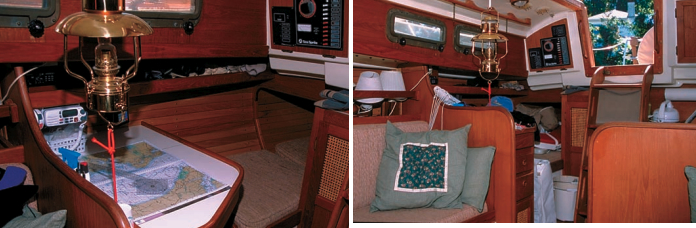
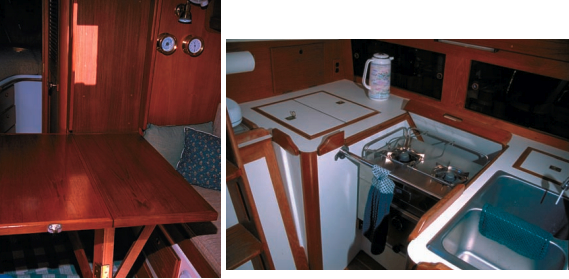
C. E. Ryder offered owner- completion kits as Stage 1, 2, or 3 boats. Stage 1 offered a bare hull with only the deck attached. Stage 2 offered the addition of bulkheads and an operable engine in place. Stage 3 offered all running and standing rigging, an essentially finished exterior, a mounted and operable engine, bulkheads, a companionway ladder, galley, icebox, and some interior furniture, such as the chart table. All finishing and completion of the interior and systems was left to the owner. While not a completely bare hull, major systems were missing. There was no plumbing. There were no pumps. No head. No sinks. No steering system. No sails. No stove. No ground tackle. No bunk cushions. No electronics. These were finishing items that required a lot of labor and provided the greatest opportunity to save costs.
Finishing instructions
“We were provided a box of labeled parts (mostly rigging) and a checklist to follow during commissioning . . . we were given a book on general finishing instructions on Ryder boats and, at my request, a complete set of blueprints for the cutter-rigged Sea Sprite 34,” Bruce recalls.
“Nancy and I began by doing what we have done our whole married lives. We applied our learned skills, mine in engineering and hers in sewing. We divided the work to be done and divided the tasks into doable chunks. We decided where to start and began.”
They first applied and glassed ribs to the hull so they could line the hull with ash battens. Then they built a dinette table, drawers and doors for the cabinets, and doors for the head and V-berth. Bruce is “reasonably skilled at woodworking,” by his own admission. Nancy trained as a nurse and spent years working in doctor’s office, hospital, and research settings. But she is also a talented seamstress in her own right . . . the kind who isn’t afraid of industrial-strength sewing machines and tasks.
“Bruce gave me my first sewing machine in 1965 when I was graduating from nursing school,” she recalls. She made clothes, draperies, and the like for the family and did some tailoring. Then she expanded her talents to create upholstery, sailbags, sail covers and other canvaswork for the new boat. Most daunting of all, she made the sails, although she notes that she did not make the dodger or the roller furling sail when they later added that convenience. This new talent eventually led to the end of the nursing career and the beginning of a career as a canvasworker and sailmaker for Nancy, who then sewed sails for smaller boats, such as Hobie Cats. She also did a great deal of contract work for Sailrite, which was located nearby.
Sailing again
Hoosiers for most of their lives, Bruce and Nancy raised their daughters and rediscovered sailing in Fort Wayne, an Indiana town not more than a few hours’ drive to lakes Michigan and Erie. Even before that, Bruce spent summers growing up in a cabin on Chapman Lake in northern Indiana and sailing a Sea Snark. “That’s a small wet sailer,” Bruce says. “I had a ball with that. It was upside down most of the time.” While still young, Bruce vowed that he’d have a boat by the time he was 35.
Indeed, by the time he was 32 or so, a career man, the father of two young girls, and firmly planted in northern Indiana, the sailor in Bruce was allowed to re-emerge. The Worsters bought an AMF Paceship PY 23 and named her Finesse. The price was $7,600. “It was all the money in the world,” Bruce remembers. Nancy adds, “I thought you were out of your mind.” But the broker promised the couple, “If you don’t like sailing, bring it back; I’ll give you all your money back.” Of that offer Nancy says, “He knew he could always sell that boat.” They did not give him the opportunity.
Finesse is fondly recalled by the two as “a boat that went like a banshee” and “you could sail it in a zephyr.” The first day, however, was a bit of a trial for Nancy, who’d never been sailing. “We took delivery on Lake Erie on a gusty day,” she says. The boat, which was equipped with a 170-percent genoa and a full main without reef points, was a handful for a couple of inexperienced sailors in gusty conditions.
Learned the terms
“I thought I’d never live to see shore again,” Nancy recalls. “When we did make it back, I said, ‘I won’t be comfortable sailing until I can do what you do.’ ” And she made that her goal. “I had to learn the terms, had to feel confident, had to take the helm,” she says. They trailered this boat all over Indiana and to Great Lakes destinations, cruising and doing some one-design racing, but primarily using it as a family boat on Lake Wawasee, not too far from home.
Daughters Jennifer and Stephanie were 4 and 7 when they became sailors. “The whole reason for getting into sailing at all (besides the fact that I love it) was that it was a family activity,” Bruce says. But Finesse got small as the family grew, he points out, and it was time for a larger boat.
The next boat was another trailerable boat: a 26-foot S2 that they named Jubilation. They did a great deal of family cruising in this boat, but it was not the sailer the Paceship had been. In one case they hobby-horsed in some large waves without being able to point adequately or make headway. Nancy recalls screaming at no one in particular that she’d take five cents for the boat right there on the spot. She might have sold the boat, but there was no one with a ready nickel within range of her voice. That was the end of that boat’s career with the Worsters, however.
They began a quest for a bigger boat and, because of the memory of not being able to point when they needed to, they overreacted when they did find their dream boat. They had their Sea Sprite built with inboard shrouds, a decision they now regret, since movement on the sidedecks is restricted by three shrouds.
Full-keel vessel
Their quest was more like a process of elimination. They agreed on the type of boat they wanted. It should be a full-keel vessel with relatively heavy displacement. It should be 30 to 35 feet in length. It would have relatively low freeboard, be cutter rigged, have no more than a 5-foot draft. They deliberated about a deck-stepped mast versus a keel-stepped mast. At one point Bruce called Bull Luders, who advised them to go with a keel-stepped mast if they planned to be doing offshore cruising. They considered this but then selected a deck-stepped mast for the sake of additional space, particularly in the head. In the end, Bruce says, Bill Luders agreed that a deck-stepped mast, as built by Ryder, would do well wherever they sailed it. They have not regretted this decision and have since decided that their sailing is mostly limited to coastal cruising anyway.
“I began research that included the Goderich 35, Jason 34, and Southern Cross 31,” Bruce says. “I knew that the cost would dictate that we do some, if not all, the finish work. Because of the various owner-completion options offered by Ryder, their line of boats offered the most options and the least amount of pain for achieving our goal.”
The Southern Cross was their favorite, so they visited the Ryder plant while on vacation on the East Coast. While discussing Tom Gillmer’s Southern Cross 31, which was built there, they were also shown the Sea Sprites at the plant. Ryder was building Sea Sprite 23s, designed by Carl Alberg, as well as the 28, 30 and 34, designed by Bill Luders. They were intrigued by a 34 under construction that was being made into a cutter with high-profile toerails. Then, Bruce recalls, on another trip east he requested a sail on one of Ryder’s Sea Sprite 34 models before committing to an order. “I was hooked, and the hook was well set,” he says.
September delivery
“In early 1983 we placed an order and got on the Ryder build schedule for delivery late in the summer . . . we took delivery in September 1983, named her Crystal Vision, worked hard on her all winter, and christened her in June of 1984,” Bruce says. “We got familiar with Crystal Vision and grew rapidly to love her.
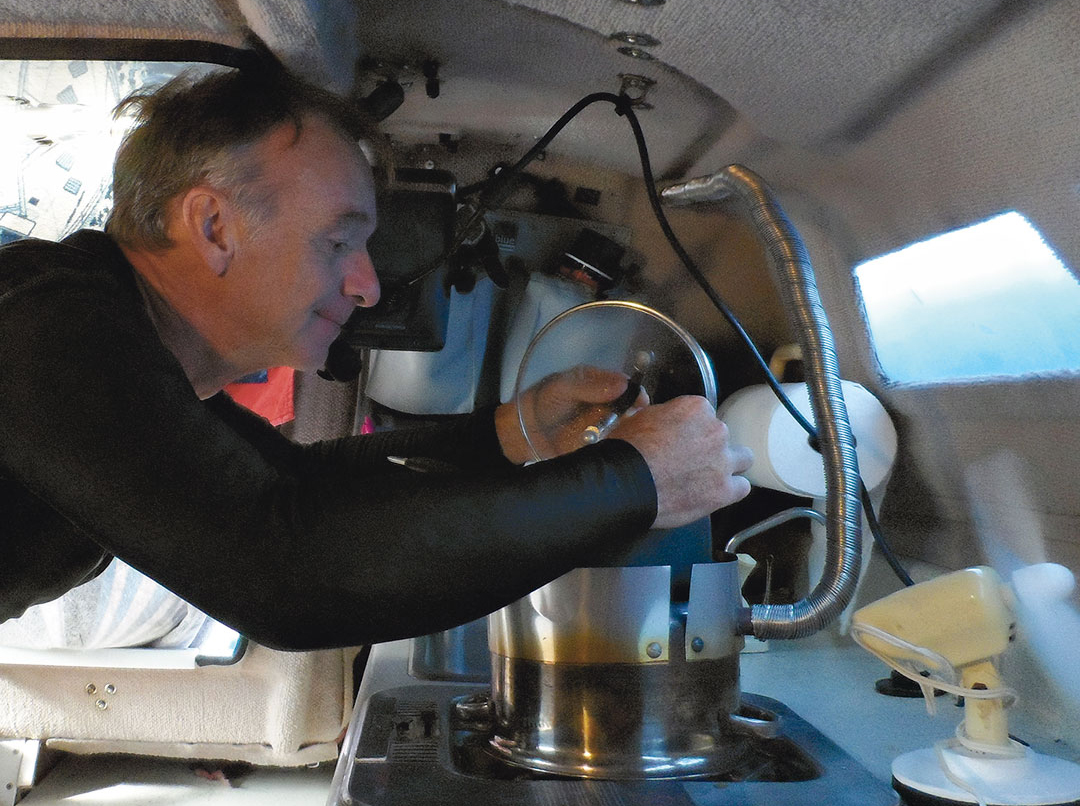
“Once Crystal Vision was completed, I lined up a truck, brought her to Indiana, and put her in a secure area at a friend’s manufacturing facility in Ft. Wayne. The boat was about 15 or so miles from our home, and we worked nights and weekends all winter to complete as much as we could before spring. We completed the ash lath and most of the cabinetry. I installed foot-pump operated faucets and galley and head sinks. I also installed a bladder holding tank and a manual head. I installed the steering system, a Richie compass on the binnacle, and automatic and manual bilge pumps. I completed some of the wiring to such things as lamps. I also installed the galley stove and pressure alcohol tank.
The next step was to rig her and take her sailing. The sails were completed in the spring of 1984 with final handwork done on board over the Fourth of July. After we rigged her, we christened and commissioned her on June 23, 1984. In late July and early August we took her up the Detroit River into Lake Huron.
“The finishing work has been going on most of the 18 years she’s been in the water,” Bruce says. The Worsters say Crystal Vision continues to be “a work in progress.” Although she was sailable, they continued to add refinements and their own modifications. They added shelving and caned cabinet doors. They made the chart table flat to accommodate their Sailrite sewing machine. Over the years they replaced the hanked-on jibs with a furler and added self-tailing winches. After, as Bruce puts it, “we kissed a piling” they added a teak rubrail a few inches down from the hull-deck joint.
Still more to do
Since boatwork is never done, there’s still more to do of course, but perhaps if they have come to the point of replacing original parts, the Worsters will soon conclude that their work-in-progress was completed at some point after all and now is being upgraded like so many good old boats in marinas everywhere.
Not long ago, they added pressure water. Now they’re planning to add refrigeration. They’ll replace the stove. They’ll add radar. They want to replace the port glass, the dodger, and the hatches. Eventually, they’ll redo the deck, Bruce says, since it is showing a bit of crazing. “We do something new and enjoy it for two to three years,” Bruce says thoughtfully. “Then it’s time to redo it.” But he notes the hull is sound, and they have had no laminate/core separation. “Ryder did an excellent job of building this boat,” Bruce shrugs.
The following summer Bruce was transferred to Virginia, and the boat, which they’d trucked to Indiana, was in the wrong place. “My new boss was kind enough to give me enough time to move Crystal Vision by water,” Bruce says. “We traveled across Lake Erie stopping in Ohio and Pennsylvania on the way to the Black Rock Canal outside of Buffalo, N.Y. Once through the Black Rock Canal, we stopped at the entrance to the Erie Barge Canal and lowered the mast in order to go through the canal. That was quite a trip: under some 315 bridges and through 33 locks to exit in the Hudson River. We raised the mast again at a yacht club just outside the canal at Albany and proceeded down the river to Sandy Hook and offshore to Cape May, N.J. From there we went north up the Delaware Bay to the Chesapeake and Delaware Canal and into the Chesapeake to Annapolis. What a great trip. We would like to do it again when we have more time.”
Not enough time
Of course that wasn’t the end of it. Bruce was transferred back to Indiana in 1991, just six years later. On this round there wasn’t enough time to move a boat by water, so Crystal Vision was loaded on a truck once more and hauled west. But once they were back home again in Indiana, the Worsters longed for Chesapeake sailing. “Lake Michigan is cold even on the Fourth of July,” Bruce notes. “In 1996 we moved her again by truck and simply drove to Maryland a few times that year for vacation. In 1996 I was fortunate enough to get a job with a company in Maryland. I might point out that trucking a large sailboat is hard on it. Notwithstanding the diesel soot caused by the truck, which is difficult to get off teak and fiberglass, the constant flexing results in cracks that were not there before. I don’t recommend it. Boats belong in the water.”
Rather than live near the beltway and commute to their boat, Bruce elected to locate near their boat and com- mute to the job in D.C. They built a home a couple of blocks from Crystal Vision’s slip. “I know there are many sailors who would give their eye teeth for our situation. We are happy here,” Bruce says. To put icing on the cake, he is now commuting to a job only 30 minutes from home (and the boat, of course).
Life is so good, in fact, that even as retirement looms, the Worsters say they feel no compulsion to sail around the world. A year in the Bahamas might be nice . . . a trip to the Great Lakes wilderness destinations they enjoyed so much . . . or perhaps to Maine. “Otherwise we mostly will do coastal cruising and can sail well into our 70s in comfort on Crystal Vision,” Bruce says. A few other (larger) boats have occasionally caused them to be briefly unfaithful (lusting only in their hearts) to their Sea Sprite 34, but they agree they’re content with their choice. “This boat is a great boat and very capable of coastal cruising,” Nancy says. “We’re glad we don’t have a big investment in a boat and plans for circumnavigation.”
Thank you to Sailrite Enterprises, Inc., for providing free access to back issues of Good Old Boat through intellectual property rights. Sailrite.com