The culinary delights of shrimp, crab, and lobster
Issue 23 : Mar/Apr 2002
Michael Greenwald told us how to collect and cook clams, mussels, and other delights in the November 2001 issue. Can the man cook? He’s a Paris-trained chef. Does he sail? He’s earned his USCG 100-ton master’s license (power and sail) and has sailed 55,000 miles, some of which included solo crossings of the Atlantic and Pacific. He is currently out there cruising. What more? Michael was a combat medic in the U.S. Army and U.S. Army Reserves. And he’s written two books, The Cruising Chef Cookbook and Survivor. “Renaissance man” has been an overused term in recent years, perhaps, but we’ve got to call Michael “well rounded” at the very least. Once again, from The Cruising Chef Cookbook, published by Paradise Cay, Michael offers everything you ever wanted to know about shrimp, crab, and lobster but were afraid to ask.
About shrimp
Shrimp abound in coastal areas near brackish estuaries or mangrove swamps. Where there is one shrimp, there are millions — and a well-developed commercial fleet to harvest them. Shrimp have become a commodity, like oil or auto parts. There is a world price for them, which varies little from place to place, and bargains should be considered suspect. The local shrimper with his handmade net is getting hard to find and so are fresh local shrimp, which are the pinnacle of fine cuisine. When you find them, buy them.
Fresh or recently defrosted shrimp should be heavy, firm, and translucent; freshly caught shrimp are about as translucent as ice. Their shells are shiny. Old frozen and defrosted shrimp are limp and opaque, the shells are dry, and their tails do not retract.
Selection
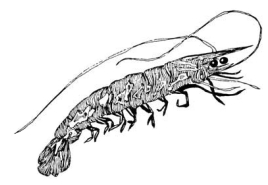
Shrimp can be purchased green (whole), headless, or peeled. The head segment contains the guts, which are full of flavor and used in sauces. The head is also the most perishable part of the creature. Try to avoid buying peeled shrimp; they lose moisture in the shelling process.
Buy shrimp that are still frozen, rather than those that have been defrosted, since defrosting results in loss of juice. Cook shrimp directly from the frozen state if possible. If a recipe requires them to be peeled before cooking, just dip them in hot water for a few seconds to thaw the shell, which can then be removed.
Prawns are freshwater shrimp and are less flavorful than ocean shrimp. Wild or river prawns are delicious but more delicate in flavor than ocean shrimp. Cultured or pond-raised prawns are downright bland. Buy them at a really good price or not at all and dominate them with a spicy sauce.
The bigger the size, the higher the cost. Do not buy big, expensive shrimp if your recipe calls for cutup or cleaned shrimp in a sauce. Buy the cheaper, smaller variety and save, save, save. Big shrimp should be served whole as the centerpiece of your meal. You can also buy just one or two giant shrimp per person as a centerpiece and complete the entrée with smaller shrimp.
Cultured, farm, or pond-raised shrimp
Wild shrimp eat plankton that flavors their flesh with that strong “shrimpy” taste. Farmed shrimp eat commercial “shrimp chow,” which results in their indifferent flavor. They aren’t worth the price. The most common farmed shrimp is the tiger, with black bands and spots, grown in the Philippines, Ecuador, and Thailand. Shrimp from these countries are usually cultured. Other countries are developing this industry and culturing other varieties. Alas, once these critters have been removed from the package, there is no way to tell what you are getting until you taste them.
The cleaning operation reduces the weight of the shrimp by half. One pound uncleaned (green), yields a half-pound of meat. Shelling shrimp reduces their weight by about a third. Six to eight medium cooked shrimp per person are a main-course portion.
Cleaning
To clean shrimp, twist off heads, pull off legs, then remove the shell, prying from the underside with your fingers. Larger shrimp are sometimes shelled by cutting the shell on the dorsal side and slipping it and the legs off in one piece.
We usually devein only jumbo shrimp, but if yours have a pronounced dark gut, slit them along the top with a sharp knife and rinse.
For butterfly shrimp, make a deep dorsal cut from head to tail, leaving a bit of meat to keep the halves together. Press between plates to flatten.
Canned shrimp require no cooking, but should be lightly rinsed in cold water to reduce saltiness. Soaking will reduce their flavor and make them soggy.
Cooking techniques
Baked shrimp: Shellfish are usually baked with thinly sliced or precooked ingredients that reduce oven time and prevent the shrimp from overcooking.
Boiled shrimp: Shrimp are delicate little beasts, and great care must be exercised not to overcook them. Use plenty of water, stock, or shrimp boil (water with prepared spices) to prevent a significant drop in water temperature when shrimp are added. Bring water to a rolling boil; add shrimp, bring to a rolling boil again and remove from the heat. Let stand for a few minutes, drain, and allow to cool to room temperature.
Braised shrimp: Breaded fried shrimp can be dropped into a pan of simmering sauce, such as soy, beer, garlic, or a BBQ sauce and tossed for a few minutes until the sauce bonds with the breading.
Sautéed shrimp: This means simmering very gently in a sauce. The cooking time for shrimp should be very brief, not more than 10 minutes. Finish the sauce and have it simmering when the shrimp are added. Outstanding sautéing sauces include marinara, curry, butter, and a roux.
Shrimp stock is usually made from the shells, particularly the heads, which are full of flavor. Simmer them for a half-hour in white wine with a bouquet garni and vegetables in a small pot. Drain and reduce by simmering. Use in sauces, thicken into a roux, or cool and add to fresh mayonnaise.
About crabs
Every crab I ever met I “et,” and it was delicious! Whether it is a crab from land or from the sea, the fine textured flesh and delicate flavor made it an esteemed culinary delicacy. In my opinion, every crab is delicious, the only question is whether they are large enough to be worth the trouble of cooking and cleaning.
Generally speaking, when it comes to saltwater crabs, the colder and deeper the water, the larger the crab. The huge Alaskan king crab, which may exceed eight feet from leg tip to leg tip, is typically taken at the 100- to 150-fathom line. Blue crabs, which weigh less than a pound, inhabit shallow bays.
Tiny crabs may be too small to clean but they can be chopped up and cooked with vegetables in a little wine and water. Bring the liquid to a boil and allow to cool. Pour into a narrow bottle and give it a good shake. Loose crab meat will swirl up into the liquid, and the shells will fall to the bottom. Quickly pour off the liquid. The resulting rich broth can be thickened and used as a soup.
Buying crab
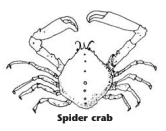
Except for “softies,” crabs should be purchased either cooked or alive and not merely “breathing.” They should start moving as soon as you pick them up or be too dangerous to pick up by hand. If not, they are “dead crab,” not a good sign. Dead crabs spoil very quickly.
Crabs cooked alive often break off their own legs and claws as the temperature rises, so kill them before cooking. The easiest way to kill crabs is to force a screwdriver between their eyes and “pith” them by wiggling the screwdriver around, destroying the brain. Crabs may be steamed for 15 minutes in a large covered pot with a half-inch of sea water, or they may be put in cold sea water brought to a boil for 5 to 10 minutes depending on size. After cooking, drain and let the crab cool.
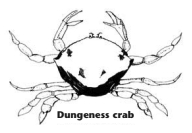
One pound of king crab legs will feed two. A two-pound whole Dungeness crab or a pound of Dungeness crab legs or two cups of cleaned crab meat will serve two.
Some crabs have considerable body meat. Other species have most of their meat in the legs and claws. Even these crabs have a large lump of meat where the leg joins the body. Do not break the legs away from the body. The only way to get the meat is:
- Remove the upper shell. If you pry the shell forward from the rear, it will lift like the hood of a sports car. Don’t be discouraged by your first glimpse of the insides; remember, it’s well worth the trouble for that superb flavor.
- Scrape the crab butter from inside the shell. Crab butter is a yellow paste that adheres to the upper shell inside the “points.” It is delicious and may be made into all kinds of pâtés or sauces. Some people mix the fat with butter as a dip for the meat. Delicious.
- Tear off the “tail” and remove internal spongy material. This includes the thin cover tissue, the gills, and all viscera.
- Most crabs sold commercially are males. If the crab is a female with eggs under the tail, carefully snip off the tail and save; crab roe is delicious raw or steamed. Pickling the eggs in salt for a few days, then rinsing, improves their texture.
- Break the crab in half along its midline.
- Separate by breaking the body and legs into sections. The legs and claws may be cracked with a lobster cracker. Meat can be freed from the body segment by tapping it sharply against a bowl.
This is a messy job. If you are serving cooked crab legs, we recommend that only good friends be invited to the orgy as shells fly everywhere. Put a roll of paper towels on the table. Cover the table with newspaper. Cleaned crab meat may also be used in all mixed seafood recipes, Newburg dishes, fritters, devil sauces, or just chilled and eaten with cocktail sauce.
Canned crab meat
Fresh crab in cans must be kept refrigerated. The meat has been cooked but not sterilized. There is usually a refrigeration warning on the lid. Canned crab that requires refrigeration may be used the same as fresh crab; it is quite delicious.
Crab in unrefrigerated tins has been cooked until sterile and is immortal. The texture of the meat is damaged, but some good flavor remains. Treat canned crab with great love and tenderness. Use it in recipes where other ingredients dominate the flavor or where other fresh seafood is added. Always add the crab at the last minute to prevent further flavor loss.
Hermit crabs
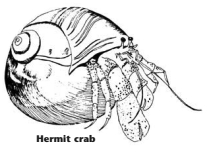
Marine hermit crabs often grow to great size and inhabit conch or other large shells. These large crabs are extremely delicious and taste more like lobster than crab. They may be steamed in the shell with the opening toward the top of the pot. As the heat penetrates the shell the beast will usually abandon it. If the crab remains inside the shell, pull it out gently as the meat is in the tail. Large hermit crabs (in their shell) should be steamed in a small amount of water for about 15 minutes. The cooking time varies depending on the size of the shell, but it is better to undercook the crab initially. It can then be removed from its shell and steamed to completion.
Sauce choices
- Canned cream of tomato soup with a dash of sherry and lemon juice.
- A sauce béchamel blenderized with a roasted red pepper, Parmesan cheese, lemon juice, thinned with milk.
- A soy sauce, garlic, ginger, mustard powder, and beer thickened with a little corn starch and garnished with scallion ends.
The noble lobster
Lobster species differ greatly in appearance and may not be closely related to one another, but they all taste great! The so-called American lobster has claws. It varies in color from green to dark blue. A meaner, more voracious critter is hard to find. They fight each other to the death for territory, and the winner usually consumes the loser!
They eat their own young and give no quarter. They would probably be glad to eat you if they could. In the Northeast, American lobsters are hatchery-raised until they are about three quarters of an inch long, then released. Large numbers of male lobsters are caught during the summer months and stored in ponds for sale during the winter.
The mole lobster, a clawless relative of the American lobster, looks more like a crab with a fat abdomen. It is a cold-water species found on or around weed beds, usually near isolated islands. Many are found in the Azores, while some have been netted off the Shetlands, Greenland, and Iceland. Mole lobsters seem almost as broad as they are long since up to 60 percent of the creature’s weight is a huge hunk of tail meat.
There are several species of clawless, warm-water spiny or rock lobsters, also called crawfish. Do not confuse crawfish with crayfish (sometimes called crawdads), which are a smaller, less delicious freshwater species. Another freshwater river shrimp, which may run up to eight ounces, is called a langoustine. It is also tasty but more bland in flavor than saltwater shrimp.
Unlike the aggressive American lobster, spiny lobsters are usually timid. During the breeding season they lose their instinctive fear, often crossing shallow grass beds in great numbers — boldly advancing en masse, antennae waving. Spiny lobsters grow about the same size as American lobsters. They can be found in tropical seas all over the world. Fresh spiny lobsters are just as delicious as fresh American lobsters.
The Mediterranean Sea and the Indian Ocean are home to several species of clawed, shrimp-like crustaceans. Their size, however, never exceeds one-half pound; normally they are only four to six ounces. Their claws are long, thin and of equal size. They are tasty like shrimp but do not share the absolute gastronomic pinnacle with American and spiny lobster.
Selecting fresh lobster
A fresh lobster must be alive and still have a little fight left in him, otherwise he is what the fishmonger calls “still breathing.” If the fishmonger sees you looking at a lobster for signs of life, he will give it a shake, knowing its primitive nervous system will still react, even though the lobster is dead. Dead is unacceptable because it begs the next question: how long dead?
Female lobsters are more succulent than the males and may contain delicious roe. The females are at their peak just before the egg-laying season when they contain roe. Lobster connoisseurs know this and often ask for females when they dine out. As a result, most of the females go to the better restaurants. It is rare indeed to find a female lobster for sale, but lobster aficionados always search for them. Lobsters may be sexed by examining their swimmerets, small finlike appendages on the underside of the tail. The males have narrow swimmerets.
American lobsters reach the market with pegs in their claws to prevent mayhem in the fish shop and to keep them from destroying each other. Should you meet an unplugged lobster, grab and close the claws. They close easily. Wrap a rubber band around them. Keep in mind that the thin claw is for feeding and the fat claw is for crushing. You really, really don’t want to find out how hard the fat claw can crush. Lobsters sold with one claw missing are called “shorts,” not to be confused with illegal, undersized lobsters, which are also called “shorts.” You can get real bargains by purchasing shorts with just one claw.
We are of the general opinion that when it comes to buying lobster, bigger is better. You get more meat proportionally because the meat in the legs becomes accessible. The meat in a large lobster is just as tender and delicious as in small ones.
Selecting precooked lobster
Make sure the meat has the briny odor of the sea. Pull the tails back; they should recurl when released. If they do not, the critter was dead when it was cooked, not a good sign.
Frozen spiny lobsters are sometimes tough and often have an iodine taste if the tail is over 10 ounces. It’s expensive and has little of its distinctive fresh flavor. Who needs it? Especially when frozen shrimp taste better and are cheaper.
The American lobster, most commonly found commercially in the 3⁄4- to 2 1⁄2- pound range, makes a fine meal. A 1-pound lobster feeds one person, and a 2 1⁄2-pound lobster feeds three — or it can feed one. While these sizes are typical market weights, it is not unusual to find 15- or 20-pound monsters on occasion. The largest spiny crawfish I ever caught weighed 14 pounds, and it was delicious!
Live lobsters will keep for a day if refrigerated at 45° F to 50° F. Placing them in a thick sack surrounded by ice has similar effect. American lobsters may be kept alive indefinitely in a mesh sack or pen if stored in their native water.
Killing and cooking
Lobsters are usually cooked whole without any preparation. The most humane way to kill a lobster is to pierce it between the eyes with an ice pick or screwdriver. You can also add an inch of seawater to a large pot, add the lobster, and bring slowly to a boil. The lobster just keels over. Plunging them into boiling water causes a violent reaction.
A common practice, when a spiny lobster is too big for the pot, is to twist off the tail. Kill the lobster first by pithing between the eyes or just chop the body in half lengthwise if you are broiling. Once the lobster is dead, the tail muscle relaxes and can be pulled free with the help of a spoon inserted to free the muscle. If the lobster exceeds about 1 3⁄4 pounds, meat can be found at the base of the antennae and the legs. These joints may be twisted off and cooked with the tail. Larger lobsters have edible meat in the legs.
Steamed lobster: Add about 3⁄4 inch seawater to a large pot. Add lobster. Cover; bring water to fast boil. When steam begins escaping from under lid, reduce flame and cook for 15 minutes. No more. Boiled lobster are similarly cooked but in boiling water.
Broiled lobster: Split lobster in half from head to tail; discard the dark stomach, a hard sack near the head. Squeeze lemon all over, and dot with butter; let stand for a few minutes. Brush with melted butter; slip under broiler for 7 minutes, checking frequently and basting with more butter to prevent drying.
Deep-fried tail: We disdained this Caribbean specialty until we tried it. However, it requires close to a quart of very hot oil. Kill the lobster and sever tail nerve by slipping a small knife between body and tail joint. The tail should relax. Slip a butter knife up inside the body cavity against shell and separate the tail meat. Remove tail. Dip exposed meat into a fritter batter. Drop in very hot oil. Watch out for spatters. The oil does not penetrate the lobster because the steam from inside the shell blocks its entry. Fry half-pound lobster tails for 4 minutes.
Gutting
After cooking, a 4- to 6- inch piece of antenna is usually broken off, and the broken end is slipped into the anal vent. With a good jerk, the antenna is pulled out, effectively eviscerating the beast.
Opening
- Work should be done in the sink. Use a heavy scissors or a pair of cooking shears. Work with a towel and be careful of hot splatters.
- Cut the underside of the shell from the anal vent to the tip of the head. Just cut through the shell.
- Lay in the sink, let drain.
- Now cut the lobster from the end of its tail along the top to its head.
- Finally, cut through the front of the head, giving you two body halves.
- Separate.
- Crack the claws and joints.
- Allow to drain.
- Remove the head sack. Be careful to retain the green liver, which is delicious. If there is any black, gooey material inside, remove it.
- Twist off the claws at body.
- Crack each arm segment with a cracker.
- Lever the lower part of the claw from side to side, not up and down, and pull it free.
- Break legs the same way and pull each segment free, taking the cartilage with it.
- Discard the spongy gills and suck free the meat in the body cavity. Serve with hot melted butter.
Thank you to Sailrite Enterprises, Inc., for providing free access to back issues of Good Old Boat through intellectual property rights. Sailrite.com