Built for cruising and round-the-buoys fun
Issue 24 : May/June 2002
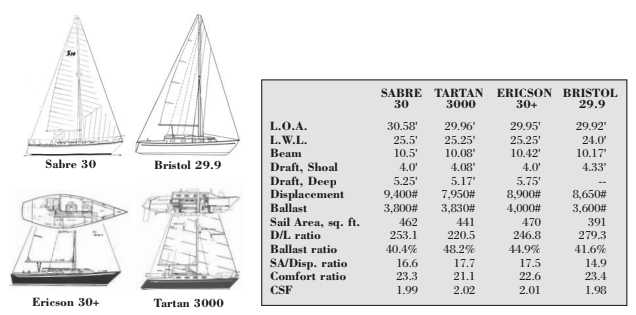
The Sabre 30 is a fine example of the modern club racer/coastal cruiser and stacks up very well indeed against much of the competition. When she is compared to such stalwarts as the S&S-designed Tartan 3000, Bruce King’s Ericson 30+, and Halsey Herreshoff’s Bristol 29.9, the Sabre 30 is right in there, both for cruising and for local round-the-buoys fun.
The Bristol 29.9 appears to be the least competitive of the four boats here, having the shortest waterline, the highest displacement/length ratio, the lowest sail area/displacement ratio, a longish fin, and a skeg-hung rudder. The Tartan 3000 could well be the performance champion, thanks to having the lightest displacement and highest ballast ratio of the group, but I expect she would find the Ericson and Sabre right on her heels. The end result would probably depend on the skill of the crew and the wiles of the skipper. Consider the numbers in the table.
The Sabre, Tartan, and Ericson all offered deep-draft models with the Ericson’s, at 5 feet, 9 inches, being the deepest by a good 6 inches. The deeper- draft models might stir up a lot of mud in the Chesapeake, but they’ll pay off in added weatherliness and stability when it breezes up. If you are the competitive type, then by all means look for the deeper-draft version. On the other hand, the Bristol 29.9 offers a shoaler 3-foot, 6-inch draft keel/centerboard model, and that could be the much wiser choice for skippers sailing our southern waters where the bottom is often so close to the top.
In looking over the small (very small!) drawings that I have of the boats, it struck me that the Ericson, in plan view, was heavily influenced by the early IOR rule. She shows the extremely pinched bows and relatively narrow stern of the typical old IOR boat. I expect her transom is well vee’d as the rule encouraged that anomaly also. This hull form undoubtedly gave her quite a competitive rating in her day, but it is not a particularly desirable feature for a cruiser. The pinched bow means that the forward berths become very tight at the foot, the foredeck has less working room, and the ride can be wet in a chop, while the narrow vee’d stern does not provide the reserve stability of a wider, fuller transom.
The other three yachts show a more rounded deck plan forward which will result in less spray flying aft and a bit more room below. The Sabre and Tartan also have a much wider transom, and this will result in added reserve stability when the boats are well heeled in a stiff breeze.
None of the four are outstanding in their figures for motion comfort but they are all quite typical of modern yachts of their size. The difference between the Tartan’s rating of 21.1 and the Bristol’s 23.4 is so slight that only a very sensitive stomach would notice the difference. Out of curiosity, I ran the comfort ratio of the husky little Falmouth Cutter 22, featured in the last issue of Good Old Boat, and it worked out to 33.6. ’Nuff said!
As far as seaworthiness goes, the four boats here are all very close to, or over, the Capsize Screening Factor of 2.0. In theory, that means they are not true bluewater cruisers but, in actuality, the CSF only considers beam and displacement and ignores the critical factor of the location of the vertical center of gravity (VCG). It’s obvious that a Sabre with 5 feet, 3 inches of draft is going to carry her ballast lower than one with 4 feet, 0 inch draft and will have a lower VCG and a higher capsize angle as a result.
Furthermore, it’s manifest that a yacht with over 40 percent of her displacement in ballast will have a lower VCG than one having only 30 percent ballast. The yacht with the lower VCG will be less stable upside down, so she will right herself more quickly than her shoaler sister in the unlikely event that she is capsized by a rogue wave.
All four of these yachts have ballast ratios of 40 percent or better, and that sets them apart from many of the fashionable Euro-style production boats which often carry less than 35 percent ballast on a light and beamy hull of moderate draft. In effect, given good seamanship and a decent weather window, the Sabre 30 and her three contemporaries, while not Cape Horners perhaps, are quite capable of making credibly fast ocean passages in comfort and safety.
In my opinion, the final choice has to come down to quality, accommodations, personal considerations, and cost. They are all fine yachts.
Thank you to Sailrite Enterprises, Inc., for providing free access to back issues of Good Old Boat through intellectual property rights. Sailrite.com