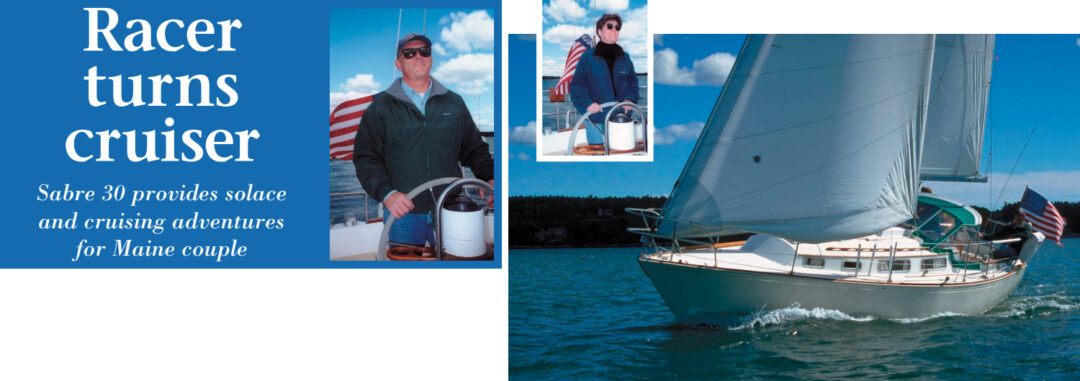
Sabre 30 provides solace and cruising adventures for Maine couple
Issue 24 : May/June 2002
I don’t want to drift around in those rag boats,” David Taft remembers complaining when his father forced him to take sailing lessons as a youngster. “But I loved it. I love to win.”
The cabinet full of silver at his waterfront home shows his success — racing a plywood Sailfish, competing in 18-foot centerboarders (Cape Cod Knockabouts and lean, mean, high-performance Jolly Boats) at their local yacht club, racing one-designs from Interclubs to Luders 44s at Tufts University, and crewing for others on Bermuda Races.
“The first time I sailed a Jolly Boat, it took me around the racecourse — for they can hit 25 knots-plus off the wind with crew on the trapeze,” says the 53- year old South Harpswell, Maine, dentist and Naval Reserve captain.
“Racing wasn’t fun after officials eliminated the reaching legs, leaving only windward/leeward courses,” he says. Nevertheless, when racing, David remained so focused on winning that he never saw the scenery, only the boat’s bearing. “I finally realized I was missing the point of sailing. Now, if the weather prevents us from going anywhere, I just enjoy being on our boat at the mooring. That’s quite a switch for a racing sailor from Marblehead, Mass.”
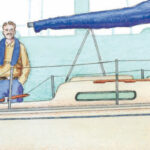
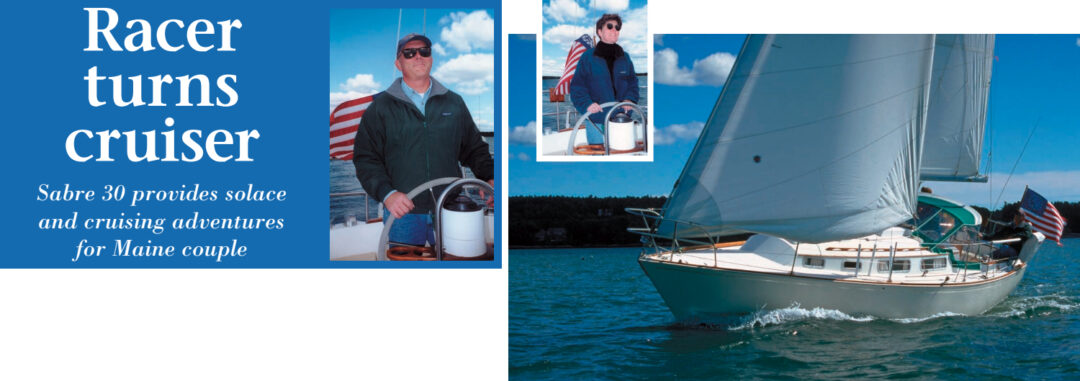
David and his wife, Anne, 46, a Bath Savings Bank branch manager, cruise their 1979 Sabre 30, Solace, in mid-coast Maine. They bought the sloop (hull #8) shortly after their 1996 wedding, to replace David’s Sabre 28 (hull #22), on which they had their first date and honeymoon. They moor Solace at High Head Yacht Club, a half mile from their house.
Winding down
“Often we buzz out to the boat after work and just sit on deck facing west to wind down,” he says. “Sometimes we stay the night on board.”
Solace lives up to the name — for David, after intense 10-hour workdays, and for Anne, who is recovering from vision and balance problems caused by a toxic reaction to an antibiotic in 2000.
“I couldn’t have survived that first summer without sailing,” she says. “I love sailing because I never know what challenges we’ll face from one hour to the next. I never get bored.”
“Three-day weekends give me a day to relax at home and two days to sail,” says David. His Sabre belt and admiration for Capt. Horatio Hornblower and Ernest Shackleton reveal his passion for sailing. Even their home decor (nautical books, boat models, “Gone Sailing” cushions, and a portrait of David’s great- grandfather’s schooner) suggests that this is the home of sailors. David also owns Gift Horse, his late father’s 20-foot Aquasport, a gift from his mother. “I had to eat a lot of crow from sailing friends when I accepted that boat,” he says. “But we do use it some.”
When the Tafts want to go sailing, they just grab their “ready bag,” perishable food, and dinghy oars. Anne keeps Solace stocked with sleeping bags, staples, and lots of polar fleece clothing. “I’ve been sailing long enough in Maine to put vanity aside,” she says. “I just want to be warm.”
“We’re pretty laid-back cruisers, not destination oriented,” says David. “We get up and see what the day brings. On our 10-day summer cruise, the wind usually takes us Down East, to Penobscot Bay — Maine’s best cruising grounds. Unfortunately, we often have to beat back.”
No crowds
Anne adds, “We enjoyed the Sabre rendezvous last August, seeing other people’s Sabres and what they had done with them, but we usually stay away from the beaten path. No Boothbay Harbor or Camden for us. Our idea of a great place is to be alone in a protected cove along Merchants Row (a string of uninhabited islands in eastern Penobscot Bay).”
Before casting off the mooring, Dave warns Iron Mike (their 13-hp Volvo MD 7A diesel), “I can take you apart piece by piece and toss you over the side, or you can start.” It usually starts. “If not, we have to sail more aggressively than normal, like picking up the mooring under sail,” he says. “Anne’s the one on the foredeck to grab the mooring pennant, which can be difficult with her balance problem.”
As they get underway, Anne takes the helm, David raises the sails. He sheets the main, she the jib. “We get lots of exercise when short tacking off the mooring and out of Harpswell Sound against the prevailing south-easterlies,” says David. Both are fit and up to the work.
“I’m quite comfortable at the helm, but Dave does all the navigation,” says Anne. “I have complete confidence in him. My job is to stay calm.”
“She does very well for an inland girl (raised in Dover-Foxcroft, Maine) who only fooled around on a Sunfish before she met me,” he replies.
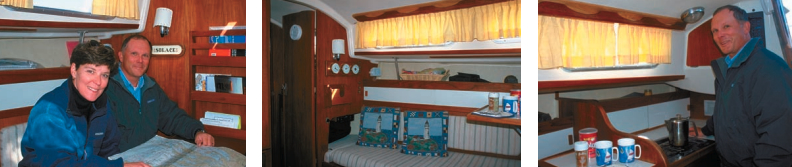
“Down cellar” as they call Solace’s accommodations, the spacious main cabin contains two quarterberths, galley (aft to starboard), navigation station (aft to port), two settees and a three-way teak table that they can open fully, halfway, or stow out of the way against the teak bulkhead. The head and V-berth are forward.
More storage
“The boat has six berths, sleeps two, and has so much more storage than my Sabre 28,” David says. Anne says they take turns preparing meals, though David claims he’s been restricted to making morning coffee on the two-burner alcohol stove. “That stove’s a dream compared to a Coleman camp stove,” she says.
David points with pride to his new GPS chart plotter. “Maybe it takes the challenge away, but GPS eliminates problems like the time we groped our way, buoy to buoy, through fog to Carver’s Harbor, seeing neither the ferry that passed too close nor the red and green buoys, 150 feet apart, that we sailed between.”
Other upgrades enhance cruising pleasures. Screens, two solar ventilating hatches, and many locker gratings increase ventilation to ease Anne’s allergies. The solar shower converts the cockpit into a sit-down bathing area. New plumbing connects directly into the holding tank. An alcohol heater takes the evening chill off the V-berth.
In the cockpit, which they term “out on the verandah,” a new awning zips onto the dodger’s aft end to protect the whole seating area. David notes other improvements: new hasps, refinished teak, new wiring, and a stereo with cockpit speakers. “I’m always doing something,” he says. “It’s fun.”
Anne would like more drinking water than their 30-gallon tank holds, to avoid taking extra water in jerry jugs.
Solace may seem like new, but when they bought the boat the hull was delaminating where water had seeped into the balsa core around the mast, chain plates, steering station, and hull fittings. “Royal River Boatyard did a great job cutting out the fiberglass where it was bad, putting in new balsa, rebedding the fittings, and replacing most of the deck,” says David.
Breaking wave
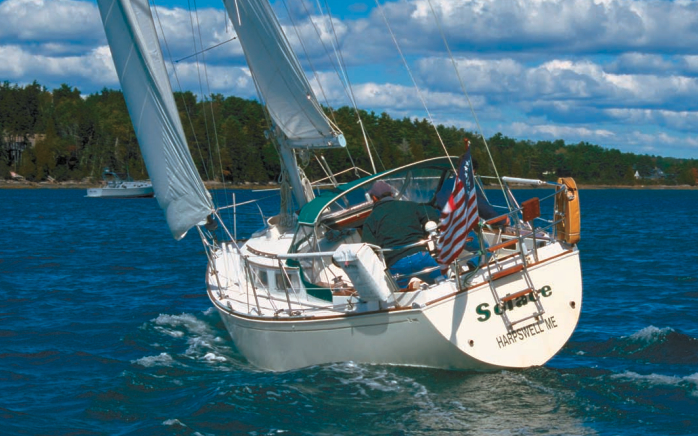
He says Solace sails and handles well, even under jib alone, and grins at the memory of sailing at eight knots with the quarter wave breaking next to the cockpit. The sloop heels when pressed, “but only twice have we taken water over the deck.” He adds, “When the wind pipes up we lower the main.”
Back at the mooring, as he turns off the key, David compliments Iron Mike for its very nice job. “The engine can be very frustrating, for I can’t depend upon it. However, it’s very accessible, and I can bleed the fuel system in seven minutes. Mechanics say I need a new engine; brokers say I need a new boat.”
David admits he’d love a Sabre 34. “But why?” he asks himself. “Solace is perfect for what we do — daysailing, weekending, and one annual long cruise.”
Thank you to Sailrite Enterprises, Inc., for providing free access to back issues of Good Old Boat through intellectual property rights. Sailrite.com