The rise and sudden fall of a boatbuilder with thousands of boats still in use today
Issue 24 : May/June 2002
Columbia Yachts. Ever heard of them? They were one of the largest manufacturers of production fiberglass sailboats in the country, and perhaps the world, for a time. The company soared, leading the fiberglass sailboat industry in production and innovation, then went through several owners, and finally — literally — faded away in a puff of smoke.
From 1961 to 1986, perhaps 30,000 boats were produced bearing the Columbia name. Fifty models were offered, from an 8-foot Sabot up to the magnificent Columbia 57. Columbia had two U.S. plants, one in California and one in Virginia; it licensed production in Canada, Australia (International Marine), and Japan (Yamaha); and boats carrying the Columbia shield were also produced in Italy and Spain.
In addition to an in-house design team, Columbia Yachts came off the design boards of Sparkman & Stephens, Charlie Morgan, William B. Crealock, Bill Tripp, Wirth M. Munroe, and Alan Payne Sr. Thousands of Columbias are still found all over North America, and indeed the world.
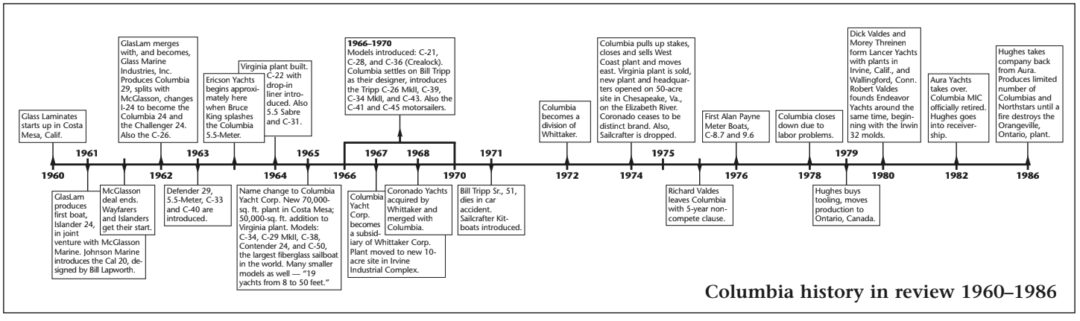
Columbia’s story begins with the birth of the fiberglass boatbuilding industry in Southern California. Columbia Yachts started life as Glas Laminates, in Costa Mesa, California. Started in 1960 by Richard (Dick) Valdes and Maurice (Morey) Threinen, Glas Laminates’ primary business was manufacturing fiberglass camper shells, shower stalls, and portable chemical outhouses for the construction industry.
But Dick had long been interested in boats, even prior to forming GlasLam. In his third year attending UCLA on a naval scholarship, he started a company called Continental Fiberglass Corporation, which produced about 200 Sabots for Sears, Roebuck and Co. Dick met Morey Threinen when he hired him for that first company. Dick sold his interest in Continental Fiberglass and went to work for a coincidentally named, but unrelated, company called Continental Plastics, which produced hundreds of fiberglass runabouts in the 12- to 18-foot size. Dick hired Morey as a sales manager while working there.
New-fangled stuff
After college, Dick and Morey decided to have a go at this new-fangled fiberglass stuff and started Glas Laminates, manufacturing the items noted above. But Dick had boats on his mind, and before long they were producing and selling fiberglass Islander 24s in a joint venture with McGlasson Marine. The Islander 24 was originally a wooden sloop designed and built by Joseph McGlasson. Under the joint agreement, GlasLam produced molds from the wooden boat — including the grooves from the planking — and GlasLam began to produce fiberglass hulls and decks, which were sold to McGlasson to finish and sell.
According to Vince Valdes, Dick’s son, GlasLam would also pay McGlasson to finish off boats, with the hull, deck, ballast, and rudder supplied by GlasLam, for GlasLam to sell through its own dealers. At the time, GlasLam had no woodworking facilities. The Islander 24 drew much interest, and production sold out the first year. (McGlasson and Ritchie also produced the Catalina Islander, an Alden-designed wooden sloop, which is unrelated to the 24-foot Islander.)
GlasLam and McGlasson parted ways sometime in 1961 or 1962, and the McGlasson connection branches off into Wayfarer and Islander history. The 24-foot boat continues to play an important role in the Columbia story, and more will be said in a moment about it.
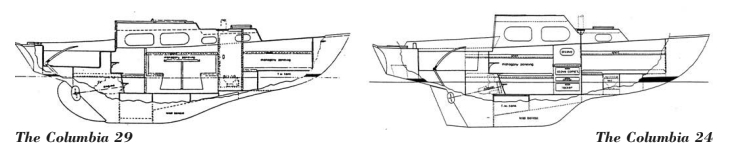
GlasLam began producing the first model of their own in 1962. This was the Columbia 29, a Sparkman & Stephens design, Number 1508, originally commissioned in 1959 by a lumber company owner named Lester Bitney of Palo Alto, California. Bitney built the tooling and molds and completed three or four boats, at which point Dick Valdes purchased the tooling and all rights to the design, as well as the Columbia name for $40,000. The C-29 was a big hit and inspired the company to adopt the Columbia name for all their models. (Although the company referred to the boats by the full name “Columbia” and the number or model name, the boats are commonly referred to simply as “C-whatever” and will be for the balance of the article.)
Started it all
In 1962, GlasLam was producing the C-29 and the Islander 24 — this is where the little boat that started it all re-enters the story. When GlasLam and McGlasson went their separate ways, GlasLam retooled the 24-foot design, including removing the planking grooves to produce a smooth hull, raising the sheer four inches and enlarging the trunk cabin. They named the resulting boat the Columbia 24. (Jumping ahead for a moment, Columbia subsequently produced two additional 24-foot models based on the same hull, the Challenger and the Contender.)
There were no laws at the time preventing anyone from making a mold from an existing boat, “splashing” as it was called, and producing similar boats under a different name. The original 24-foot design was splashed by another entrepreneur to become the Del Rey 24. It was fairly common for fiberglass molds to be taken from wooden hulls (or even other glass hulls) and the designs produced in glass.
A Chicago dealer, Bosworth Marine, placed the first large order with the young company in 1961, and 24 C-24s and 12 C-29s were delivered. Business was brisk.
Glas Laminates became Glass Marine Industries in a serendipitous uphill merger. Dick and Morey were at the Chicago boat show in 1962. Their company, Glas Laminates, was already making the C-29 and the I-24. They saw an ad in the Wall Street Journal: “Wanted: Merger with boat company. We have substantial cash and no liabilities.” Following was the name, Joseph E. Bell, attorney, with a Chicago address and phone number. It was the weekend. When nobody answered the phone, Dick looked in the phone directory for Bell. By chance, the first J. Bell they phoned was the correct one, and a merger was worked out in the following months.
Merger arrangement
It was just luck that Dick and Morey were the first to contact Joe Bell in person. Glass Marine Industries, which he represented, worked out a stock-swapping merger arrangement with GlasLam, which left GlasLam owning Glass Marine Industries. The merged company was publicly offered under the Glass Marine Industries name with boats “produced by Columbia Yachts, an inspiring addition to a growing division of Glass Marine Industries Inc.,” according to one brochure. The Columbia name was adopted in honor of the popular Columbia 29 design. Boats were manufactured in Costa Mesa, California.
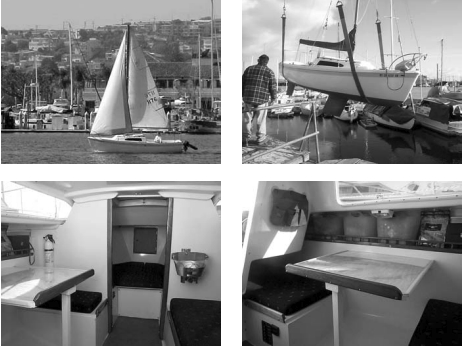
Following the merger and name change, the company took off. A procession of new models was introduced. Joining the 1962 model lineup of the C-29 and C-24 was the C-26, a stretched version of the C-24, and then the Challenger, which was a raised-deck version of the C-24. The Cal 20 had recently come out, and raised decks were all the rage; the Challenger sold for $3,995, $500 more than the Cal 20, but it offered stiff competition since it was a lot more boat for a little more money (for more on the Cal 20, see Good Old Boat, July 1999). There are many Challengers still to be found sailing, and an active fleet races in Stockton, California.
Raised-deck version
Raised-deck boats are often referred to erroneously as “flush-deck boats.” On a true flush-decked design, the deck, usually uninterrupted by a cabin or doghouse, is at the same level as the natural sheer of the hull. On a raised-deck boat, there is a cabin, but the cabinsides are brought all the way out to the rail. There are no side decks. In effect, the hull sides continue upward above the sheer line to form the “raised deck.” Raised-deck boats are not a new idea; for an example of a more traditional looking design, see the 1931 Sam Crocker-designed Stone Horse featured in the January 2002 issue of Good Old Boat, rendered in fiberglass by Edey & Duff.
In 1963, Columbia introduced the Defender 29, the 5.5-Meter boat, and the C-33. The Defender is a raised-deck version of the C-29 — the same hull, but a different deck dropped on. The C-33 is a Wirth Munroe design, traditional in appearance, with longer overhangs and a centerboard.
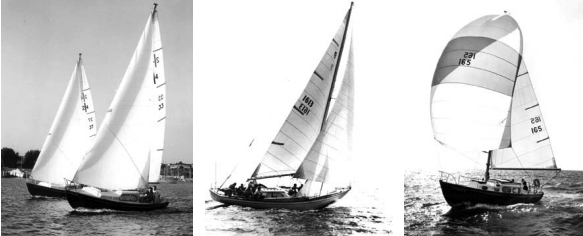
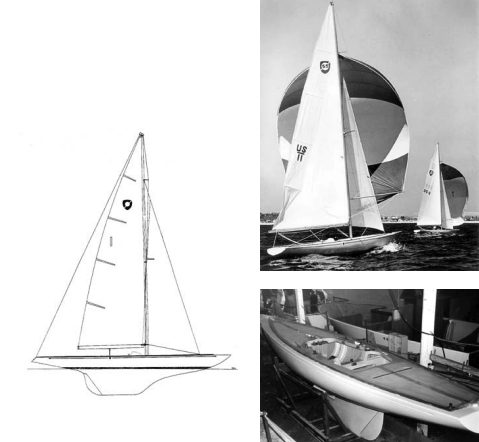
The 5.5-Meter is a very interesting boat. These boats were designed and built to the Olympic 5.5-Meter International Measurement Rule. At 32 feet, 5 inches long, with a very narrow 6-foot, 3-inch beam, and displacing only 3,900 pounds, these boats just shout “performance” in the older full-keel, flush-deck daysailer style. With a waterline length of only 25 feet, this boat sports impressive and beautiful classic overhangs (see photo on Page 14). The boat is startlingly narrow for its length, especially compared to more conventional designs.
A full-page ad for the Columbia 24 from the November 1963 Yachting magazine lists the 1964 model lineup as the 5.5 (Olympic class) Meter boat, C-29, Defender 29, C-26, C-24, Challenger 24, and two Columbia “flagship” models, the C-33 and C-40. Also mentioned are three Columbia “power yachts,” 30, 35, and 40 feet long. Columbia only dabbled in powerboats, with several designs never leaving the drawing board. According to Dick Valdes, only one, the Columbia Express 30 cruiser, actually made it into production. Between 1964 and 1966, 167 of these were produced. The design, along with the hull and deck tooling, was subsequently sold to Luhrs.
The success of Columbia and consumer interest in their products warranted a cross-country expansion. 1964 saw Morey Threinen overseeing the building of an East Coast plant on a nine-acre site in Portsmouth, Virginia. The move reduced the distance and delivery times to the East Coast markets. Again the company expanded its product line, introducing the Bill Crealock-designed C-22 and the Charlie Morgan-designed C-31 and C-40, both centerboard designs. The 5.5 Sabre was also introduced, which was the 5.5- Meter boat with a cabin and deckhouse, providing full, if cramped, cruising amenities. (Ericson Yachts got its start when Bruce King, who had worked for Columbia, splashed the Columbia 5.5, added a cabin and different deck, and produced the first Ericson).
Noteworthy boat
The C-22 may be one of the most noteworthy boats Columbia produced, for the model marks an important development in fiberglass boat production — the introduction of the molded drop-in hull liner. Up to this point, fiberglass boats had most or all of the wooden interior structure and furniture laboriously crafted and installed, each piece attached to the inside of the hull with fiberglass tape (tabbing) and components, assembled for the most part, in place aboard. According to Dick Valdes, who pioneered the idea, the introduction of the liner cut some 40 to 50 manhours of labor — labor that had to be skilled in carpentry and other trades. The Columbia 22 was strong competition for similar pocketcruiser designs because of the savings in labor and the increased quality the liner provided. The C-22 remains one of the more numerous Columbia models seen around the docks, with more than 1,500 boats made before production ceased in 1972. It was offered in a deep fin-keel version and a centerboard-fin version. Sales literature from the period boasts that the 22 is “hailed by many to be the biggest 22-footer afloat.”
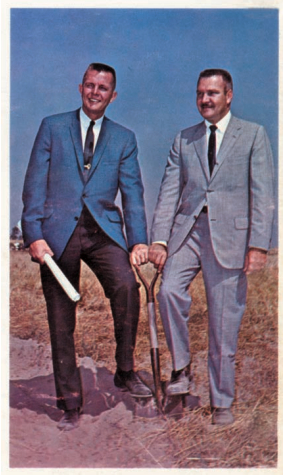
Business was booming in 1965, and Columbia officially became “Columbia Yacht Corporation,” linking the new corporate name with the well-known Columbia Yachts brand. Ground was broken for a new 70,000-square-foot plant located on 5 1⁄2 acres in Costa Mesa, California. The builder’s fee was to trade his C-40 for a new C-50. The ever-growing demand for Columbias was also met by a 50,000-square foot addition to the Virginia plant.
Innovative style
In keeping with the company’s innovative business style, more models were introduced including the C-29 MkII (a new deckhouse and rigging improvements for the original design), a C-34, C-38 (a budget C-40), the C-50, and the Contender.
The C-50, a Bill Tripp design, was announced in late 1965, with hull #1 to be launched in January of 1966. It was the largest production fiberglass sailing yacht in existence and is a stunning blend of a traditional-looking hull above the waterline, a flush deck that seems to go on for acres, and a relatively small rounded doghouse, a precursor to the Tripp “bubbletop” designs to come. The underbody has a cutaway forefoot and a spade rudder. The C-50 was definitely in the “performance cruiser” category and was a very successful ocean racer. A promotional blurb exclaims, “The first luxury fiberglass yacht that is big enough to be completely comfortable . . . fast enough to win major ocean races . . . and not too big to be owner maintained.”
The 24-foot Contender model harkens back to the very beginnings of the company. It was a development expressly for the more traditional East Coast markets — Columbia simply returned to the original Islander 24 design (sans planking grooves), reintroducing it to the East Coast markets as the Contender. The Islander 24 and the Columbia Contender are essentially identical and often mistaken for one another. Apparently the tradition-steeped East Coast markets were not quite ready for the modern raised-deck boats like the Challenger and Defender, so popular on the West Coast. Other West Coast manufacturers like Cal, Coronado, and McGregor had jumped on the raised-deck bandwagon as well.
Five new boats
A company magazine, Columbia News, boasts the following in the 1965 fall/winter issue: “More big news is our forthcoming entrance into the small boat market with five new boats: the Columbia Sabot, an 8-foot sailing dinghy; the Columbia Cadet, a 14-foot sailboard; the Columbia 14, a 14-foot self-bailing daysailer; the Columbia Kat, a 16-foot catamaran; the Columbia Jolly, an 18-foot high-performance class boat; and the Columbia 20, a 19-foot, 6-inch planing daysailer . . . With the addition of the Columbia 34 and the fabulous Columbia 50, our line now totals 19 yachts from 8 to 50 feet in length.”
Business was good, and Columbia’s star continued to rise.
Continued growth and some big changes, on both the business and design fronts, marked the period from 1966 to 1970. On the design side, Columbia continued to introduce new models, including the C-21, a daysailer version of the C-22, the Crealock-designed C-28 and C-36 models, and perhaps the most noteworthy, a daring new line of boats by Bill Tripp.
The introduction of the Tripp designs ushered in a new era of common lineage and vision to the product lineup. Up until this point, Columbias represented an eclectic mix of designs and designers. The company drew on half a dozen outside designers and an in-house team that produced new models by making modifications to existing designs. The end result was an amazing array of models; many shared a distinctive large bullet-shaped window in the main cabin, and the cabin silhouettes were similar, but the boats did not share a common heritage. By turning to Tripp as the sole designer of the new boats, Columbia was introducing an element of continuity to the new lineup.
Tripp’s “bubbletops”
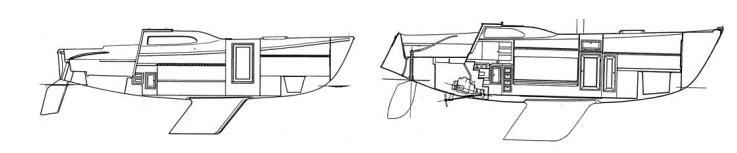
The first of these Bill Tripp designs, the so-called “bubbletops,” were rolled out in 1966 and 1967 — the C-26 MkII, C-34 MkII, C-39, and C-43. The MkII appellation signified far more than simple upgrades or design changes to the previous 26 and 34 models; these were totally new designs. All four were a radical departure from the more traditional narrow full-keel type designs of the day. These new designs were beamy and of light displacement, with severely cutaway underwater shapes sporting fin keels and spade rudders. They carried high freeboard, flush decks, and a small rounded doghouse (hence the bubbletop nickname). These “performance cruisers” were controversial in their day for their striking design and appearance.
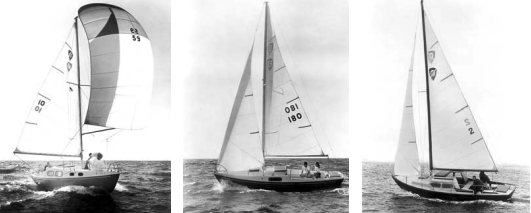
Probably the best-known examples are the C-26 MkII and C-34 MkII (shown on opposite page), with at least several thousand produced and many still sailing. Practical Sailor observed in an August 1984 Used Boat Survey of the 26 MkII that the bubbletop designs “were perhaps too radical for their day.” It went on to say, “the bubble cabin never became fashionable” and the designs were ahead of their time, but . . . “their time never came.” Nevertheless, many were sold, and they are still to be seen nearly everywhere. Thirty-something years later the boats now have a contemporary modern look. Perhaps “their time finally came” after all. Remarking on the bubbletops, one Columbia owner states, “I’ve always thought of them as a love ’em or hate ’em deal, with few people on the fence. Looking at some of the modern racers today, such as the Around Alone boats, you see very similar flush-deck-bubbletop styles. Maybe form does follow function.”
Remarkably successful
One thing about the Tripp designs no one questioned was the performance. Speaking of the 26 MkII, Practical Sailor noted that the boat remains “a remarkably successful club racer . . . and (performs) creditably against even the most up-to-date boats of the same dual-purpose design.”
The 34 MkII, also billed as a performance cruiser, has made some impressive bluewater voyages. The bubbletop appeared on the 26 MkII, 34 MkII, the C-35, C-39, C-43, C-52, and the C-57, all Tripp designs. The Constellation and C-50 carry what might be called “proto bubbles,” as these earlier cabins are longer and not quite as radical as the “true bubbles.”
By this time, at the end of the 1960s, Southern California fiberglass boat production was in its boom days, and there were many manufacturers competing with Columbia in this still-evolving market, including Catalina, Cal/Jensen, Coronado, Aquarius, Balboa, Wayfarer/Islander, Venture/McGregor, Schock/Santana, and a host of other well-known and not-so well-known players.
The Tripp “bubbletop” series may have been an attempt by Columbia to regain declining market share with an exciting and eye-catching line of boats, designed to set them apart stylistically and performance-wise from the rest of the pack. The Tripp bubbletops remain distinctive more than 30 years after their introduction, and the 26 MkII continues to be a very competitive boat, perhaps the most numerous Columbia model out there sailing. They are exceptionally roomy and sporty boats. During this period the C-41 and C-45 motorsailers were introduced, which were based on the C-39 and C-43 Tripp hulls, with interiors and decks designed by Blain Seeley.
Undergoing changes
Not only the designs, but also the company itself was undergoing some big changes. In 1967, Columbia Yacht Corporation became a subsidiary of a California-based conglomerate, Whittaker Corporation, and the headquarters and West Coast plant moved to a 10-acre site in Southern California’s Irvine Industrial Complex. The additional managerial expertise and financial support, coupled with the technical and engineering resources of the parent company, allowed Columbia to further strengthen its position of innovation and growth in the sailboat industry.
One year later, Whittaker acquired Coronado Yachts, merging it with the Columbia operation, but maintaining separate marketing policies. There was some cross-breeding between Columbia and Coronado designs. For example, the C-28, designed by Bill Crealock for Columbia, appears to be marketed as a Coronado 28 by simply substituting the emblems on the hull. The Bill Tripp-designed C-34 Mk II bubbletop inspired the center cockpit Coronado 35, with a different deck and interior and perhaps some minor changes to the hull. The Coronado 27 was derived from the C-26 MkII. There may be other crossover models.
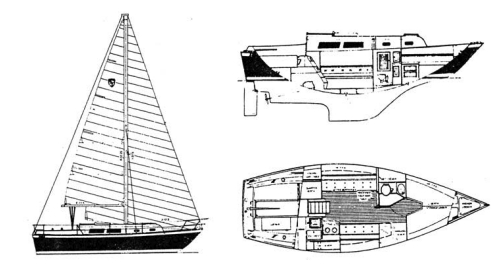
The decade of the 1970s continued to be one of change for Columbia, marking perhaps the zenith of the company’s success. In 1971, Columbia launched Sailcrafter Custom Yachts, which were kit boats based on the regular production models. A brochure lists five kits available: finished hull; deck and deck headliner; lead ballast; rudder, fittings, and steering gear; engine and controls. According to a flier, the models available as Sailcrafter kits were the Sailcrafter 22 (C-22), 28 (C-28), 36 (C-36), 50 (C-50), and 57 (C-57). Several Coronado models were also available, the S-23, S-25, and S-32. Columbia deep-sixed the Sailcrafter kit-boats in 1974. Evidently few were sold, and it was felt that kit-boat production was interfering with regular production.
Whittaker division
There was important corporate shuffling happening. In 1972, Columbia changed from a subsidiary to a division of Whittaker Corporation. In 1974, Columbia pulled up its stakes from its birthplace in Southern California and re-established its headquarters on a new 50-acre site on the Elizabeth River in Chesapeake, Virginia. The Irvine, California, and Portsmouth, Virginia, plants were sold. One observer suggested Columbia had simply “worn out its market on the West Coast.” Coronado Yachts were blended into the Columbia product line. This seems to be the end of Coronado as a distinct brand.
Dick Valdes left Columbia in 1975 or 1976. He apparently had a five-year non-compete clause. As soon as that expired, he formed Lancer Yachts in Irvine, California. (Dick’s brother, Robert, who had managed the Virginia operation, went on to form Endeavor Yachts, buying the molds for the Irwin 32 and producing the Endeavor 32. Endeavor Yachts closed around 1989.)
It was in the mid-70s that the first of the Alan Payne-designed meter boats appeared. Columbia, after settling on Bill Tripp as their designer, was forced to shift gears by Tripp’s untimely death in an auto accident. The company settled on the Australian Alan Payne, perhaps best known at the time for his America’s Cup boat, Gretel. Around 1976, the C-8.7 (28 feet) C-9.6 (31 feet), and the C-10.7 (35 feet) appeared. These were followed in the later 1970s by the C-7.6 (25 feet) and C-8.3 (27 feet). The switch to metric was probably part of a marketing strategy to bring the boats into the modern era. The new designs reflected this as well; the Payne C-8.7 was rolled out as “The First Widebody Supercruiser! You’ve never sailed a 29 footer like her!” And indeed, at 10 feet of beam on a 28-foot 7-inch length overall, it was certainly a departure from the narrower designs of the day. The “Widebody Supercruisers” proudly carried a wineglass-shaped transom, of which much was made. It was advertised that the “ . . . traditional wineglass transom . . . pulls the quarter wave aft, and makes for a fine trailing edge at all angles of heel. This results in a light, bubbling wake, not a boiling trail of foam.” A wineglass of champagne and the title “Tiny Bubbles” headed this promotion.
Trouble brewing
Despite the introduction of the meter boats, the company merely idled along for several years, and trouble was brewing. Production continued until 1978, when Columbia closed down because of undefined “labor problems.” In 1979, Howard Hughes, from Hughes Boat Works (no, not that Howard Hughes of Hollywood and Spruce Goose fame) picked up all the molds, brought them to Centralia, near London, Ontario, in Canada and began producing Columbia Yachts. These are known as the “Hughes Columbias” and were for the most part the above-mentioned meter boats. Several of the most popular models from this period are the C-8.7 and the C-9.6.
It’s unclear if Hughes actually introduced any new models or just reshuffled some designs and names. For example, the Hughes C-36 appears to be a Coronado 35 (based on the Tripp-designed C-34) with some modest design changes. Hughes changed the long-standing and well-known Columbia shield by adding a vertical wing-shaped V element that intersected the shield. Hughes also produced the Northstar line of sailboats. Hughes did not do well either, and in 1982 the troubled company went into receivership.
According to the U.S. Coast Guard website, “CLY,” the Columbia manufacturer’s identification code (MIC) was retired August 28, 1982. Many Columbia owners observe this date as “Columbia Day,” a day of mock-solemnity to mark the passing of this fine line of boats and, of course, to hoist an appropriate beverage in honor.
In 1982, Aura Yachts took over Hughes or what was left of it. Aura apparently produced a limited number of boats, exact production figures are unknown. Aura must have run into problems. Around 1986, Hughes took the line back. From 1986, Hughes built boats until a fire destroyed the factory in Orangeville. It is unclear when this fire took place, how many of the molds may have survived, or what happened to them. There is anecdotal information about some of the Columbia molds. One rumor has the C-50 or C-57 molds ending up in Texas. There was even a rumor several years ago that new or kit versions of the 50 or 57 might be made again. But this fire certainly marked the end of Columbia’s long run.
Largest concentrations
Columbia sailboats may be found today all over the U.S. and Canada, but the largest concentrations seem to be found around the two areas of former production: Southern California and the Chesapeake. There are thousands of boats still in service; used models of all sizes can be found for sale in any condition, from lovingly restored and upgraded to better than new, to, uh, shall we say “awaiting someone to fall in love with them.” While the boats have not been produced for quite some time, and were admittedly in the mass-produced Chevy category of their time, they were well made and built to designs by noted naval architects. There are many resources available to owners, including the large and active Columbia Yacht Owners Association (CYOA) with a website, a quarterly journal, and two online discussion groups with hundreds of people participating, hosted by Yahoo and Sailnet. All in all, Columbias present an excellent opportunity and good value for the good old boater. Now you’ve heard of Columbia Yachts!
The author thanks all those who have collected and contributed information over the years. Sincere appreciation goes to Eric White, the Valdes family — Dick, Vince, and Marguerite — and Doug Ward for their direct contributions and co-operation.
Thank you to Sailrite Enterprises, Inc., for providing free access to back issues of Good Old Boat through intellectual property rights. Sailrite.com