Good safe coastal cruiser, but no world-girdler
Issue 25 : Jul/Aug 2002
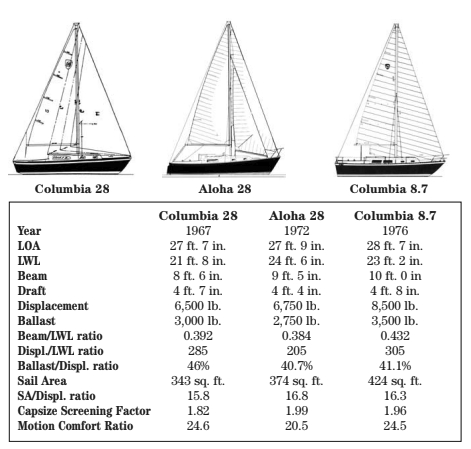
In the mid-to-late 1960s, many designers, myself included, were turning out full-keel auxiliaries such as the Luders 33, my own Douglas 31, and Carl Alberg’s husky designs for Cape Dory and Whitby. Some of us began to change our minds about lateral plane shapes when the Cal 40 appeared on the scene, showed her heels to the competition, and started collecting all the silver. Still, it took quite a while to convince some people that the fin keel had been rediscovered and was here to stay.
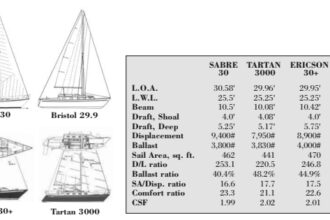
Obviously, Bill Crealock was one of the early converts, as his 1967 design of the Columbia 28 sports a rather high-aspect-ratio fin as well as a spade rudder. Indeed, she appears to be quite an advanced design for a small boat of that era. The table is interesting, as the three boats we’re comparing cover a period of 10 years from 1967 to 1976 and include the Alan Payne-designed Columbia 8.7 along with my own Aloha 28.
Note that I’ve changed the term Comfort Ratio to Motion Comfort Ratio, as this better describes the result of the calculation. I have every right to do this since I invented the darned term in the first place. I also added another ratio to this list since I worked out the Beam/LWL ratio of the boats to satisfy my own curiosity. It shows that the one-foot narrower Crealock design is actually quite close to the Aloha in proportion while the 8.7 well deserves the “wide body” appellation that Columbia gave their Payne line of cruising yachts.
The 8.7 would undoubtedly be the stiffest of the three with her wide beam, heavy displacement, and good ballast ratio. Stability would be almost a tossup between the Aloha and the Columbia 28 though. The latter’s slightly deeper draft and higher ballast ratio would tend to partially offset the greater form stability provided by the Aloha’s wider beam and longer waterline, although the Aloha should still have a small advantage.
Varied appeal
Despite the similarity of overall length, these are very different boats, and each will appeal to different sailors. When it comes to the question of performance, I feel the Columbia 28 would be a contender in lighter air due to her low wetted surface. The Aloha might well shine in medium breezes, thanks to her good D/L ratio, form stability, and sail area. Then when it really blows a duster, the 8.7, given her husky displacement and resultant stability, could take the honors.
As I’ve said before, no one is going to be comfortable in a boat of this size in a gale, but here the 8.7 probably has a small edge. The Columbia 28’s motion comfort, the speed of her scending on a sea, will be about the same as the 8.7, but she will be heeled over considerably more due to her lesser stability. This is important because many sailors equate heel angle with comfort. In any case, the Aloha will be quite the corkiest of the three due to her low D/L ratio, and this is reflected in her lower figure for motion comfort.
It’s no surprise that the Columbia 28 has the lowest capsize-screening factor either, due to her narrow beam. Indeed, with her good ballast ratio she could well be the safest of the three if caught out in that ultimate blow. However, we’ll hope no one ever has to make that discovery, as all of these boats were intended as coastal cruisers, not world-girdlers. Long bluewater passages should only be made after careful preparation of the boat and all its gear, and with an eye on the weather. Any one of the three would be a good choice for a family cruiser, but Cape Horners they are not!
Thank you to Sailrite Enterprises, Inc., for providing free access to back issues of Good Old Boat through intellectual property rights. Sailrite.com