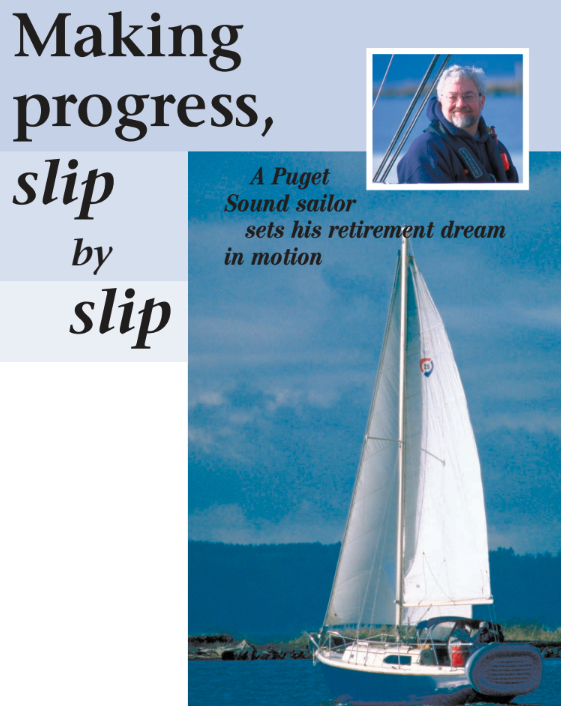
A Puget Sound sailor sets his retirement dream in motion
Issue 25 : Jul/Aug 2002
A really big boat and a really small house is Walt Pierce’s ideal retirement setup. He hasn’t exactly achieved that goal. But then he’s not quite ready to retire yet. When the pieces fall into place, Walt will know it’s time to retire.
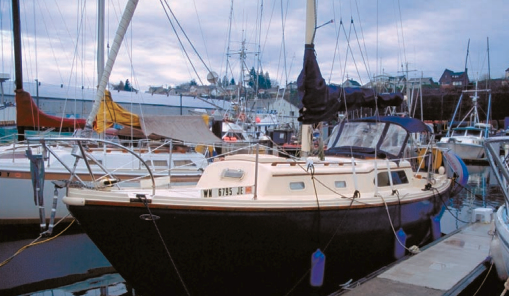
Consider the way he got his present boat, for example. The boat, a 1969 Columbia 28, wasn’t even a gleam in his eye in early 1997 when Walt signed up for a 32-foot slip in Everett, Washington. He knew there was a three- to five-year waiting list. He was prepared to wait. He figured on “smooth sailing” by some time in 2002. Perhaps even a bit sooner.
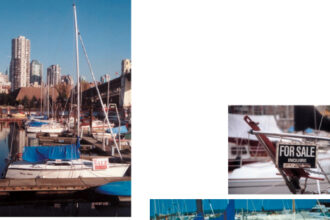
Because it is crowded, the rules in this part of the state of Washington are simple. When your name comes up for a slip, you start paying slip fees immediately, of course, and you must have a boat in there within six months. No sneaking a dinghy in to hold the space. This boat must be sized appropriately. This isn’t too difficult if you already have a boat in a slip somewhere else. But getting started in this game of musical chairs is a bit tricky, as Walt discovered.
When he put his name on the list at the Everett Marina, he was number A few months flew by before he stopped back by the marina to learn that he had advanced to number 66. A short while later, and the number had, to his horror, shrunk to 30-something. By the time it got to the teens and a year had not yet slipped by, Walt panicked. It was time to find his dreamboat. He was about to have a place to put it. But his financial situation was not quite ready for the responsibilities of boat ownership.
Order up
“If I won the lottery, the first thing I’d do is stop by the Island Packet dealer and tell them to order up,” Walt says. The lottery was not in the cards, but the slip was. Walt began studying the classified ads in sailing magazines with new interest. But the boats he wanted were too expensive for the abbreviated schedule he was facing. Move his name back to the end of the list? Not a chance!
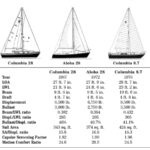
A chief telecommunications engineer with the Snohomish Public Utility District, Walt heard of a boat that a co-worker wanted to sell. It sounded reasonable at $8,000. The fellow brought a photo to work, and Walt developed a keen interest in Columbia sailboats. He searched the Internet for more information about this boat, and found an active owners group led by Eric White and Mike Keers . Through the Columbia discussion group, he began learning about common failures: in particular, keelbolt problems and leaky ports. He figured, with the advice of other Columbia owners on the list, these problems could be surmounted.
The next dragon to slay was the problem of insuring a rather tired, but willing, boat. He was able to get homeowner’s insurance. Next, a surveyor pronounced the hull sound with a few areas in need of repair (the keelbolts, for example), and Walt became the third owner of Columbia 28 hull #330. This happened in March 1998 . . . way ahead of schedule on his timeline but just in time to hold the slip.
The boat was located in Anacortes and now needed to be delivered to Everett, a 12-hour sail. No problem, except that Walt would wind up doing the delivery singlehanded, and his sailing experience was somewhat limited and a bit rusty at that. He’d spent most of his adult life in Alaska near Prince William Sound where, as he notes, the sailing season is a bit short and winds blow at gale force or not at all. Therefore, while in Alaska, Walt often thought of sailing but wasn’t able to get much experience.
Sleep aboard
“I dreamed of owning a 32-foot Ericson . . . I figured I’d have it made,” Walt recalls. He’d had a Portabote with a sailing rig. But soon, he says, he wanted to sleep aboard overnight. “Then once you have something a bit bigger,” he admits, “you want a Porta Potti.” Before long you’ve got your eye on a cruising sailboat.
So Walt had had the opportunity to charter occasionally. Nothing more. But the love of boats runs deep in his veins, and he knew he’d have a boat as soon as he was settled in the Seattle area.
“I love Puget Sound with the islands nearby and Canada to the north . . . Desolation Sound . . . ” he pauses to consider. “And you don’t need to haul the boat often.”
Blame it on Grandpa
His grandfather must take the blame for Walt’s need to be on or near boats and the call of the sea. His grandfather was a sea captain who commanded two freighters for many years and was a pilot licensed for Puget Sound. It was while he was working in the Puget Sound area that he instructed young Walt, then 8, in the rules of the sea, rules that govern Walt’s nautical life.
A few of his grandfather’s sayings include, “A man with no vest (life jacket) is a man with no sense,” “Always point your bow to the waves,” “One to use, one to lose (always carry spares),” and “When you need a bilge pump, the biggest one is not big enough.”
He taught him to rely on his hearing: “The best thing a sailor has is his ears; always listen to the sounds. They tell you what is happening, even in the fog. Listen for the sounds of waves on shore and on rocks or the bow wake and engine sounds of an approaching ship.” He told his grandson that when a captain navigates down a channel in fog he blows his foghorn and listens to the echo. “You know you are mid-channel,” he told him, “when the echoes from both sides of the channel are heard at the same time.” This, of course, was crucial to commercial ship navigators in the days before radar. He taught him to use a foghorn to locate a sharp shoreline by listening for the echo and counting one second for every 500 feet of distance.
These and other truisms have achieved a high level of status with Walt as he has grown older and wiser. A few objects that once belonged to his grandfather serve to reinforce these lessons. Walt treasures, almost as highly as his grandfather’s advice, the sextant he used, a sea chest from Shanghai dating to 1830 or so, and the flag from his grandfather’s second ship, the SS Canada Mail. A flag is retired and given to a master when he leaves the ship for the last time.
Reality hits
So there was Walt in 1998 with a slip in Everett, a boat in Anacortes, and the need to make a long solo trip to unite the two. “It was the third weekend of March 1999, and the weather was clear,” Walt says. “Daytime temp about 58, the night temp about 45. The engine purred right along. With the extra fuel tank (burning about 3⁄4 gallon per hour at 1,800 rpm), the old Atomic 4 never missed a beat. I had an old dinghy tied to the back. I just sat there enjoying the views of the lighthouses along the way, Deception Pass, and Mount Baker with its snow-filled top sticking so far up into the sky.
“Although winds were calm, I took the Admiralty Inlet course, checked in with the USCG Vessel Traffic System several times en route. I started at 7 a.m. and got into port later that day at 7 p.m. I arrived at my slip for the first time in the dark, but I pulled her in well and simply stepped off and tied her up. She handles so well and is very responsive.”
Once home, of course, there was work to be done. Since 1999, Walt has given the Atomic 4 a new lease on life with a conversion to fresh-water cooling, an electronic ignition system, and an electric fuel pump. Indigo kits made these modifications possible. While he was at it, he added a loop in the freshwater cooling system to heat the cabin (at least when motoring). A previous owner had added a 16-gallon tank to supplement the boat’s existing 12-gallon tank.
Replacements
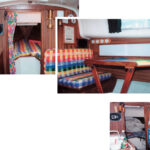
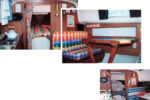
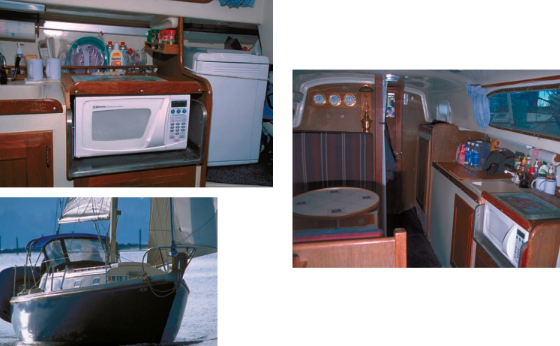
He also spiffed up the cabin, improving the lighting, adding a small chart table, a stereo and radio, replacing the galley stove, and adding a galley pump. And he improvised a method for monitoring the level of potable water in the tank. These improvements came in handy when he spent one summer living aboard. Of that time, he says with a grin, “I knew I had become a wharf rat when I realized I was timing my laundry trips by the tide table.”
Other improvements included a new CDI roller furler (Walt says the furling system is an undeniable asset when singlehanding) and a bilge pump (remembering his grandfather’s words, he upgraded his pump from 500 gallons per hour to 2,000 gallons per hour).
Of course there had to be a new name and a ceremony in honor of that new name. The boat had been called Newfie II. Walt renamed her Yemaya after a mythical sea goddess.
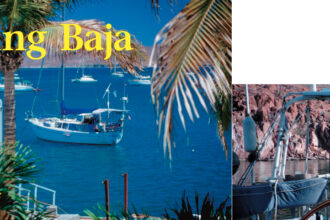
Walt is lucky to have three days off at a time. When he can, he spends this time cruising, enjoying the orcas (he tells of a resident pod of 28 whales), the seagulls, and the sights in general. On longer trips he enjoys heading for remote destinations where he can gunkhole and spend quiet time hanging on the hook. The northwest is perfect for this type of cruising, and Walt expresses absolute contentment with the cruising grounds and the Columbia 28 that takes him there.
But Walt is mindful of his retirement dream: a really big boat and a really small house. In order to keep that plan alive, Walt recently put his name on an eight-year long list for a 50-foot slip. Since the length of a waiting list is clearly a relative thing at the Everett Marina, it seems that his grandfather should have taught Walt, “You must be careful what you wish for . . . ”
Thank you to Sailrite Enterprises, Inc., for providing free access to back issues of Good Old Boat through intellectual property rights. Sailrite.com