A famous designer tells how to discern real quality in a yacht
Issue 30 : May/Jun 2003
Those who have read that fascinating book Zen and The Art of Motorcycle Maintenance will be aware of the author’s interminable search for the meaning of the word “quality.” My old Webster’s dictionary lays it on the line quite nicely as far as I’m concerned: “quality is the degree of excellence which a thing possesses.” Now you can look up excellence!
I offer one man’s opinion of what constitutes quality in a yacht. The quality I’m talking about is not what many think of as “gold platers.” I’ve never believed that gold plating adds much quality to anything from a cheap brass watch to a 100-foot yacht. In yacht construction, the real “gold” is evident in the materials, the hardware, the equipment, the workmanship, and the care that have gone into her original construction.
When I speak of equipment, I’m concerned with the initial gear the builder used, not the after-market radios, dinghies, depth sounders, wind indicators, radar units, and other relatively short-lived accoutrements that owners add over the years. If the yacht is more than 10 years old, much of that apparatus will be suspect, if not outright junk, and has little or no bearing on the vessel’s value.
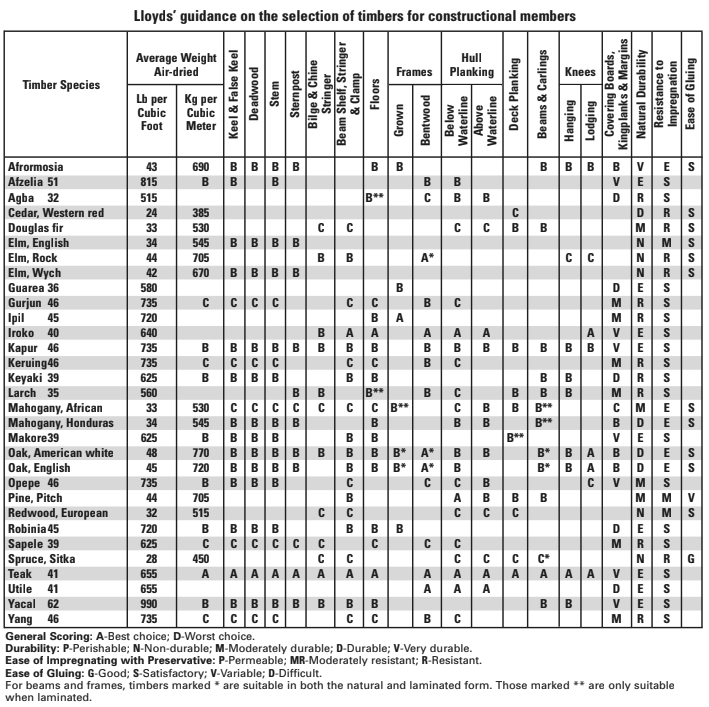
Quality begins with the basic construction and that begins with materials and workmanship. In wooden yachts built in North America, that typically meant an oak backbone and frames, Honduras mahogany planking, and teak decks, all bronze fastened. The table on Page 31 gives Lloyd’s ratings of other native and foreign woods that you may find in yachts built here and elsewhere, and it bears study if you are looking for a quality wooden yacht, new or used.
Strength, too
Of course, the finest woods will not ensure quality unless the various parts of the yacht are adequately strong for the work at hand. This can be assured if the yacht has been classed by Lloyd’s, The American Bureau of Shipping, or one of the European classification societies such as Norske Veritas. Where this is not the case, the buyer can check with Nevins or Herreshoff’s Rules (as laid out in Skene’s Elements of Yacht Design by Francis Kinney) to help ascertain the suitability of the scantlings used, but in all likelihood this will require the assistance of a marine surveyor to determine if the vessel is adequately strong.
Even first-class materials and stout timbers will not produce a quality yacht without true craftsmanship. One sign of excellence in wooden yacht construction is that the boat was built by a first-class yard. In the old days, that meant Herreshoff, Nevins, Luders, Paul Luke, Derektor, Crocker, and similar yards. Overseas yards included Berthon Boat, Abeking and Rasmussen, Plym, Fife, McGruer, and so on.
Fortunately, in the past 30 to 40 years, there has been a substantial resurgence of interest in wooden yachts, and this has encouraged the establishment of many small high-quality builders and yards. New and respected names include Brooklin Boat Yard, Covey Island Boatworks, Legendary Yachts, and Bent Jesperson. These and others are highly capable of producing fine new boats from the plans of good old boats.
Increasing thickness
In the early days of fiberglass there was a crude rule of thumb for the thickness of the typical solid fiberglass-reinforced plastic (FRP) hull supported by taped-in bulkheads and furniture. Basically, the hull thickness was to be one-thousandth of the length of the boat. So if the boat was 31 feet 3 inches (375 inches) long, the hull should be 0.375 inch (3⁄8 inch) thick. It might be a tad thinner or thicker, but that was the general rule for a boat built of the typical combination of alternating layers of woven roving and mat.
Often, the topsides were a bit lighter and the bottom a bit heavier, with further thickness increase down the sides of the fin to a “keel” laminate of 1⁄2- to 1-inch thick or more running from stemhead to transom. For obvious reasons there should also be thickening of the laminate at the mast step and chainplates. This often extends from sheer to sheer on a well-built yacht, both on the hull and under the deck. A few older boats, such as the U.S. Naval Academy yawls, were laminated entirely from woven roving. A number of cheapies were built completely of the weaker mat but, fortunately, most of the latter have been scrapped or abandoned over the years.
Many builders use a core of rigid plastic foam (such as Airex) or edge-grain balsa between the inner and outer glass laminates of the hull. In effect, this makes an I-beam out of the structure, adding great rigidity and strength. I can testify to one 42-foot ketch that hit the rocks at 40 mph! Her hull was cored above the grid. She suffered minimal, and readily repairable, damage with only minor penetration of the inner laminate. Incidentally, “40 mph” is not a misprint; the trailer tipped over while she was being towed cross-country!
Whether solid or cored, the result is a good yacht if the laminate and the workmanship are up to the job. Indeed, one of the finest yacht builders in the United States preferred a solid FRP hull to a cored hull. A test for quality in construction is simply to stand back and carefully look at the boat. Ripples in the gleaming topsides usually mean carelessness in the manufacture of the original mold. This may carry over into the boat. Hard vertical ridges can indicate a poorly fitted bulkhead or chainplate knees, a too-thin hull laminate, or simply bad laminating.
Increased stiffness
The decks, even in good old boats, were usually cored with edge-grain balsa to increase their stiffness. Some Asian yards, however, used the balsa on the flat, and this can result in rot spreading if water penetrates the outer laminate. A few builders prefer waterproof-glued plywood, which has the advantage that you can bolt down hardware anywhere, but it is heavier. With balsa-cored decks it’s important to have a large backing plate below all fittings to spread the load and reduce the chance of crushing the core. Every deck fitting must be set in good quality sealant. The careful builder will use resin to seal the edges of any holes cut or drilled through the laminate, or at least dip the bolts in resin before they are pushed home to keep water from getting at the edges of raw laminate or balsa core.
The hull-to-deck joint is a weak spot on many FRP boats, and the best quality yachts will have the joint well-seated on a wide flange, set in 3M 5200 sealant or its equal with through-bolts fitted every 6 inches or so. A few top builders even fiberglass tape over the joint after sealing and bolting. That is quality and ensures a strong, leak-free joint. Check carefully on older boats for softness in the deck itself due to core rot and for weakness of the overall structure by jumping up and down. Also give a good pull on the lifeline stanchions. They will feel rigid on a quality hull with little movement at the deck or in the tubing. No lifelines at all are preferable to inadequate ones. If the stanchions flex to excess, there is a chance they have inadequate or no backing plates or that the deck/hull joint itself is weak.
Not true quality
Many sailors love the look and the footing given by a teak deck but, in my opinion, too many of the teak decks are simply “gold plating” and not true quality. Too often the teak is very thin, and the plugs covering the fastening heads are even thinner. These soon start popping out to reveal the screw heads, which are usually stainless steel rather than bronze. Water eventually gets into the structure, whether it is a plywood subdeck or the balsa core in an FRP laminate, and then you have the makings of serious trouble with corroding screws and rot.
A small but significant sign of quality in workmanship is the proper fit of hardware. The installation of the portlights may provide a clue. Too many yachts have shiny brass or stainless-steel rings around the outside of their opening portlights and windows. In the good old days, this was a sign of sloppy workmanship. Today it can mean that the workman installing the port did not have the skill to make a close fit. The result was a gap between the metal casting of the port and the wood or fiberglass cabin side, which was then hidden by a cheesy metal trim ring.
A proper fit can be made, even in an FRP yacht. I insisted on proper installation of the oval bronze ports on my Nimble 30, and they were — a tight fit and no ugly trim rings! Unfortunately, the metal trim ring seems to be widely accepted today; so many buyers say “lovely” when they should think “hiding bad workmanship!” However, many modern ports are designed to clamp the fiberglass cabin sides, and there is no way to install them without trim rings. In any case, the slots in the heads of the machine screws should all be aligned fore and aft or, in a wood yacht, countersunk and plugged so as to be invisible. That is quality.

Varnished brightwork
The interior of the yacht will also express the general quality of workmanship. Finely varnished brightwork and slick paintwork are an indication, of course, but can also blind a buyer to other faults and omissions. A real teak-and-holly cabin sole (not thin plywood teak and holly) is a good sign, as are well-rounded corners on the furniture, a dust trap on the cabin sole, drawers that open and close smoothly and stay closed in heavy seas, well-ventilated locker doors, strong fiddles on locker tops, a decent trash bin, well-insulated icebox or fridge, and, of course, quality brass, bronze, or stainless-steel hardware throughout. A small magnet is a handy tool for checking that hardware is not simply plated steel.
Access to the hull is vital for maintenance, so the fine yacht will have removable sole panels and berth bottoms. These panels will be locked in place so they can be opened quickly in an emergency but cannot go flying about, spilling their contents in case of a knockdown. Removable overhead panels and furniture will give access to the wiring and permit the inspection, tightening, and fitting of deck hardware. Up on deck, the quality yacht will have generous Dorade vents, and the thoughtful builder will fit shut-offs below so the vents can be closed in cool weather.
Both good and bad builders obtain their engines, machinery, controls, and other major components from the same manufacturers, so there is little to choose between them in this regard. The difference lies in the quality of care that goes into the installation of these components. Unfortunately, it is not always possible to discern the strength of engine beds, the adequacy of stuffing box installation, or the security of tank mountings in a quick inspection. But a sailor can tell a lot by simply checking the neatness of the engine room, the lack of which is a sure sign of careless installation and poor workmanship.
Neat wiring
Quality will show in the general organization of the machinery space; in the installation of wiring runs and piping; in the cabling and color coding of wiring; in the labeling of wiring, piping, valves, and seacocks; and in the proper support of piping and wiring at regular intervals, with attention to chafe prevention. Is there a wooden plug alongside each seacock? The engine and stuffing box should be readily accessible for maintenance, and the engine space should be well insulated for sound and well ventilated. A blower is imperative with a gasoline engine, of course, but is also useful on a diesel installation to rid the engine space of excess heat after the engine is shut down. Large-volume manual bilge pumps, such as Whale or Edson, are a reassuring sign that the builder cares, even when a husky electric pump is fitted.
One sign of quality is a heavy-duty battery box with a ventilated cover and tiedowns strong enough to ensure that the batteries will still be in place after a 180-degree roll. The batteries must also be accessible for maintenance without requiring the skipper to be a midget or contortionist. The tanks should withstand the same 180-degree roll, but that is not always easy to judge. Obviously the best engine in the world is worthless unless it will start, so heavy-duty fuel filters are a must, and the fuel fills and vents must be such that water cannot enter the tanks. A very nice touch on larger craft is dual filters set up so one can be changed while the engine continues to run on the other. A simple method of checking the tank level — tank gauge or dipstick — is essential to avoid that letdown feeling when the engine tries to run on air.
Tapered spars
Quality in the rig begins with the mast. The finest yachts will have their spars properly tapered above the spreaders to reduce weight aloft. Chainplates will be fitted with toggles, and headstays and forestays will have toggles both top and bottom. The upper toggle is too often omitted, unfortunately, and this can promote stress in the mast- head fitting over the years. Rigging end-fittings, if swagings, will not show banana-like bends or cracks if the rigger is a careful workman. However, most sailors will prefer renewable and less problem-prone Sta-Lok or similar fittings, particularly on the lower ends of the rigging.
If the halyards are inside the mast, the builder should ensure that they can be inspected and replaced at sea. Otherwise, halyards are better outside where they can be checked and maintained. I simply cannot understand the reason for the modern fad of internal halyards on cruising yachts. Seeing your spinnaker go over the bow while hundreds of miles offshore is not pretty, as I can testify from experience.
Proper metals are also a sign of the quality of materials used in wood and FRP yachts. Aluminum bronze (91 percent copper, 7 percent aluminum, 2 percent iron) and silicon bronze (96 percent copper, 3 percent silicon, 1 percent manganese) are both highly acceptable marine metals. The latter is the choice for fastenings in wood yachts as well as for propeller and rudder shafting in wood and FRP vessels. Aluminum bronze is excellent for weldments such as hull and deck strapping, mast steps, engine beds, chainplates, and floors. Manganese bronze (58.5 percent copper, 39.25 percent zinc, 1 percent iron, 1 percent tin, .25 percent manganese) is used for propeller hubs and blades, but commercial brass (65 percent copper, 35 percent zinc) should never be used under water. Its only function on a yacht is for nameplates, trim, and screw fastenings where corrosion resistance and strength are not important, such as on internal furnishings.
Joined athwartships
“Floors” in a wood or metal yacht are the athwartship parts that join the heels of the frames and connect them to the keel. They can be wood or metal in a wooden yacht and, in a metal yacht, they are of the same material as the frames, of course. In an FRP yacht, the floors are usually of fiberglass or fiberglass over plywood, bonded to the hull. Many modern FRP yachts will have a grid system incorporating floors, mast step, and even tanks. This is glass taped to the hull to add the necessary strength. Unfortunately, a few fiberglass yachts are built without floors, and this can be taken as a lack of strength and quality. Generally, while there will be a floor on every frame in a wood or metal yacht, the rule for an FRP vessel is that there should be a minimum of three floors in way of the ballast fin or keel, and additional floors should be fitted to spread the stress and support the hull below mast steps and engine beds.
Of course, bronze shafting, seacocks, and chainplates should never be used on a steel or aluminum hull, as corrosion will begin the instant she is launched and will progress rapidly. The only answer is stainless-steel alloys such as Aquamet 17 for shafting and type 316 or 316-L stainless steel for seacocks and other parts. The problem of mixing copper-based and aluminum metals was demonstrated the hard way when, back about 1919, Capt. Nat Herreshoff built a large racing yacht with aluminum plating on bronze frames. She was scrap when she was barely a year old!
A point to note is that brass screws and bolts should not be used where they are subject to the elements, even on deck. When commercial brass is exposed to a salty atmosphere, the zinc is eaten away, leaving only weak copper, which quickly fails. That was a problem on a couple of the boats I’ve owned. Nuts too often simply broke off the corroded brass bolt, which then had to be replaced with a bronze fastening.
Needs oxygen
Definitely, for wood or FRP yachts, bronze is the metal of quality. The problem with stainless steel is that it depends on oxygen to repair itself by creating an oxide film, and it is therefore subject to crevice corrosion when oxygen is not present. This crevice corrosion manifests itself in stainless-steel keel bolts, tank seams, wire end swagings, and similar parts that are continually wet with a thin film of water. The stainless steel leaches the oxygen out of the water and then starts to corrode when there is no replacement water with its oxygen source to replace the old. There is, undoubtedly, a better way to phrase this but the reader may understand when I say that I have seen crevice corrosion failures of stainless steel in keel bolts, chainplates, freshwater tank seams, rigging swagings, and in the shaft underneath a tightly fitting bronze propeller hub.
The problem is worsened when stainless steel is used with a metal superior in the galvanic scale, such as lead or bronze. In my opinion, stainless steel should not be used for fastenings in wood yachts, for tanks, or keel bolts in lead keels. A point to note is that the U.S. Coast Guard does not approve of stainless-steel fuel tanks, due to corrosion problems. I’ve seen a costly stainless-steel engine exhaust system pinholed by diesel exhaust within a year. Galvanized iron bolts are superior to stainless steel in an iron ballast keel, again due to problems of crevice corrosion. Aquamet 17, a form of stainless steel used for propeller shafting, is quite acceptable but needs the protection of proper zinc anodes for reliable service. It took many years for designers and builders to discover the problems of stainless steel, so you will not find many older FRP boats with bronze keel bolts, chainplates, and so on. At least you will know where to look for potential problems.
The foregoing is but a short list. I’m certain many readers will have their own favorite signs that are indicative of quality and craftsmanship. I presume that most of our readers will be more concerned with used boats rather than new ones when they get that crazy itch to move upward a couple of feet in size. So I will say this just once: do not let your heart rule your head! Do as I say, not as I’ve done (to my regret): get a qualified marine surveyor to check out your dream ship after you have checked it for quality and before you sign the check.
Thank you to Sailrite Enterprises, Inc., for providing free access to back issues of Good Old Boat through intellectual property rights. Sailrite.com