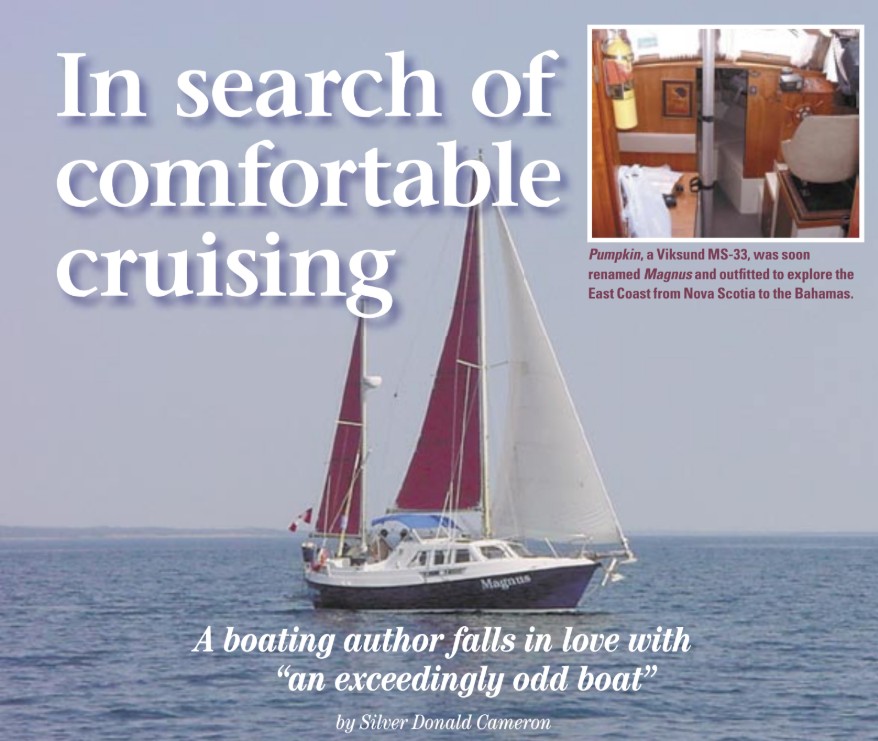
A boating author falls in love with “an exceedingly odd boat”
Issue 34: Jan/ Feb 2004
PUBLISHERS ARE PUPPETEERS. Writers are marionettes. On a summer day in 2001, I had a call from Doug Gibson, of McClelland and Stewart, who modestly style themselves “The Canadian Publishers.”
“What are you writing?” he asked.
“A novel.”
“Admirable,” said Doug. “But what about non-fiction?”
“Nothing.”
“But surely you have a book you’d like to write.”
“Nope,” I said.
“Come, come,” said Doug. “You must have something in the back of your mind.”
“Well,” I allowed, “I’ve just put an engine in our boat, and it has occurred to me to sail her to the Bahamas via the Intracoastal Waterway and write a book about that.”
“Sailing Away from Winter!” cried Doug. “Great! Who’s publishing this book?”
“It’s not a book,” I protested. “It’s just a foggy fantasy.”
“I’m going to make you an offer you can’t refuse,” he declared, and he did. If you’re getting paid for sailing, resistance is futile. I agreed to cast off in July 2003 and submit a manuscript the following spring.
An alarmed wife
My wife, Marjorie, evinced some alarm.
“Beloved, Silversark is wonderful,” she said sweetly, “but she is, um, very small. She has 5-foot 1-inch headroom and 20 square feet of living space. It would be like spending a year in a piano box.”
Darn. Our beloved 27-foot cutter was designed for crossing oceans, but not for living aboard. She does have a reliable engine, a double berth, good social space, a well-planned galley, a comfortable cockpit, shallow draft, and two tables, so two writers could set up their laptops separately. But she lacks headroom, a shower, refrigeration, and such electronic niceties as radar and autopilot.
Furthermore, I have long believed that an intelligent sailor in Nova Scotia’s climate would have an enclosed steering station and a furnace. Only people who go to sea for pleasure would insist on a helm drenched by the cold, wind-driven rain, and spray. Only a chowder-head would cruise Nova Scotia without heat, as I did for 17 years. That’s why yachts haul out in October, while our fishermen sail all winter.
I checked the web. Yachtworld.com listed 51,580 yachts offered for sale by 1,499 brokers — and just 130 were pilothouse sailboats between 32 and 38 feet. Almost all were too big, too small, too awkward, or too expensive. They were located in Greece, Slovenia, Norway, and Thailand. A few were in New England and Ontario. One looked perfect — a 34-foot Westerly Vulcan, located in Newfoundland. Alas, she was apparently the only Vulcan in North America, and another Nova Scotian had already bought her.
In desperate shape
After a few weeks, I discovered British Columbia. Happily, British Columbia was in desperate shape. Fishing, lumbering, and mining had all tanked at once. A new government was slashing jobs and services. British Columbians were not dreaming of buying yachts. They dreamed of avoiding bankruptcy.
The web described several affordable pilothouse vessels in B.C., including a beautifully finished 35-foot Endurance cutter named Yucatan. B.C. sailors would call her “skookum” — strongly built, powerful, substantial. She had all the features we wanted. A salty B.C. friend scrutinized her and loved her. The broker answered endless questions satisfactorily. The shipping cost would be daunting, but we factored it into our offer. The owner accepted. Our credit union authorized a truly skookum loan. In late April we flew west.
Yucatan was splendid, even better than we had hoped. But she had an astounding, utterly unexpected flaw. From the inside helm, the helmsman could see the bow of the boat and little else.
“Well, you can’t see out of most pilothouses,” shrugged the surveyor. But what’s the point of “inside steering” if you can’t actually steer from inside? We withdrew our offer.
A good sailor always has a Plan B. There were hundreds of boats for sale in B.C. For 2 weeks we prowled the coast from Anacortes, Washington, to Halfmoon Bay, British Columbia.
We did find vessels with usable pilothouses. But the enchanting Pacific Pilot was no larger than Silversark. The pilothouse of the New Bombay Clipper 31 seemed flimsy, and the interior was inflexible. The elegant Truant 37 was too expensive. The North Sea 34 was a workmanlike boat, plain, spacious, and simple. But her interior was finished with gray fuzzy stuff called “mouse fur,” and enormous clouds of smoke billowed from her exhaust.
A new focus
We moved our focus to center-cockpit yachts with fixed dodgers and aft staterooms. The Warrior 35 was profoundly tired. The Pacific Seabird 37 had an ungainly forward cabin. The Finnsailor 29 was small, well-designed, impeccably maintained. But with her stubby rig and shallow keel, she would sail like a 45-gallon drum.
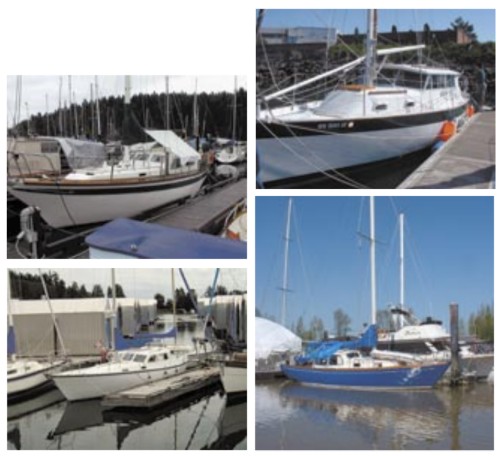
We located a center-cockpit Buccaneer 320 up the coast, built by Bayliner, the powerboat manufacturers. Not an inspiring pedigree. Her name was Morning Wind. Think about that. The Melancholy Slav who owned her would not fax us the particulars. We approached her with low expectations.
“This ees a trragedy,” declared the Melancholy Slav, unlocking her. “My vife cannot sail, and I have injured my back. So my future ees not on the ocean. But I luff thees bot.”
Small wonder. She was designed by the brilliant William Garden, and she had a more ingenious, livable interior than one would think possible in 32 feet. A private stateroom forward was followed by a lounge stretching right across the boat. To starboard, beside the companionway, was a full-sized head and shower. To port a passageway led to an aft cabin with a full-sized double berth and a second head. The passageway contained the galley and also gave generous access to the diesel. She was well-priced and well-equipped.
True, she was high-sided and boxy. Practical Sailor once cruelly commented that these boats look like layer cakes on the water, and they are only tolerable sailers. But her insurmountable problem was the Melancholy Slav himself. He had two surveys, and he would not permit another. Nor would he arrange a sea trial.
Protecting her name
“I have to save the name of my boat from smear,” he explained in an email. “Evil rumors will go around the coast if the boat keeps going up and down the ways without selling or out to sea for trials and don’t sell.”
“You see what’s happening?” said Marjorie. “He luffs this boat. He doesn’t vant to sell it. He’ll put up one obstacle after another until we quit. So let’s quit now.”
We flew home to Nova Scotia.
“Morning wind and mouse fur,” said Marjorie. “It’s been an education.”
We had intended to spend the summer of 2002 in shakedown cruising aboard our new boat. Instead we continued to trawl the web and prowl the boatyards. The LM-32 was lovely, but pricey. The Colvic Victor was sold. The Gulfstar 36 and the steel-built Fisher knock-off both had clumsy interiors. An acquaintance suggested I call King Nener, a retired airline pilot with a 34-foot Dutch-built Rogger motorsailer. Nener’s health problems had kept Seeboll on the beach for 3 years, but he utterly refused to sell.
“I don’t need the money,” he said. “I’d only lose it on the stock market. Also, I subscribe to the belief that he who has the most toys when he dies, wins!” But he applauded my impulse. Seeboll, he said, was seakindly and easy to handle. With a fair wind, the big roller-furling genny shoves her along at 6 knots. And otherwise?
“Forget about going to windward,” Nener smiled. “There’s an old saying: ‘Gentlemen do not beat to windward. That’s what Mr. Perkins is for!’”
A motorsailer, it appears, is an elderly gentleman’s easygoing boat. Did it follow that I was morphing into an elderly gentleman? Oh, all right, it did. But where would I find an elderly
gentleman’s boat?
Only a few imported
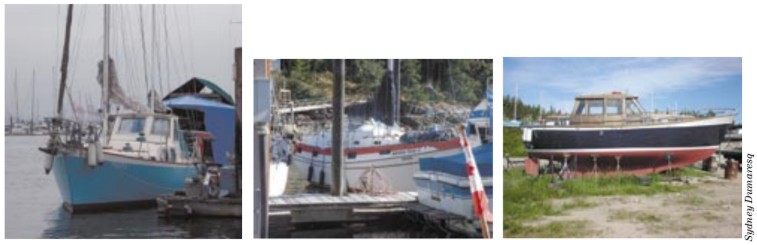
During the heyday of fiberglass boat-building, motorsailers were built mainly in Europe and on the West Coast, for sailors in cold, blustery waters like the North Sea, the Baltic, and Alaska. Only a few were imported into eastern Canada. Which brings us to an idiosyncratic German we’ll call Horst.
Horst imported Seeboll when he immigrated to Nova Scotia in the 1970s. (The Old German name means “lump-fish.” Horst had the soul of a poet.) In 1984, he sold Seeboll to King Nener and bought Seeboll II — the very same Westerly Vulcan that captivated me months before. Neither Seeboll was for sale, and Horst bought no more motorsailers. Eventually he gave up sailing altogether, says King Nener, and bought “floating streetcars with huge engines.”
We found a Finnish-built Nauticat 33 lying neglected on Nova Scotia’s South Shore, but — like Morning Wind — Moomintroll was only nominally for sale. Her owner, Chops Viger, cheerfully conceded that he was poorly motivated. He had set his price. If I wanted to pay it, fine. If not, not. Good-bye.
There’s a pattern here. Motorsailer owners hate to sell. And there’s a certain poignancy in this. Motorsailer owners are independent spirits — pilots, professionals, entrepreneurs. They march to their own drummers. They don’t care if the high-testosterone crowd at the yacht club bar scorns their boats as “not real sailboats,” and they’re not saving for the future. This is their future. They can generally afford to leave their boats on the beach for years, if need be. They love sailing, and they don’t want trawlers, but they do want more comfort than a traditional open-cockpit sailboat provides. So they buy motorsailers — and when they can’t sail anymore, they just furl the sails and motor.
They’re realists. They know their motorsailers are their last boats. Selling will mark the end of one of the great joys of their lives. Their heads say “sell,” but their hearts rebel.
Pain of leaving
What I see here — and honor — is the love of boats and the sea, and the pain of leaving it behind. Wind in your face, the roar of the bow wave, a hammered silver sea. If you don’t have to kiss it good-bye, why should you? I will be exactly the same when my turn comes.
But it wasn’t my turn yet. And I still wanted a motorsailer.
In September, a curious boat named Pumpkin surfaced on the web, a Viksund MS-33 built in Norway in 1973. Never heard of a Viksund? Neither had I. But mid-September found me standing on a wharf near Detroit, cell phone to my ear.
“She’s an exceedingly odd boat,” I said.
“So she’s off the list?” Marjorie asked glumly.
“Not yet,” I said. “We’ll talk again after I sail her tomorrow.”
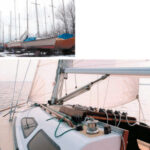
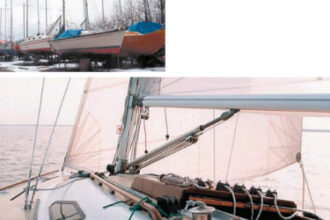
Pumpkin had all the essentials, and what she lacked could easily be added. She was heavily built, with deeply molded non-skid, a hefty rubber rubrail, a stout canvas dodger, handrails everywhere. Her mizzen mast was mounted on the aft cockpit bulkhead, and her wheel on the for- ward one, leaving the spacious center cockpit clear and open. Like other Scandinavian boats, she had a canoe stern. Her two short masts carried a low-aspect ketch rig. Her only exterior wood was the bowsprit, the cabin doors, and the flagstaff.
But she was an exceedingly odd boat.
Her inside steering was far up at the front of her house, behind a car-type windshield complete with wipers. Her working jib hung inside a canvas sausage, while a strangely-shaped sailbag in the rigging contained the genoa. Her trapezoidal portlights may once have been thought stylish. Her cockpit boasted two bar stools and a picnic table. Her afterdeck was crammed with anchors, fenders, fishing-rod holders, man-overboard gear, and unused pinrails.
Phlegmatically handsome
She looked stubby, functional, and seakindly. Handsome, even, in a phlegmatic manner. Still, if your taste in vessels was formed by the lean, feather-lovely lines of Nova Scotia schooners, Pumpkin would take some getting used to.
But then, the next morning, I went aboard with the owner.
I was stunned by her huge, airy interior. Two sets of upper and lower berths forward, and then a saloon with well over 6 feet of headroom — plus a big galley with fridge and freezer, a spacious convertible dinette, a sizable head and hanging locker, and excellent visibility from her inside helm. People could dance in the cockpit. Beneath it was a cavernous engine room with a little-used 35-hp Yanmar. Her roomy aft cabin provided a double berth and excellent access to her skookum steering gear. She was the only boat I had ever seen that seemed bigger inside than outside.
The more I looked at her, the more she looked like intelligence cast in fiberglass.
The Yanmar purred as we motored into Lake St. Clair. The wind whistled, and the racing sailboats were reefed and heeling. With all sails set, Pumpkin surged out into the lake — rolling some, but scarcely heeling at all. She was more stately than sprightly, and in light winds she would be under-powered. But in a lusty breeze she sailed very acceptably. She was not at all what I had in mind, but she was perfect for us — and affordable. Back on the dock, I called home.
“Marjorie,” I said, “we’ve found our boat.”
Pumpkin arrived in Nova Scotia in early November — by truck. Two weeks later, Doug Gibson visited us to discuss the possibility that a book about the Gulf of St. Lawrence would precede Sailing Away from Winter, sending us north, not south, in 2003.
I led Doug to the boat shop. Climbing aboard, he sat at the wheel and gazed through the windshield.
“Ahhh!” he said, smiling. It was all his fault, and he felt not a shred of remorse.
Silver Donald Cameron soon renamed his new boat something more befitting: Magnus. He and Marjorie are enjoying their new boat in their home cruising grounds of Nova Scotia. There are many more books yet to be written by this talented author. The next will, no doubt, feature Magnus in a leading role. –Editors.
Thank you to Sailrite Enterprises, Inc., for providing free access to back issues of Good Old Boat through intellectual property rights. Sailrite.com