Do your homework before you put your boat in charter
Issue 32 : Sept/Oct 2003
The pull to own a sailboat can be understandably strong. So when the temptation looms to save expenses by putting it in charter, examine the plusses and minuses of charter ownership and your personal situation thoroughly.
The charterboat industry surged in the 1980s as the result of attractive tax benefits for boatowners. Jay Kraft, co-owner of Bay Breeze Yacht Charters of Traverse City, Michigan — the state’s largest and oldest charter company — says he seized an opportunity when another operation shut down. “The remaining yachts formed the starting point for Bay Breeze when we identified the need and desire for charterboat sailing in the region and recognized the business opportunity,” says Jay.
The charterboat business took off when President Reagan signed legislation in 1981 allowing tax credits to buy, depreciate, and write off purchases such as boats and other luxury goods. Skip Van Horn, for 20 years the dockmaster at Bay Breeze, remembers those days well. “People would come in with their W-4s in hand. We’d see what they needed to spend and match them with a boat of comparable value,” recalls Skip.
Some of the tax advantages of the ’80s have since disappeared, but would-be boatowners can still make a case for choosing charter ownership. Seek advice from the experts — an accountant, financial planner, or other reliable source. The basic premise is that you own the boat, and you can sail it. In some arrangements, all the maintenance is taken care of for you, usually for a contract period of five years. Costs for dockage, insurance, launch, haulout, storage, and annual inspections are paid by the owner. All marketing, promotion, literature, and personnel costs are assumed by the charter company.
Splitting revenue
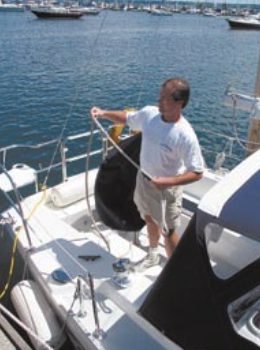
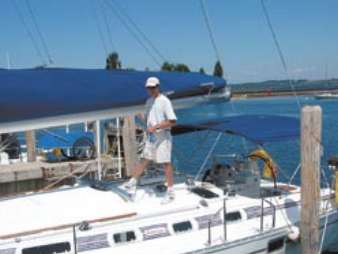
In the case of Bay Breeze, the company and owner split user revenue 50/50, often creating enough income to cover the annual expenses of ownership. “Basically, there are none of the headaches for charterboat owners,” says Jay. “There is the assurance that it’s well cared for with a strict maintenance schedule that we adhere to and share with our owners.” It’s not Jay’s favorite part of the job, but he frequently stands in line in the office of the secretary of state, awaiting licensing papers and tabs and saving boatowners the trouble.
Many charter companies will let boatowners assume some of the maintenance on their boats. Engine tuning and repairs may not be encouraged, however.
What are the downsides of charter ownership? If the idea of someone else using your stuff is upsetting, it may be difficult to put your boat in charter. Wear and tear on the boat can be expected, and there is the very real chance that when you want to use it, your boat will be booked by someone else . . . making money but unavailable to you.
“Chartering is not for the person who wants to use a boat as a cottage every weekend, and it’s definitely not for the controlling, Type-A personality,” says Jay when describing potential charter owners. Since many charter owners are professionals, aged 45 and up, a common complaint is that they are unable to use their boats on the weekends designated for their use, due to career demands and family events. A bargain is only a good deal if you use it.
Another issue is the resale of a boat that goes out of charter. Resale is rarely a problem, according to Bay Breeze, if the company is reputable, carefully screens its charterers, and maintains the boats in the charter fleet regularly and well.
Heavy usage and occasional damage can be a factor, but the more likely problem in the outright purchase of a charter boat could be in winding up with an improperly outfitted boat ill-suited for your needs and therefore in need of expensive upgrades or modifications. In addition, boats used extensively in salt water may be prone to corrosion of fittings and engine parts.
Reputable firm
Putting your boat in charter can be a smart move if you plan to use it regularly but not constantly, and if distance or commitments don’t prohibit you from enjoying your investment. The first step is to find a reputable firm. Check references, look for active marketing programs and boat-show representation, visit the company, and get to know the staff and their level of commitment.
“Some question what the company does for their 50-percent split and feel the boatowner is the one bearing all the costs,” says Skip. “But that’s simply not true. The business relationship starts with trust and seeing firsthand the care and maintenance provided by the charter company. You get what you pay for, and the outcome is far better.”
Consider management companies that also operate well-run sailing schools. It is just one more assurance that all questions are being asked, potential charterers of your boat are well trained, and that answers and help are readily available.
On the other hand
Perhaps all the paperwork, down payments, time commitments, and uncertain economy have you wondering if charterboat ownership is right for you. The perfect solution for some is chartering someone else’s boat. You choose your chartering company, the vessel, when you want to sail, and where. You book it, pay for it, enjoy it, and leave the details of ownership behind. Many use chartering as a way to explore other parts of the world by sail. It makes sense and enhances their own boat appreciation and expectations.
Skip thinks chartering is the way to go. “Personally, that is what I would do,” he says. “You can spend two grand or less with two couples, have a great time, and just walk away.” In the northern climes of the Great Lakes, the short 15-week season is a consideration for winter charters farther south.
Whether it’s your boat in charter management or a week-long bareboat charter, look for reputable companies in order to avoid disappointment. A successful arrangement can make the difference between an unfortunate investment and many wonderful hours of exhilarating sailing . . . on your boat or a charter of your choice.
As Jay says, “How do you put a value on that kind of fun?”
Thank you to Sailrite Enterprises, Inc., for providing free access to back issues of Good Old Boat through intellectual property rights. Sailrite.com