Prioritize your upgrades
Issue 3 : Nov/Dec 1998
At Good Old Boat, we recently received an email letter asking us to list some good old boats and put a price on what it should cost to upgrade them. While it would be nice to develop a simple rule of thumb, we were at a loss. However, it got us to thinking about upgrades. What follows could save you some money.
Odds are you’ve heard that promise before, and you’re skeptical because what usually follows is an invitation to spend some money now to avoid spending more later. Worse, the money spent now is very tangible while the avoided expenses are usually a little fuzzy. At ease. This is not one of those.
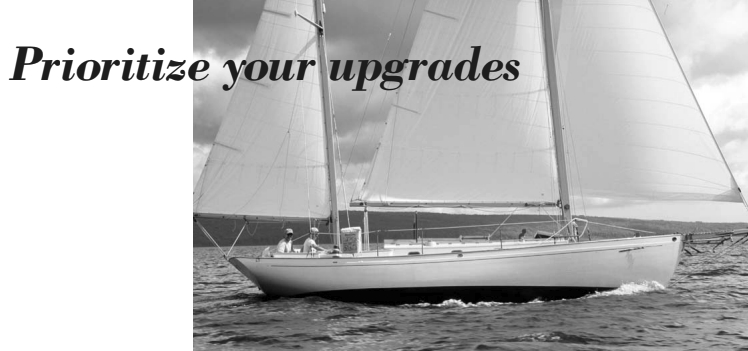
Picture in your mind’s eye a beautiful good old boat sailing in a beautiful place in the same year she was built and commissioned. The crew members are all smiling. They are competent recreational sailors thoroughly enjoying themselves. It is a lovely snapshot in time. What is missing in the picture? Be historically accurate now. Got it yet? When that boat was built, many of the upgrades we might hang on it today didn’t even exist. Many of the ones that did exist were not common. What you’re conjuring up is a fairly simple good old boat, one which is making the crew happy and working well without most of today’s upgrades.
Let’s start with that reference point instead of the one we commonly carry around in our heads in which there are so many things “you gotta have” on your boat. The implication is that if the boat was a good design to begin with, if it has been well maintained, and is being used as the designer intended, it may not need any upgrades. This is a radical departure from the advertising copy you may be accustomed to, so let’s go step by step.
Rule Number One: Maintaining and upgrading are different activities. Good maintenance does not require adding new gear.
Rule Number Two: The “best boat” must be understood in the context of the best boat for a particular owner and crew. They must be able to afford, understand, and work it. It should be well-suited to the ways they use it in the area where they use it. Using a bluewater voyager for day sailing and coastal cruising is an expensive equipment mismatch, unless that bluewater boat really will be heading out to sea in the foreseeable future.
Rule Number Three: The “necessary upgrades” for a boat should be determined by the locale and the use.
Rule Number Four: The “optional upgrades” should be understood to be just that.
Rule Number Five: Upgrading one kind of boat until it is another kind of boat is an expensive plan that rarely produces a fine boat. Daysailers, weekenders, coastal cruisers, bluewater voyagers, and racing boats are all designed with their primary function enhanced at the expense of their secondary functions. All design is a compromise.
Most new boat advertising tries to make you believe this is not true. Manufacturers and distributors often paint a picture of a boat that maximizes interior space and convenience. It has accommodations for a large crew and is extremely fast, seaworthy, comfortable, and safe. It is solidly built but wins races and can be sailed short-handed by a couple. In short, it exceeds in all areas.
Sorry, all design is a compromise, and the best boat designers were the ones who made the best compromises. Even the term “best compromises” must take the intended use into account. If your boat’s essence and spirit are in the lightness and quickness of her design, adding tons of gear to make her a voyager will prove disappointing. Tread lightly.
Rule Number Six: Speaking of lightly, upgrades not only cost heavy money, but they also add weight. Regardless of the type of boat you have, add weight sparingly. Too much gear can crush the spirit of a club racer and compromise the properties of a voyager. If you sail in an area where an all-chain anchor rode is not needed, use rope. It is much lighter and easier on you and your boat. The same is true of anchors. Heavy ground tackle will often require a heavy windlass. This is going to be up in the bow remember, not in the keel. Think twice before upgrading all that ground tackle to the point where you can’t lift it without an expensive, heavy windlass mounted high and forward.
Those are the concepts. Now let’s apply them. First, just so you understand what’s at stake, make a list of all the upgrades you can think of that you might want on your boat. Then get out a catalog and add up the cost in dollars, hours of installation and modification, and pounds of added gear. Don’t be surprised if the costs are a significant percentage of what you paid for your boat. Even the weight may be a significant percentage of the boat’s weight. Be careful to look for the domino effect, in which the increased electrical usage requires a generally upgraded system, and the improved anchor gear requires a windlass. Last, look where the weight will go. Lower is better than higher. Too much weight in the ends is not good either. New toys on the mast take away stiffness. The higher they are, the worse they affect the properties of the boat.
With the list prepared, determine the purpose of each upgrade. Common purposes may be:
- Replacing weak, worn, or obsolete and defective equipment.
- Enhanced safety.
- Improved navigation.
- Improved communications.
- Improved speed.
- Improved comfort.
- Improved convenience
- Adding to or changing the “mission” of the boat.
- Just plain novelty.
Make your own list of purposes, but be honest about why you would want a particular upgrade and what you hope it will do for you. Note here not what the ad copy says it will do for everybody, rather what you hope it will do for you.
Next, list how you use your boat. Include all the types of uses the boat has been put to in the last few years and will be put to in the next few years. These might be:
- Daysailing.
- Weekend sailing.
- Coastal cruising.
- Long-distance voyaging.
- Racing (perhaps even list the types of racing).
Again, make your own list. Try to avoid the “I-think-I-might-want-to-sail-around-the-world-someday” type of thinking. Be realistic. Now apply Rule Number One: Forget about upgrades until all the maintenance is done and done well. If you buy some new gear in the process of making things work, that’s fine. For example, it may not be cost-effective to repair a 1966 depth sounder. Replace it. That’s not really an upgrade in the sense we’re talking about here, even though the new instrument may have more features than the old one. New sails, standing rigging, and the like are not really upgrades for the same reason. They’re maintenance.
To apply Rule Number Two, look at your boat and how you use it. Only when comparing your boat and crew to the intended uses can you determine what reasonable upgrades may be needed, which are optional but will enhance some important aspect of your sailing experience, and which are expensive mismatches.
For example, if you really only daysail in very familiar waters with a very shallow-draft boat, the only instrument you may need is your weather radio at home. You will probably want a compass and depth sounder if you have a vessel with a deeper fixed draft and you could get caught in situations which you can’t navigate “by eye.”
Rule Number Three should help you remember to review how and where the boat is used. Go ahead and pick some upgrades. Now look at each one in terms of its cost, weight, and the possible domino effect. Because you have made a list of the intended enhancements that these upgrades would provide and what they will do for you — not in general terms but in specific terms considering you, your boat, and how you use it — you can ask the next question. It is:
Given that I will spend that much money and add that much weight, is this the best way or are there better ways to get the enhancement I want?
Will you, for example, sleep better at night with a plow anchor and 300 pounds of all-chain rode or with two smaller, lighter anchors set Bermuda-style on nylon rode? The smaller anchors and rodes may cost the same or less, and you can lift them without a windlass. Identify the enhancement, then find the most cost- and weight-effective way to get it. Don’t go for gear, go for what it does for you and choose from alternatives.
Rule Number Four helps you know when you’re considering optional upgrades, as opposed to necessary upgrades. There are gray areas here, but think of it this way: all the gear that goes in the category of “that would be nice (or even really, really nice), but I don’t need it today,” is optional. Optional upgrades are OK to have on a boat but not until the necessary upgrades are in and done. In the list above, for example, replacing weak and worn or obsolete and defective equipment, enhancing safety, improving navigation, (and maybe) improving communications might be the necessary upgrades for your boat. However improving speed, comfort, and convenience; adding to or changing the “mission” of the boat; or adding novelty items would fall in the optional upgrades category. Mark your own list to help you remember when you’re considering something optional.
Rule Number Five is the one that has to do with changing the mission of the boat. Many good old boats were designed as dual-purpose club racers. By appealing to one of several rating or handicapping systems, it was hoped that a family coastal cruiser could be a competitive racer as well. To some degree this worked, and a lot of sailors got a chance to try racing as well as cruising without having to support two boats.
You may well be the owner of a racehorse that has been put out to pasture, and you probably want to go cruising with it. In the case of these dual-purpose boats, this works fairly well, provided you keep some things in mind. Every boat has a spirit or personality which is the sum of what the designer put into her lines and specifications and what the builder put into her construction.
This gets a little gray, too, but hang in there, it’s an important point. There will be some things that the boat does very well. These will be the things you enjoy doing most with that boat. Be very careful not to harm the best characteristics of your boat in an effort to change the mission capabilities of the boat. Adding a large three-bladed prop to a fast light fin-keel boat is an example of this. It is possible to modify a boat until it doesn’t do anything well. It is difficult to enjoy a boat like that.
Club racers can take on some weight before they become overweight, slow, and sluggish. A rough estimate would be to weigh the intended racing crew (say four or five deck gorillas) and consider the ones you will not carry when cruising as the weight you can add without too much harm to the properties of the boat. If you cruise with two, you can add three-gorillas-worth of gear, and she will still float on her lines. The added gear will not immediately jump to the high side in a tack, so she will not be as fast as she was in racing trim, but she will be good enough for cruising.
Heavier boats, boats with long overhangs, and those that never made any pretensions about being dual-purpose club racers can usually take on more weight gracefully. It is important to recognize however, that you can add enough weight to ruin the properties of any boat. As you consider your upgrades, think about what they weigh. Remember that if you want to cruise, you will take on heavy stores. Leave room for them in your weight budget.
There are some upgrades that are definitely worthwhile. Good life jackets you are willing to wear are worthwhile, as are good foul weather gear, sea boots, and deck shoes that will grip a wet deck. The newer man-overboard recovery equipment is also worth the investment. Every boat with an inboard engine should have a minimum of two fuel filters also. If you have a reliable, but aging, Atomic 4 in your boat, take care of it, and don’t change a thing except maintenance items. If it does not always start and run the way you want it to, there are upgrades for it that are worth the cost.
Some upgrades seem to offer little bang for your buck. Electronic wind speed and direction repeaters cost hundreds of dollars and are almost as good as an experienced sailor looking at a dinghy sparfly or a tuft of yarn. These electronics seem to have a high failure rate, probably because in many cases they are working year-round.
There are many advances in navigation and communications that have taken place since the majority of good old boats were built. If you need it, GPS costs very little and provides a valuable margin of safety. Like everything else on a boat, it will eventually fail, so you need to know how to navigate without it. Learn to do that, and practice doing it regularly so you have the equipment and skills ready when that little gem takes a timeout.
That’s it. What’s good is only what’s good for you. Evaluate your boat, crew, and usage, and upgrade accordingly. Experienced sailors respect seamanship, not equipment lists. Perhaps this kind of thinking will save you some money and help you fit your boat out in a way that is right for you.
Thank you to Sailrite Enterprises, Inc., for providing free access to back issues of Good Old Boat through intellectual property rights. Sailrite.com