Cost-effective sailing vacations; let us count the ways . . .
Issue 32 : Sept/Oct 2003
Sailing and sailboats (and perhaps life in general) are all about compromises. Sometimes it would be nice to sail in the body of water near home; sometimes you’d rather be somewhere warmer, cooler, or more exotic. Although you may prefer to sail on a boat you’re familiar with, you may not have the time or money to own and maintain your own. In fact, having your own boat means maintaining it, which takes away from sailing time. Chartering a boat has advantages and disadvantages. Having a trailersailer solves some problems while creating others.
These days, there are some new and compelling alternatives to consider. These cruising alternatives include trading time on your boat for time on someone else’s boat in another location, jointly owning a boat with others in a new kind of partnership, and buying regular timeshare vacations on boats.
Sailboat Exchange
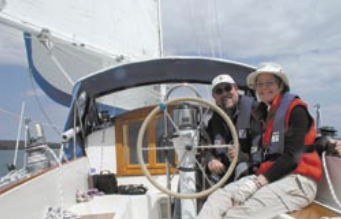
Tom McMaster and Rose Hansmeyer are Lake Superior sailors with an itch to travel and a frustration with long cold winters when their sailing season is on hold. Chartering seemed expensive to them since they also had the expense of owning and maintaining their own Alberg 37. A year or so ago, they discovered a website offering to match sailors willing to trade time on their boats for a like vacation in a different location. They were interested in learning more. The site owner was too busy but looking for a way to continue the service. Before long, Rose and Tom had agreed to take on the site and the matchmaking responsibilities that went with it.
“The beauty of a sailboat exchange is that it allows you to avoid the high cost of chartering by simply exchanging the use of your own boat,” Rose says. She is the first to acknowledge that owners have some concerns but believes that exchanging parties would treat the other boat as well as their own . . . or maybe better. The benefits outweigh any concern.
Because Rose and Tom help “likeminded sailors” find each other for a boat exchange, the arrangement between the boatowners is as formal or informal as they wish to make it. Each party chooses whether they want to make the exchange based on feeling comfortable with the other party’s experience. They might even choose to spend a weekend or a day sailing together prior to releasing “their baby.” The exchange can even be for a few days while they are visiting a city on business. Good friendships are made this way, in much the same way that foreign exchange student arrangements are sometimes reciprocal and often wind up creating lasting relationships.
As Tom notes, “We felt it (taking over the responsibility for this website) would benefit not only us, but also other owners who have a similar desire to explore the world.” He points out that the advantages of this informal arrangement include a reduced cost when compared with chartering and the ability, when planning a trip itinerary, to get local knowledge from people who live or cruise in the area. Just as with chartering, sailors can choose a new cruising location. They gain the ability to cruise in areas too far or unrealistic to reach with their own boats. Northern sailors can extend their cruising season in the winter, and southern sailors can go north to beat the summer heat.
Sailboat Exchange has listings for abut 130 boats from all over the world. There is a small membership fee that helps support the website hosting and program marketing. Tom and Rose do this as a hobby. They agree that this sort of work is done for the love of it and the ability to interact with and help other sailors. Theirs is not an income-producing adventure.
Fractional ownership
Fractional ownership is a boat partnership with several advantages and fewer of the disadvantages of most informal partnerships. You no longer have to coerce Uncle Joe and three friends into sharing boat payments and maintenance with you. And you won’t lose the goodwill of your friends or family members if the relationship goes sour. Great Blue Yachts, a company founded by Rick and Lisa Sabol, helps you find two co-owners, keeps the partnership on a businesslike level, and leaves you and the others to choose how much maintenance to do and what upgrades to make.
This is a hands-on program. In fact, Rick and Lisa call it a “Hands On” membership. There are no professional cleaners. You take the boat out yourself and clean it up for the next folks. It is, after all, your boat. You and two others share the costs and time aboard in equal thirds through a Limited Liability Company, or LLC. If you already own a boat and don’t have much time for it lately, you can place it in this Hands On arrangement with the help of Great Blue Yachts. And you can do it in your own cruising grounds. This is not about long commutes or vacation charters in exotic locations.
If you want to get out of the agreement, you can sell your third share without the tax consequences associated with selling a boat. You are selling a share, after all. Great Blue Yachts began arranging fractional ownerships on the Chesapeake Bay helping sailors there who bought new boats together. But the program is gradually growing up and down both coasts, along the Gulf of Mexico and throughout the Great Lakes. And “experienced boats” (read: good old boats) are also being included these days.
The beauty of the one-third-share arrangement is that the owners share one third of the costs (loan payments, slip and storage fees, insurance premiums, maintenance, and upgrades) while using the boat for just one third of the season. For many sailors, this split is more realistic anyway since family events have a way of stealing precious sailing weekends from even the most dedicated among us.
“Though most of us would love to sail each and every weekend, the reality of it is we can only use the boat about every other or every third weekend,” Rick says. “Life happens; you have weddings, graduations, and children’s soccer games to attend. Sailing is put on the back burner.”
Rick plays matchmaker, connecting sailors. He handles the purchase, along with scheduling, insurance, and marina arrangements. He also ensures that all members are competent sailors before setting them up in their own LLC. The sailboat belongs to the LLC (which is owned by the three members), allowing for tax advantages and limiting liability. The LLC spells out the conditions of the partnership and preserves relationships when one shareholder is ready to move on.
Timeshares
And finally there are timeshare sailing experiences much like those offered by vacation resorts everywhere. One nice feature of this concept, also offered by Great Blue Yachts, is that because the time purchased is aboard a sailboat, the boat is moved from place to place every three or four years in order to give the vacationing sailor a change of scenery. Rick calls this a “timeshare with a nautical twist.” So far, this program, which Rick and Lisa refer to as their “Smooth Sailing” program, is available in St. Maarten, Grenada, and the British Virgin Islands.
The advantage of this arrangement is that you come back each year to a boat that you know. However, if in the beginning you need to get familiar with the boat or want to learn about the local sailing area, you may begin this relationship with a hired captain. Like charter boats, these boats are professionally maintained. Cleaning, maintenance, layup, and provisioning (if requested) are provided. Timeshare units of 12 days a year are available. Some members purchase back-to-back shares or several vacation slots per season. In something like a co-op plan, each boat is sold after 12 years, and the proceeds are divided among the LLC members. In the Caribbean there are 21 timeshare periods available in each year with a scheduled layup period to avoid the hurricane season.
Thank you to Sailrite Enterprises, Inc., for providing free access to back issues of Good Old Boat through intellectual property rights. Sailrite.com