Simple ebb and flow results from highly complicated physics
Issue 32 : Sept/Oct 2003
Poets and ancient cultures have long compared life itself with the tides. Historically, a flood tide has been considered an omen of good fortune, and an ebb tide has been looked at with foreboding; in fact along the North Sea coast of England it was believed that most deaths occurred at ebb tide, as when Dickens wrote: “He’s a-going out with the tide.” In A.D. 77, Pliny described tides in his Natural History, but it wasn’t until centuries later that this phenomenon was explained more fully when Sir Isaac Newton presented his Theory of Gravitation in his book, Principia, one of the greatest scientific works of history.
The earliest known tide table was compiled by the monks of St. Albans, near London, in the 13th century. It predicted the tides for each day of the moon’s age for the waters at London Bridge. This tide table, or “rutter,” copied by hand, was made available to the mariners who navigated the Thames.
Now, tides are no longer wrapped in mystery. They are created chiefly from the gravitational effects of the moon and the sun, as well as from atmospheric pressure and wind. Even though the sun’s mass is 26 million times that of the moon, the moon is 400 times closer, so it is the major force in creating tides. The moon’s gravitational pull is more than two times that of the sun, so our tides usually “follow the moon,” but are slightly modified by the gravitation of the sun.
In most parts of the world, the gravitational effects of the moon and the sun create two high tides and two low tides every day (or, to be more accurate, every 24 hours and 50 minutes). These are semi-diurnal tides. One of these semi-diurnal high tides each day is when the moon is overhead and the other is when the moon is on the opposite side of the earth.
One tide change
There are a few places on earth, such as parts of the Gulf of Mexico, where there is only one tide change each day, due to local coastal and bathymetric configurations. These are diurnal tides. Mixed tides (“diurnal inequality”) are an amalgam of the two, where one is usually stronger than the other. Accompanying these vertical rises and falls of water are various complex lateral movements, known as tidal currents. A current flowing toward shore or upstream is called a flood current; and one flowing away from land or downstream is an ebb current. During the period of reversal between a flood and an ebb, we have slack water.
The moon rotates around the earth so that it passes over the same longitude about once every 24 hours, 50 minutes, and 28 seconds. This means that at any given location, celestial tides, those created by the moon and sun, occur 50 minutes and 28 seconds later every day. If you see high tide at 9 a.m. Monday, you can expect a high tide to occur about 9:50 a.m. Tuesday, at about 10:40 a.m. Wednesday, and so forth.
Due to several variables — the shape of continents and estuaries, the depths of the sea beds, the frictional drag between the water and the earth, the Coriolis effect, changes in the moon’s orbital plane, and so on — the difference in time from when the moon passes a certain point’s longitude and when that point experiences high tide is called the lunitidal interval or high-water interval. The low-water interval is the time difference from the moon’s meridian crossing until the next low tide.
Spring tides
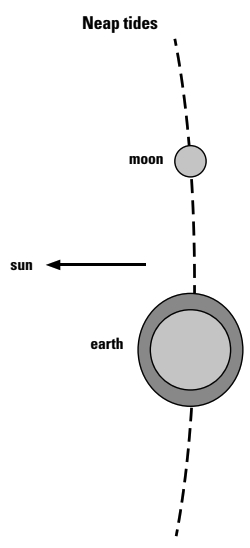
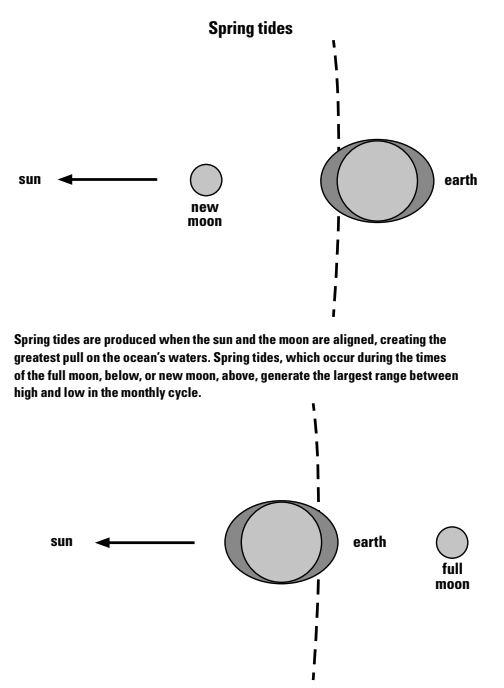
When the sun and the moon are in line with the earth, which happens at the time of a new moon or a full moon, the gravitational pull is greater than average, and so-called spring tides occur. In this case, spring does not refer to the time of year but rather the welling-up of the water, as from a spring. When the sun and the moon are at right angles to each other with the moon in its first or third quarter, the gravitational pulls of the moon and sun tend to cancel each other out slightly, and we have less than average, or neap tides. Near the times of the equinoxes (March 21 and September 22), the spring tides are usually larger, and near the time of the solstices (June 21 and December 22), spring tides are usually smaller than normal.
The moon’s orbit around the earth is not circular, but like that of most heavenly bodies, elliptical. So the moon’s gravitation is stronger at its perigee (when closest to the earth) than at its apogee (farthest from the earth).
Also, the moon’s orbit around the earth is inclined in relation to the earth’s equator. Its declination is over the southern hemisphere part of the time and over the northern hemisphere part of the time and only directly over the equator twice a month, at which time the two daily high tides will be about the same height. When north or south of the equator, these daily tide heights will be different (semi-diurnal inequality).
Orbital tides
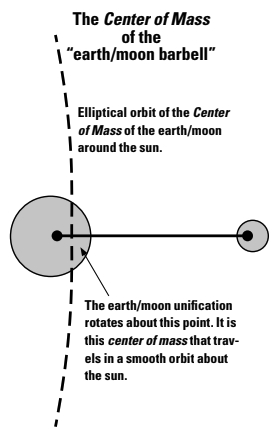
Although this scenario is one that most people know well, it actually becomes more complicated. We can imagine the earth and moon to be traveling around the sun as a single, combined mass. Visualize a barbell, with a heavy weight on one end of the bar (the earth) and a small weight on the other end of the bar (the moon). See illustration on Page 32. The bar connecting the two represents the gravitational attractions of the earth and moon. Now, if we go to pick up the barbell with one hand, we will have to do it with our hand on the bar very close to the heavier weight. This position is the center of mass of the barbell’s two weights. If we were able to fling the barbell through the air in a rotating motion, we would find that this center of mass follows a smooth trajectory, while the heavy and the light ends of the barbell rotate back and forth across this smooth trajectory — rotating around the center of mass. The same holds true for the earth/moon combination. It is this center of mass that rotates in a relatively smooth orbit around the sun. Thus, since the earth and moon are rotating around this center of mass, it means that both the moon and, to a lesser extent, the earth, swing inside and outside of the orbit of this center of mass. So instead of the earth rotating around the sun in a nice, neat ellipse, as we like to think, it actually swings inside and outside this ellipse with the phases of the moon.
Now visualize a car going down the centerline of a highway. If that car swerves back and forth across the centerline, the passengers will be thrown from one side to the other by centrifugal force. This same centrifugal force throws the water back and forth across the face of the earth as the earth swerves back and forth across the smooth orbit — adding an additional factor into our previously simple tide concept.
Intracoastal variations
Intracoastal tides (those tides occurring inland of the coastline) become even more complex. The mainland of the East and Gulf coasts, from New York to the Mexican border, is protected by barrier islands, broken intermittently by narrow inlets to the sea. Inside these barrier islands, on intracoastal waters, the tides are considerably less amplified than those on the ocean side of the barrier islands. This is because the narrow inlets limit the exchange of water between the ocean and the intracoastal bays, rivers, and sounds. This limited water exchange causes low tides on the inland bays that are higher than low tides in the ocean and high tides that are lower than the ocean high tides. This is because at high tide the ocean tries to fill up the inland bays through the narrow inlets, but before it gets a chance, the tide has changed and begun to drop.
The same thing happens at low tide when the water rushes out of the bays but the ocean tide changes before this can happen completely. Hence, the tide variations in these intracoastal waters never approach those on the ocean side of the islands. But as an ocean high tide starts decreasing, it is still higher than the waters in the back bays, and water keeps flowing into these bays. Thus, the times of high tides in intracoastal waters lags behind those for the ocean. The same scenario also holds true for low tides.
Atmospheric tides
The tides created by the gravitation of the moon and sun are known as celestial tides, as opposed to those tidal effects created by atmospheric pressure or the wind. Printed tide tables, as well as tide computer programs, allow the celestial tides to be calculated years in advance. One of the things these tables and programs can’t show us, however, is the effect of atmospheric pressure and wind on the tides — and both of these influences are of great importance to the boaters and residents of coastal areas.
Storms, hurricanes, and nor’easters pose special problems along coastal shores. During an extended blow, other factors affect the tides. During a long blow (12 hours or more) an ocean current is produced by the wind. The rule of thumb is that this current is about 2 percent of the wind speed, so that during an extended blow of 60 mph toward a shore, a current of 1.2 mph is set up. When this current is directed toward the coastline, it causes the water to mound up against the shore, creating higher-than-predicted tides.
This mounding effect is very real, with the ocean water level along the shore much higher than it is many miles out to sea. On top of this mound of water are the unusually high, wind-created waves. The height of these waves is directly related to the wind speed, its duration, and the distance that these winds are blowing across unobstructed water, or the fetch. This mounding up of the water along the coastline during a storm, created by the winds and the current, forces the ocean waters into the inlets between the barrier islands. Even during celestial low tide, the height of the ocean water, along with the wind, does not allow water to escape from the bays. The next ocean high tide again adds water to the bays until, after a series of high tides, the water level in the bays approaches that of high tide in the ocean.
Unusually high
Also, in a hurricane or nor’easter, the low pressure in the eye can suck up the ocean into unusually high tides, much as soda is sucked up through a straw. The combination of the mounding up of water along a coast due to the wind and the additional increase in height due to the water being sucked up into the low-pressure eye is known as the storm surge. This storm surge is often more devastating than the damage caused by the wind.
But these wind-produced tides don’t affect just ocean waters. Windy conditions can also dramatically affect large bodies of inland waters, such as the Great Lakes. In October 2001, a prolonged southwest wind of 30 to 50 mph, blowing across Lake Erie, dropped the water level at the west end of the lake by about 5 feet, while the water at the eastern end of the lake was raised by the same amount. Records show that on Lake Erie there has been up to an 11-foot difference caused by the wind, between the lake levels at Buffalo and Toledo.
Finally, celestial tides don’t only affect water levels. The earth’s crust also rises and falls in response to the gravitational effects of the moon and sun.
For sailors, the understanding of these concepts not only contributes to our safety on the water but also to the sense of our tiny place in the universe.
Thank you to Sailrite Enterprises, Inc., for providing free access to back issues of Good Old Boat through intellectual property rights. Sailrite.com