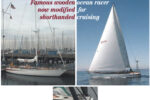
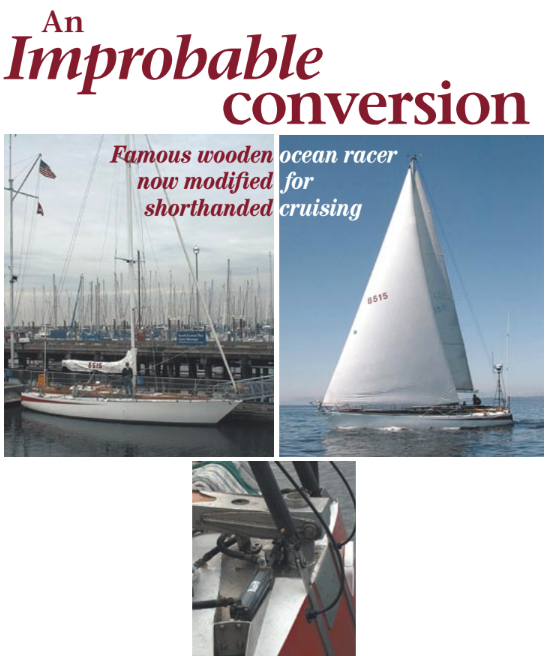
Famous wooden ocean racer now modified for shorthanded cruising
Issue 32 : Sept/Oct 2003
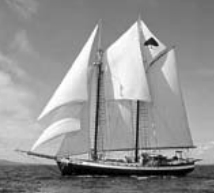
Improbable is the wrong name for this boat. Logical would be better, or Synergy, or Refinement. I wasn’t thinking about names when I first spotted her at Seattle’s Shilshole Marina. I simply responded to the boat’s great lines, clean open decks, carbon-fiber spinnaker poles, jillions of winches, no real cockpit . . . all the parts of a serious raceboat. But she was made of wood! I couldn’t help but stroll over and meet owner Len Schwab.
Len had singlehanded his 42-foot boat down from Friday Harbor in the San Juan Islands to have covers made for the two beautiful carbon-fiber spinnaker poles chocked onto Improbable’s deck. The twin poles are the latest refinement, the latest tweak in Len’s ongoing effort to improve his singlehanded sailing. Carbon fiber, of course, because there is little lighter or stronger, and Len wanted poles that he could manage alone. Twin poles, notice, because he’s worked out a two-pole spinnaker-jibing system he can pull off all by his lonesome with the boat charging downwind.
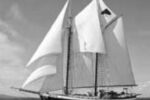
At the time, Len was 66 years old. His boat was 31 years old. They’d been together since 1976 when Improbable retired from a successful ocean-racing career that included an overall win in the 1971 Fastnet Race. This makes sense since the boat was designed for and does best in heavy weather. Built in 1971 as an all-out ocean racer with design input by the Bay Area racing’s who’s who (“Commodore” Tomkins, Skip Allen, Tom Wylie, and Ron Holland), Improbable proved to be a great ocean racer and the breakthrough design her creators envisioned. She set a record in the heavy-weather 1971 Miami-Montego Bay race and won her class in the 1972 Transpac. Those, plus other victories, landed her in Sailing magazine’s 1993 “100 Greatest Sailing Yachts in North America,” the only Northwest boat to be included in the “modern racers” category.
Intelligent modifications
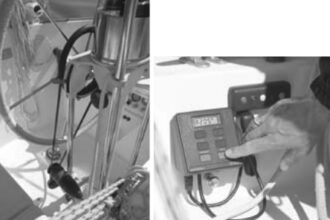
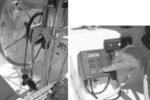
It’s interesting to take a closer look at the intelligent modifications Len has made for singlehanded or shorthanded cruising, a situation that challenges many of us. An engineer by profession, Len takes a very practical, solid approach to so-called shorthanded modifications. He has a Benmar pilot steering system on Improbable, so it’s not likely to fail. Adapted from hydraulic units used in fishing vessels, Improbable’s autopilot has the power to push a 19,000-pound boat around in heavy seas. There are no little plastic gears to explode, just good old hydraulic fluid squishing around inside fat hoses. It’s an impressive system.
From the beginning, Len saw the need for the robust autopilot system. He has maintained the same simplicity and ruggedness in all the other modifications he has made to his beloved vessel. A review of one man’s visions may stimulate the dreams of others.
But first a bit about the boat. Designed by Gary Mull in 1970 to goals generated by a racing syndicate, Improbable is far from the usual production vessel. Nonetheless, she has proved to be a first-rate ocean-cruising vessel precisely because she was designed to go fast under difficult conditions. She was the antithesis of the customer-pleasing assemblage of head-to-bed specifications around which naval architects try to wrap a successful sailing vessel. Stepping below on Improbable, the immediate impression is “Gee, this is a working boat . . . a stripped-out ocean voyager.” But a second look reveals that it’s all there from bed to head to nav station and galley. It’s just all in one “room,” and it isn’t fancy.
Dave Allen, a top San Francisco Bay area sailor, and his syndicate cohorts first planned a 38-foot ocean racer. When their planning efforts did not gel, Dave took many of their parameters to young Gary Mull and asked him for a similar ocean racer but one with standing headroom. In his words, Gary’s 42-foot response featured a “ . . . fairly fine bow and good stability for windward work, and at the same time (would) maintain a long, light hull for off-wind performance.” He configured a deep, stern-mounted, tiller-controlled rudder for maximum steering force.
The design called for a small, shallow cockpit with a low deck box surrounding the mast for the stowing of halyards and control lines. A fin keel was called for, hanging under a narrow hull with a deeper vee than today’s ocean racers carry.
Weight concentrated
Beam came out at 11 feet, waterline length is 37 feet, and draft is 6 feet 11 inches. Sail area is around 830 square feet, balanced by 8,500 pounds of ballast. Weight was concentrated mid-vessel with the engine just aft of the mast and the top section of the steel keel holding diesel fuel. To further save weight, the boat was constructed of cold-molded, triple-laminated New Zealand kauri wood over 4-inch laminated kauri frames. Because they were experts in such things, and because the wood was there, Dave Allen had Improbable built by the T. K. Atkinson yard in Auckland, New Zealand (remember, this was before the world knew much about New Zealand sailors).
Final displacement came out to just 18,000 pounds (very light for its day). Len figures she displaces about 19,000 pounds today. The hull structure consists of three thin kauri-wood skins wrapped around longitudinal stringers. Hull thickness is 1 inch. Len has since glassed the hull for extra strength and reduced maintenance. There are two sizeable watertight bulkheads forward, joined to stringers that create a strong girder arrangement. The hull has remained stiff and rot-free, a testimony to the design, the builders, and the dense kauri wood, which is now almost a protected species — no logging, no exporting.
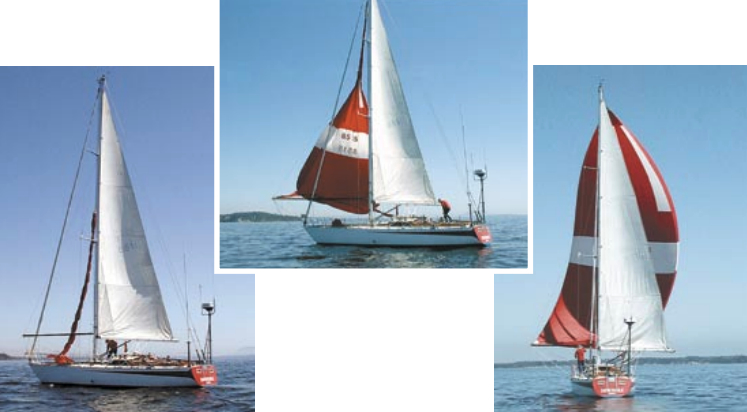
The small cabin makes for an open deck space which accommodates 14 spinnaker, sheet, and halyard winches. The setup testifies to the power of the lever. Len doesn’t have to manhandle much. Improbable even has a unique set of linked winches that allow sheet trim from the opposite side of a heeled deck. The winches are designed with below-deck driveshafts linking winch handle to winch. They are hefty, powerful, and convenient. Len modified the cockpit until it had a depth of only 6 inches. Why? He never sat in it, and eliminating the foot well created a usable aft cabin. The autopilot steers; he moves around adjusting or goes below to eat, rest, and sleep. Course adjustment is often done with a simple joystick.
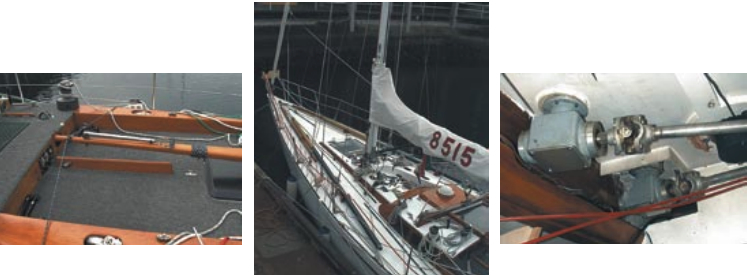
Rudder redesign
In his quest for strength and efficiency, Len has redesigned the big rudder three times. By the time I met him, he thought he’d finally got it right. He says Improbable goes to windward very well in heavy weather, chunking along at 7 knots even in big seas. When not sailing under the autopilot, Len can steer from anyplace on the working deck using a deck-circling line led to the tiller.
Len has worked out a safe procedure for solo spinnaker launch and recovery. He doesn’t hesitate to fly the big kite even in blustery conditions. The boat tracks so well, the autopilot steers so well, and the dual spinnaker poles jibe so easily, that Len has been known to drive her solo downwind at speeds up to 12 knots.
Sails and steering aren’t the only controls that Len has modified. He has put in a thoughtful system of central pad-eyes that enable him to move about the boat firmly tethered at all times. A dual line clipped to his harness means that he is never unclipped, and the short jacklines protect against projectile falls as well as possible man-overboards.
Len’s engineering training certainly aids his modifications of Improbable. Just as important is the wisdom he has gleaned from his considerable sea time. He began sailing in 1964 in southern California. Soon he purchased a Baltic 29 and got in some offshore sailing before taking a job with Boeing, in Seattle, where he purchased a 38-foot wooden ketch and moved aboard. By the early 1970s he was off with his three young sons for what would be a three-year cruise down the Atlantic seaboard and through the Caribbean aboard a 39-foot wooden cutter. Then to San Francisco, where what should catch his eye but the mighty Improbable. He bought the boat and returned to Seattle where the boys once again attended school.
Singlehanded passages
Since buying the boat, Len has single-handed up and down the West Coast several times when he moved between various aerospace firms. He doesn’t hesitate to take the old war horse out solo, even when conditions are a bit blustery. He is confident about the boat and confident in his modifications. When sea conditions prohibit sailing, Len can set Improbable up with a small backed staysail to lie hove-to, a configuration he’s used successfully in more than 60 knots of wind.
For good old boaters, the Improbable message is twofold. First, wellbuilt former ocean racers can make great (but not fancy) cruising vessels. And second, even big, powerful, 42- foot vessels can be set up for singlehanded control. More than money, it’s the proper application of physics that counts. Don’t hesitate to modify your own boat. Keep your eyes open to other setups, let yourself dream new configurations, test modifications in mild conditions, and always think safety, safety, safety. In this world of high-tech complexity, there is much reward in the straight-ahead physics of boat rigging. We can actually see the need, dream the solution, and configure the mechanism, and almost feel like we’ve got a bit of control in an increasingly technical world.
Thank you to Sailrite Enterprises, Inc., for providing free access to back issues of Good Old Boat through intellectual property rights. Sailrite.com