Try this logical, six-step method to eliminate impulse purchases
Issue 35 : Mar/Apr 2004
Is choosing the boat that’s right for you like selecting an appliance or more like falling in love? Is it a matter of the head or the heart? When my wife, Kathleen, and I decided to begin our search for the boat we would eventually live aboard and sail, we were determined to attend to the wishes of both the head and the heart. We haven’t found her yet, but what we have found is a process to satisfy our practical sides and to make our hearts beat faster.
For some, what I am about to propose is abhorrent — like making your intended sign a pre-nuptial agreement. If you are the type who goes through life making decisions strictly on gut instinct and first impressions, turn the page quickly, before we get to the really ghastly stuff, like capsize formulas. On the other hand, if you tend to approach things a bit more methodically, you’ll find that the system we describe will increase the likelihood that the boat you buy will be the boat of your dreams.
This process has six steps. It begins with something as ambiguous as your “sailing vision” and ends with selecting a specific boat from a list that you have developed. Think of it as a process that narrows the field from tens of thousands to just one. Take these steps, and your final selection will be made with confidence.
Don’t hurry, especially with Steps 1 and 2. This is a little like dead reckoning: an error of just a few degrees at the beginning of your journey can result in a big mistake after a few hundred miles. Getting a good start is the best way to ensure a good finish.
STEP 1
Your sailing vision
This first step is the most important; it will form the foundation upon which everything else is built. Think of it as painting a picture of the who, what, when, where, and how of your sailing future. Are you looking to cruise for years, cruise for weeks, daysail, race, or something else? Will your boat be a place to live in, a boat for recreation, a boat to race, or a museum piece? Perhaps you want your boat to be a multi-use vessel. In most cases that’s possible. What isn’t possible is to do a good job of choosing a boat without knowing exactly what you expect from it.
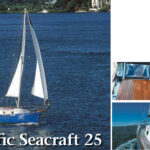
If this is going to be “our” boat — not just “your” boat — you must include all the people that make up the “our.” Kathleen and I had many conversations describing, not what kind of boat we would have, but what we would do with it. The more we talked, the clearer the picture became: we wanted a vessel that two could live aboard comfortably, that was sufficiently seaworthy to make an offshore passage, that could be handled by two, and that was small and simple enough that maintaining her would be a hobby rather than a full-time job. Equally important, we wanted a boat we could be proud of. (Our current boat is a Pacific Seacraft Flicka, and we have grown accustomed to turning heads. We like that.)
Comfort, seaworthiness, pride of ownership and simplicity of systems doesn’t seem all that specific, but these concepts have specific meanings to us. Moving from a sailing vision to a specific list of attributes is what Step 2 is all about.
STEP 2
Step 2: Developing your lists
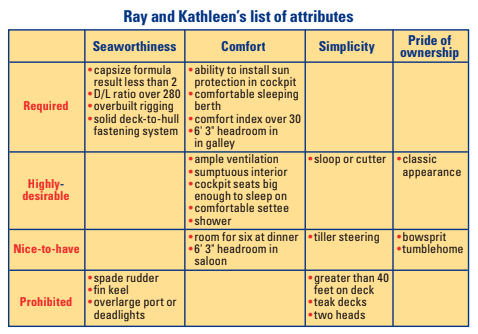
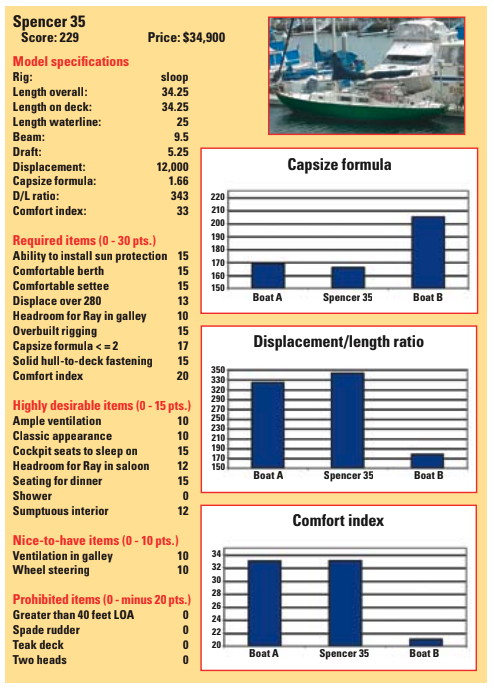
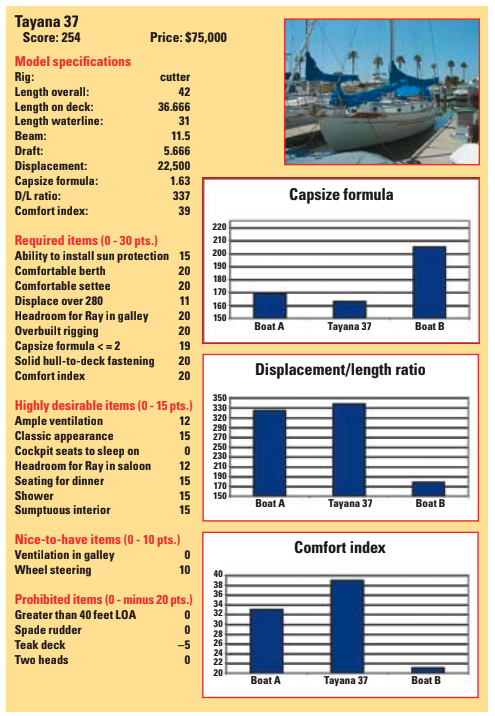
Using the word picture that you developed in Step 1, compose a short list of items that will be required, highly desired, nice-to-have, and prohibited on your boat. See the table on Page 9 for our list.
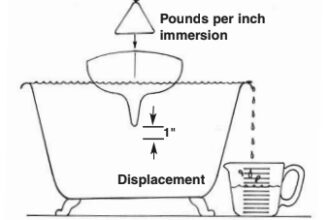
You’ll notice that some of these attributes are quite specific. Our boat will not have a displacement-to-water-line-length (D/L) ratio of less than 280, for example. Others may appear to be ambiguous, but aren’t. Our definition of a comfortable settee is one where people can sit and read without back or neck strain, preferably with their feet up. The sumptuous interior may not mean much to you, but to us it means feeling like we’re in our home, not our campsite. The “classic appearance” is probably most difficult to pin down, but in the words of former Supreme Court Justice Potter Stewart, “I know it when I see it.”
Two more quick points: first, you’ll note that there are no items on the list that could be purchased later. Our boat must have a life raft, an oven, a dinghy, and many other things, but they can be added without major construction. What you see in our list are permanent characteristics. We’ll develop a list of accessories later, in Step 4.
Second, we have not tried to make this overly comprehensive (and therefore overly complex). Our boat will have an engine, a head, a mast, a boom, an icebox, a water tank and a sink. Almost all cruising boats do. What we have concentrated on are the differences among the boats under consideration, not what they have in common. When you make your list, look for discriminators.
STEP 3
Go model shopping
Now that you know the critical elements of your ideal boat, it’s time to start looking — not for a specific boat but for different models that meet the requirements you established in Step 2. Don’t limit yourself to a couple of models you know you like. You will be amazed at how many hulls, some from manufacturers you may have never heard of, can meet your needs. Some may even satisfy your list of attributes better than the models you have thus far considered.
Where do you find good candidates? One of the best sources is the magazine you’re holding right now, as well as other sailing publications. Don’t just look at the boat reviews, though. Also examine the other articles, photos, classified ads, and corporate advertisements. If the publication doesn’t have enough information on a particular model, go to the Internet.
When you’re looking for information on a specific boat, try a top-notch search engine like Google . There are tons of owners’ associations and other sites that can tell you almost all you need to know, and any good search engine will lead you to them, as will a check of the Good Old Boat website.
But don’t stop there. You can also use the Internet to find additional models. Sites like Boats.com and Yachtworld http://www.yachtworld.com have extensive listings, almost all with photos and specifications. (One word of caution: don’t assume that the specifications are always accurate; we’ve found several errors during our research.)
Don’t be overly inflexible when you are accepting or rejecting models, especially if you are having trouble finding models that meet every requirement or if you find ones that excel in most areas but are deficient in just one or two. For example, the Spencer 35 (which, after all, was good enough for Hal and Margaret Roth) scored very high with us except for headroom in the galley. We discovered, however, that one determined first mate had come up with an ingenious seat in the galley, so that the captain (who is 6 feet 3 inches tall) could do his fair share of the dishwashing. We scored it slightly lower, but it still made our list.
Occasionally, you may be unable to determine if a particular model meets a certain requirement. In our search, if we couldn’t find line drawings, then we couldn’t tell if the berth would be comfortable for a couple. Leave the question unanswered, and leave the model on your list until it proves itself one way or the other.
STEP 4
Go boat shopping
Now that you have your list of models, start looking for specific boats. You know better than I the best local sources, but don’t ignore publications such as Good Old Boat (especially the website), Soundings, Yacht Finder, Latitude 38, 48° North, SpinSheet, Northern Breezes, and South Winds. And, of course, don’t neglect the Internet.
Step 4 is also when you develop that list of “must-have accessories” that I mentioned in Step 2. When I say must-have, I mean anything that you would be forced to add before you put your boat to the intended use you described in Step 1. This list should not include any item that you do not feel is absolutely necessary. A good example, for us, is a watermaker. Watermakers are a handy item on a cruising boat (if you have the power to run them), but we would not feel the need to add one immediately. Therefore, it doesn’t make our list of accessories.
Remember, the purpose of this process is to help you choose the right boat. If you include accessories that aren’t essential to your vision, you run the risk of being blinded by the bells and whistles, while neglecting what’s really important. If it’s truly essential, put it on the list; otherwise, leave it off. You’ll see the importance of this during Step 5, when we calculate the adjusted price of your boat. Once you’ve identified specific vessels that are for sale, perform an initial inspection in order to accomplish two things: to validate the information you’ve already collected during your model analysis, and to compare what’s actually on the boat with your list of accessories. Arrange to spend some time at the boat, and come prepared to do a quality inspection.
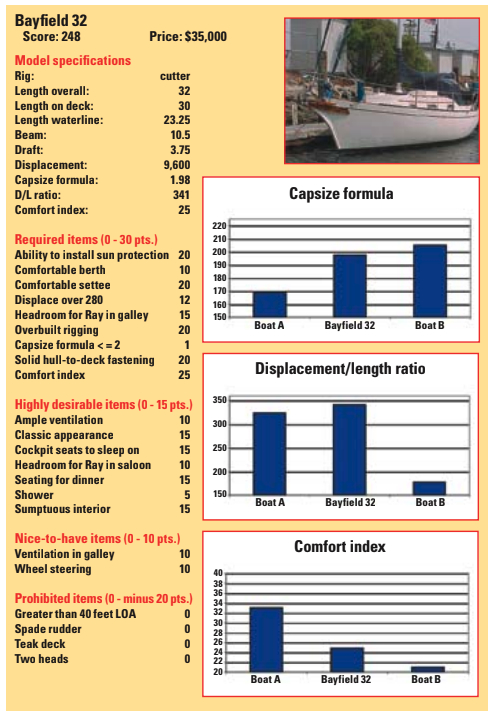
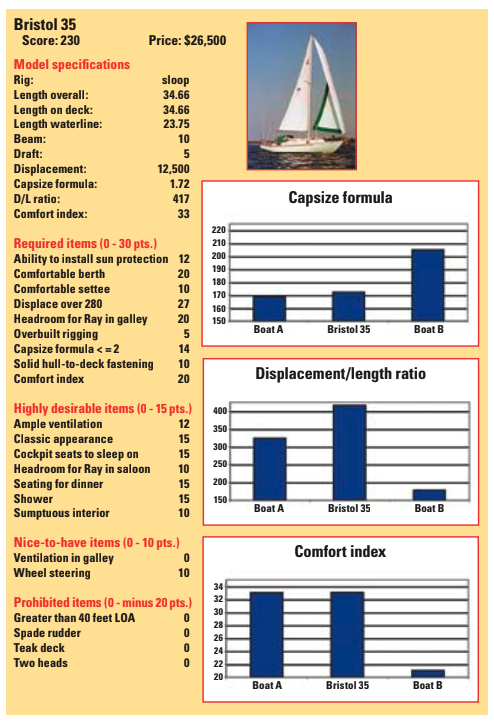
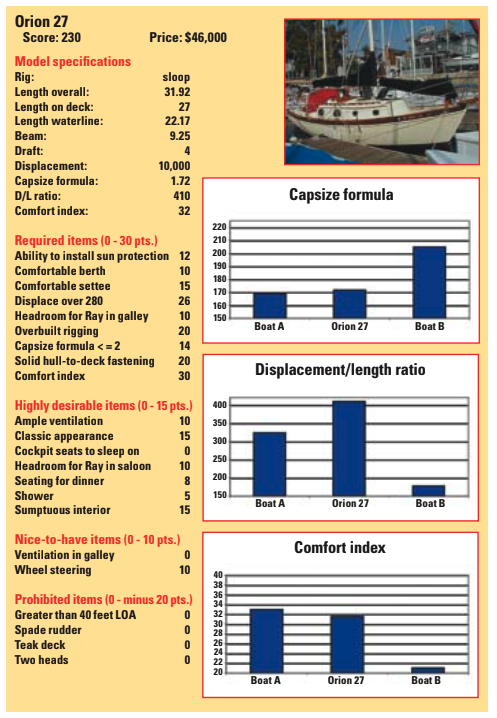
We’ve discovered some useful tools. Since we both are fairly computer literate, we developed a form (actually an Excel spreadsheet) based on our Step 2 list. It calculates the capsize formula, the D/L ratio, and the comfort index automatically. It also gives a graphic comparison in those three areas to two other boats, one that we consider to be a very seaworthy boat (Boat A on the form), and another we consider to be less so (Boat B). There are blocks on the form to score the boat on each of the Step 2 attributes (more on scoring later, and you can download an example of our form at the Good Old Boat website by following the link on the home page). That form goes on a clipboard, which we carry along with a tape measure, a digital camera, and a flashlight.
As soon as we arrive at the boat we swing into action. I stand in the galley (important to me) and Kathleen tests out the berth (important to her). We scrutinize the rigging, especially the chainplates, and use the flashlight to determine how the builders attached the deck to the hull. Each item on our Step 2 list gets a score.
Our scoring system is an attempt to impose a little objectivity on what is inherently a very subjective process. Each of our required items gets scores from 0 to 30 points; highly desired items score between 0 and 15 points; nice-to-have items score 0 to 10 points; and prohibited items get a negative score of 0 to -20.
Any galley that I can stand up in automatically gets a 20. We gave the Spencer (with the galley seat installed) a 12. Room for four, instead of the six we’d like, around the saloon table earns 5. We use the same technique for prohibited items. A full teak deck drops the score 20 points. A fiberglass deck with a teak cockpit (we saw an Islander like this) loses 10 points.
Once we’ve scored the boat in each area, and if we haven’t discovered anything that out-and-out disqualifies this hull (such as many high-cost, mandatory repairs), we compare our inventory of must-have accessories to what comes with the boat, noting the deficiencies.
Lastly, we interview the owner or broker to determine if there are any big-ticket repair or replacement items that require immediate attention. Do all the sails need to be replaced? The head re-plumbed? New cushions through-out? How about new standing rigging? We also ask ourselves if we can live with the general state of maintenance. Or are we going to have to repaint, revarnish, and renew the boat?
We’ve done so many of these inspections that we rarely spend more than an hour for a first look. The next step takes even less time — usually about the time it takes to drive home.
STEP 5
Calculate adjusted price
Calculating the adjusted price of the boat requires four numbers: the lowest amount you believe the owner will accept, the cost of any accessories you’ll need to add, the cost of any major repairs or renovations, and the cost of transporting the boat to where you need it. Add those four numbers together and you’ll get the adjusted price, which is a far more valuable figure than the asking price. For example, a $25,000 boat that needs a life raft ($8,000), a dinghy ($1,200), new rigging ($3,000), and is floating nearby produces an adjusted price of $37,200.
Using the adjusted price will quickly reveal that a lower-priced boat, without a suit of sails, or requiring $15,000 of work in the boatyard (about a week’s worth, in my experience), is not necessarily the best buy. A boat that’s 1,000 or 10,000 miles away, but also thousands of dollars less expensive, may be more competitive than you think (see the sidebar on transporting your newly purchased boat on Page 14). The use of an adjusted price allows you to do a proper comparison.
STEP 6
Make an offer
This is where all the work you’ve done pays off. After a few weeks or months, depending on how much time you have to devote to your search, you should have accumulated many score sheets, each representing a boat you have inspected. When reviewing the score sheets look at two things: first, how high did the boat score, and second, what’s the adjusted price? Once you’ve completed that review, there are several routes you can take.
One approach is to rank all the boats you’ve inspected, using each boat’s total score, and draw a line just below the boat with the lowest score that still meets your needs sufficiently. Then make an offer on the one (above the line) with the lowest adjusted price.
Let’s assume that you have looked at 25 boats. You rank them based on their score and decide that you could be happy with any of the top seven. You then review those seven and make an offer on the one with the lowest adjusted price.
A second technique might be to rank the boats and draw your line as you did before, and then concentrate on the boat that is most ready to sail away or best matches your budget.
If you are particularly passionate about a specific boat, your ranking will allow you to see where it stands against the others. Your score sheets will tell you exactly what you’re giving up (either in attributes, accessories, or money) to satisfy your passion. Perhaps the same boat that makes your heart beat faster also scored the highest.
Remain flexible even after you’ve made your offer. Two situations could send you back to your list of boats and their scores (Step 6). First, the price that you thought the owner would accept might be overly optimistic. If that happens, however, you are well prepared to respond, because you know how high you’re willing to go. If the counter-offer is $8,000 more, but you have another boat on your list for only $4,000 more, you may want to consider ignoring the counter-offer, and making an offer on a different boat.
The second reason you may want to return to Step 6 is that the results of the survey may significantly change your adjusted price. We are strong believers in obtaining a complete survey, even though they can be costly. It can be discouraging to watch a portion of the funds you’ve set aside for this purchase dwindle as you survey more than one boat, but nowhere near as disturbing as finding out that the boat you just purchased needs tens of thousands of dollars worth of repairs.
Thanks to the market (the stock market, not the boat market), Kathleen and I suspended our search in the middle of Step 4. We are ready at any time, however, to re-start, thanks to the preparations we’ve made.
When we do take the plunge (perhaps an unfortunate metaphor, considering the subject), we’re confident that our new home will be, in every way that is important to us, the boat of our dreams!
Thank you to Sailrite Enterprises, Inc., for providing free access to back issues of Good Old Boat through intellectual property rights. Sailrite.com