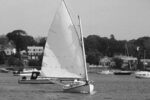
His designs were few but all became timeless classics
Issue 36 : May/Jun 2004
Traditional. Classic. Timeless. Character boats. Boats from the heart. These are just some of the terms the owners of boats designed by Lyle Hess express when describing their vessels. Although many sailors fall in love with their boats — warts and all — those owning Lyle Hess designs seem especially fervent. It matters little if the boat is a Balboa, Montgomery, Nor’Sea, Bristol Channel Cutter, Falmouth Cutter, or a Hess custom design . . . the owners are suffused with the same ardent devotion. Even his stable dinghy, humorously called Fatty Knees, has created a horde of aficionados.
Lyle died in July 2002 at the age of 90, and what may be most gratifying to him — if he’s up on his cloud eyeing his legacy — is that most of his fiberglass designs are still being built and plans for designs in wood are still being sold. Lyle’s reputation as an outstanding yacht designer is secure, even though, as fellow designer Robert Perry says, “his over- all output was scant.”
Lyle loved sailing and building boats and spent most of his life “messing about” in them. His views on how boats should look and be built were influenced by reading such writer/designers as Maurice Griffiths, who edited the British magazine Yachting Monthly and wrote the classic tales of cruising, The Magic of the Swatchways, Little Ships and Shoal Waters, and Dream Ships. Lyle’s designs thus hark back to the British workboats of yesteryear, including vessels with such delicious names as Itchen Ferry smacks, Falmouth Quay punts, and Bristol Channel pilot cutters.
Workboat heritage
Although these boats differed in design and function, they shared a stout workboat heritage. In the 19th and early 20th centuries, pilot cutters competed for the job of guiding big sailing ships and motorized freighters into harbor. These cutters would sail far out into the shipping lanes and heave-to, waiting for a ship while braving the winds, waves, and high tidal ranges off the English coast.
To survive the elements and compete effectively, they were heavily built and rigged for singlehanding. Yet they also needed to be swift to reach a potential customer. Most were characterized by long waterlines, hard bilges, and tall rigs capable of pointing high and tacking quickly. After World War I, some were converted into pleasure yachts — like idled fishing boats are finding new uses as family boats today.
The British work- and pilot-boat legacy is clear in Lyle’s designs, be they wood or fiberglass. Above all, he believed his sailboats had to be strong, heavy, simple, and “able to claw off any lee shore.” But before he developed his career as a designer, he had a long apprenticeship building makeshift skiffs and dinghies while growing up in southern California.
In his autobiography, Sixty Years a Yacht Designer, Maurice Griffiths wrote, “What causes a man to take up a certain interest, an unusual hobby or activity perhaps, and become absorbed by it for the rest of his life, has long been debated. Some experience in early childhood, for example, has been known to set off the spark of interest which might grow into obsession in manhood.” For Lyle, that formative experience took place during his early teens.
He did not come from a boating family. The eighth of 12 children, he was born in 1912 in central Idaho. Lyle’s mother was a devout Mormon, but his father — who worked in construction — had another god: gold. After economic difficulties sent the family to Long Beach, California, in 1924, he continued to spend summers in Idaho mining his gold claim and searching unsuccessfully for the mother lode. As a teenager, Lyle grew enamored of the Pacific Ocean.
Trial-and-error flotation
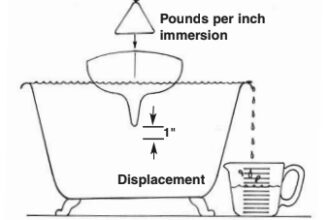
To help the family finances and earn pocket money, Lyle hawked newspapers and sold popcorn at boxing fights. In his spare time, he began sailing in whatever he could cobble together, using flotsam, metal sheets, bits of two-by-fours, and old barrels. He and his friends learned about flotation by trial and error, their wet behinds a stimulus to improve their knowledge of what it took to create stability. Help and advice came from two veteran boatbuilders, George Chalker and Bill Whiting, who ran a yard next to the mudbank where Lyle dragged up his small craft. Most of the yachts built at the yard came from Edson Schock’s drawing board, a designer who liked small and simple boats. Lyle listened avidly whenever the designer would drop by the boatyard to discuss details.
As Lyle became a good sailor and racer, he was offered opportunities to crew on other people’s boats, both teaching the owners to sail and honing his own skills. By the time he turned 16, he’d drawn and built a real boat, a hard-chined 16-footer called Viajera that had enough of a cuddy cabin to sleep in. In this little sloop, he ventured as far as Catalina Island, 26 miles to the southwest of Long Beach.
His hands-on training was supplemented by his reading. Besides Maurice Griffiths, he studied the designs of Albert Strange, which were published as a series of 10 articles in Yachting Monthly in 1914 and 1915. He learned the mathematics applied to yacht design — weights, centers of gravity, stability calculations — from Dixon Kemp’s Manual of Yacht and Boat Sailing and Architecture, first published in 1895. But unfortunately for Lyle, by the time he completed high school and was ready to work in the boating field, Black Monday and its subsequent run on the banks led to the Great Depression, and money for yacht building evaporated. He took whatever jobs turned up.
Hired as shipwright
In 1938, Lyle married Jean Seabring, whom he nicknamed “Doodle.” World War II led to an explosion in boatbuilding, and Lyle was hired as a shipwright at San Pedro’s Harbor Boatbuilding Co., building 138-foot minesweepers and 80-foot Vosper PT boats. Near the end of the war, Lyle and his family lived briefly in Eureka, California, where he built fishing boats for the Humboldt Bay Boat Company. They then returned to Southern California where Lyle constructed 168-foot steam tugs.
His desire for designing his own boats became reality when he teamed up with Roy Barteau, a wartime shipyard colleague and expert wood craftsman. They formed the L.A. Yacht Yard in Harbor City in 1946. A 36-foot, 24,000-pound ketch, Westward Ho, was their first order. A 44-foot motorsailer, Lady Elizabeth, built for famed Hollywood cinematographer Ernest Palmer, came down the ways the following year.
Then, finally, Lyle was offered the opportunity to design something along the lines of the British workboats he’d studied so intently. Hale Field, an amateur designer and frequent boatyard visitor, was searching for a small traditional vessel capable of crossing oceans. Lyle presented Hale with a 28-foot design that Hale found lovely but too expensive, though later the design inspired the fiberglass Bristol Channel Cutter built in series by the Sam L. Morse Co.
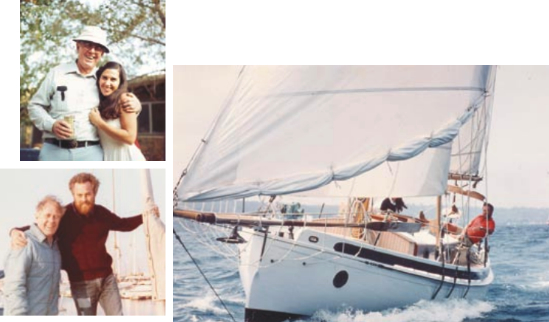
Lyle sharpened his pencil and drew a 24-foot cutter with a beautiful sweeping sheer and a traditional bowsprit. Hale approved of this smaller version, and in 1949 Renegade slid down the ways. The gaff-rigged cutter measured just under 25 feet, offered 461 square feet of sail area, and resembled British Itchen Ferry workboats, although with a finer bow, a broader beam, and a hollower garboard area.
Slow business
A few other custom designs followed but as wooden boats are a slow business, the yard produced insufficient income to support two families, especially for Lyle and his growing brood of four children. With great reluctance, Lyle sold his half of the L.A. Yacht Yard to Roy Barteau and went into the concrete construction business with his brother, Ray. For about a decade-and-a half, Lyle’s boat designing became a sideline.
All that changed when Larry Pardey, a Canadian from Victoria, British Columbia, spotted Renegade in Newport Beach and learned that she’d won the Ensenada race in 1954 and 1957 — the smallest overall winner ever. Eager to have his own offshore sailboat, Larry decided to build himself a boat from Renegade’s plans. He located Lyle, and the two sailors spent many an evening discussing plans and modifications.
“Lyle became a father figure to me,” says Larry. “I spent the next three-and-a-half years building Seraffyn of Victoria, and Lyle taught me 90 percent of my boatbuilding skills. He helped with the tooling and lofting, loaned me tools, and was remarkably generous with his time . . . to me and everyone else. He never charged for the advice he gave. He was a design savant but the world’s worst businessman.”
Soon after beginning Seraffyn, Larry Pardey met his future wife, Lin. Lyle’s relationship with the two revolutionized his life. After the marconi-rigged cutter, Seraffyn, was launched in 1968, Lin and Larry spent the next 11 years cruising the world’s oceans and writing about their adventures in magazines and then books, stimulating interest in their traditional, engineless boat and spreading Lyle’s boatbuilding savvy and philosophy. “It sure didn’t hurt that I had a photogenic boat and a photogenic wife,” says Larry, grinning.
More Hess
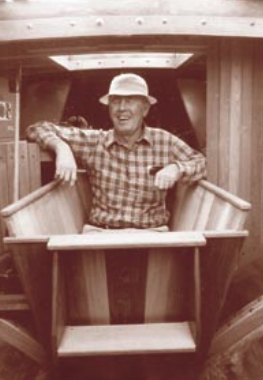
Their second hand-built cutter, Taleisin, another Lyle Hess design measuring just under 30 feet and launched in 1983, further enhanced the Pardey and Hess reputations. Larry also introduced Lyle to Richard Arthur, who had a yen to build a fiberglass, trailerable sailboat, one that would be seakindly and yet affordable for the average family. He founded Arthur Marine and started producing Lyle’s first fiberglass boat, the Balboa 20, with a swing keel. Dubbed the “Go Fast, Go Anywhere Boat,” the model caught on and sold about 3,500.
Buoyed by this success, Lyle was pleased to give up construction and return to boat design, making the 1970s and 1980s his most productive years. During the heady 1970s, Lyle even designed a couple of small catamarans but, although about 100 were manufactured, they couldn’t crack the market ruled by Hobie Cats.
The Balboa 26 followed and sold about 1,500 units. An undated price list advertises the Balboa 26 at $5,795, which included tanks, an alcohol stove, and lights — everything else was extra. Lyle also designed the 20-foot Ensenada using a Balboa hull with a new deck, a swing keel, and kick-up rudder, and also the 25-foot LaPaz motorsailer for Coastal Recreation in Costa Mesa (best known for its Aquarius 21 and 23 trailersailers). Jerry Montgomery was another Hess devotee. He commissioned both the Montgomery 17 and 23. In 1980, Jerry added his own design of the Montgomery 15, about which Lyle is reputed to have said, “It was the best boat I never designed.”
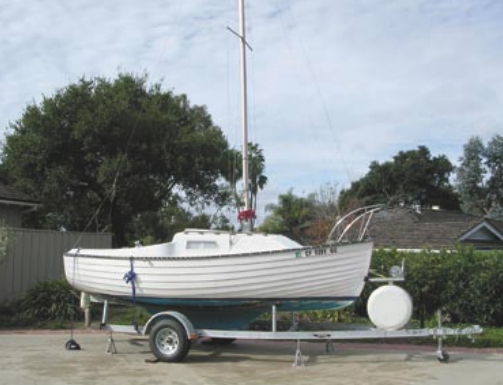
Next came the full-keel, yet trailerable, Nor’Sea 27, which was built by the Wixom Brothers at their yard, Heritage Marine. Like the Montgomery boats, an unusual feature is the lapstrake molding, replicating in fiberglass the technique of overlapping the bottom edge of one plank with the top edge of the plank below it. About 300 Nor’Sea sailboats exist today. The popularity of this boat was helped along by Wayne Carpenter, who wrote The Voyage of Kristina in 1983 and published articles in several sailing magazines about bluewater voyages he made in his Nor’Sea 27 with his wife, two daughters, and mother-in-law!
Friendly introduction
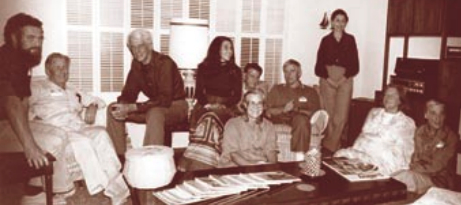
Bob Eeg, the owner of a Hess-designed boat, met Lyle at the Long Beach Sailboat Show in 1977 after having read about the new Nor’Sea 27. He fondly recalls his introduction to the designer: “He shook my hand and started telling me about this wonderful transportable cruiser that could take you around the world. He pointed out its stout construction, seakindly canoe stern, and strong lapstrake hull with its cutaway forefoot for ease of tacking when you have to claw off a lee shore. ‘This is first of all a sailboat, Bob,’ he said. ‘It’ll get you home safely.’ He was a no-frills designer. I was sold.”
Bob visited Lyle at his home office in Fullerton, where he was warmly welcomed. “He had many drawings on his board, all salty and all impressive,” Bob recalls. “He and Doodle invited me for lunch, and we talked about the Nor’Sea 27 and other cruising sailboat designs. Anyone could tell Lyle was proud of his sailboats and that designing them was his bliss. Shortly afterward, I ordered his Nor’Sea 27.”
This, however, was not the end of Bob’s association with Lyle. When Heritage Marine ceased operations in 1979 (Dean Wixom went sailing in his own product), Sam Morse bought the Nor’Sea 22 molds and tooling and changed its name to the Falmouth Cutter 22. Bob purchased the Nor’Sea 27 molds, moved them to a new factory, and restarted production in April 1980. The Nor’Sea 37, one of Lyle’s last designs, is also available from the company, though few have sold. After Jerry Montgomery retired in 1994, Bob also acquired the molds for the three Montgomery boats and started producing them again in 1999. His most recent adaptation is a Montgomery 23 hull with a new deck called the Montgomery 23 Offshore Cutter. The prototype is finished and production will start soon.
Channel Cutter 34
Another old-time boatbuilder, Bryan Gittins, has begun producing a Falmouth Channel Cutter 34 on Vancouver Island. According to Hess protégé Craig Johnsen, this design, completed in 1987, represents the evolutionary culmination of Lyle’s cruising cutter series. Bryan recently created molds and built the first fiberglass boat to be launched in Houston, Texas, in spring 2004. A second hull is in the works.
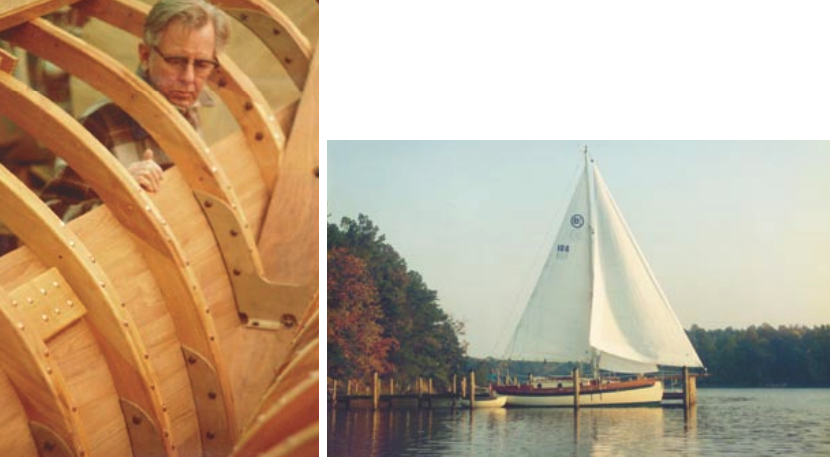
Perhaps Lyle’s best-known designs are the Bristol Channel Cutter and the Falmouth Cutter (which, as noted, started out as the Nor’Sea 22), built by the Sam L. Morse Co. Sam Morse hung out his shingle in 1975 in Costa Mesa and approached Lyle for a design. Lyle pulled from his archives the plans for the Bristol Channel Cutter (BCC).
Few boats have been reviewed so often and so favorably. Ferenc Maté included Morse’s boats in his 1981 book, The World’s Best Sailboats, titling the chapter, “One for the Eyes,” and opening it with these words: “I might as well start off by telling you that the Bristol Channel Cutter and the Falmouth Cutter are the most beautiful 28- and 22-foot boats in the world.” One might think that a boat designed more than half a century ago (then redrawn 25 years later) would no longer merit new ink. But BCC assessments and accolades continue to appear.
In 1999, John Vigor wrote in his book, Twenty Small Sailboats to Take You Anywhere, and also in Good Old Boat (May 1999), which was reprinting chapters from the book, “The Bristol Channel Cutter is a boat of superlatives. For many dedicated long-distance cruisers, she is, for her size, simply the best of everything: the most comfortable, the most seaworthy, the most traditional, and (naturally) the most expensive. There are some who call the BCC the Rolls Royce of yachts, but they have it the wrong way around. The Rolls Royce is actually the BCC of automobiles . . . ”
Crossing oceans
A 1998 Blue Water Sailing article states, “The BCC has been around for nearly a quarter century, crossing oceans and knocking off 150-mile days in the trades, riding out storms with aplomb, and carrying its crew safely and happily to countless backwaters of the world . . . ” A BCC served as cover girl on a 1993 edition of Sail magazine. Practical Sailor wrote in 1995 that “This is a go-anywhere boat, which like the Alerion, is a piece of furniture that you hope your children will cherish when you pass on.”
BCC owners are equally effusive. Kate Christensen, co-owner of Rogue-Wave, an Annapolis yacht brokerage specializing in BCCs, owns one herself. She sails Aloha, which she calls her “true love” and “the apogee of traditional yacht design.” Kate emphasizes the boat is suited to both women and men, even those who may be intimidated by sailing. “I appreciate the artistry and integrity of a well-made sailing vessel with traditional lines and seakindly movement, one with a proud and proven history,” she explains. “She’s a boat I can sail myself and she can go anywhere in the world! That’s freedom. I enjoy every aspect of sailing from the romance and tradition to the boats and everything about them . . . how they work so ingeniously, how they are built, and how they are cared for.”
Her husband, Bernie Jakits, is equally impassioned: “Lyle was the king of the long waterline. When you take the tiller, the BCC leaps over the waves. He created timeless designs that incorporated yesterday into today. He packed family values into a boat.”
BCCs are still built in the boatsheds Sam Morse put up in the mid-1970s. Today, the company is headed by Sumio Oya, who succeeds first George Hylkema and then Roger Olsen as owners of Morse’s original business. Sumio is building BCC hull No. 122. “The BCC, with her nostalgic shape, is perfect,” Sumio says. “There’s no need to redesign anything. In our high-tech world, there are new things every month. But Hess boats are timeless.”
Room for four
These factors may also be a drawback. The 28-footer demands the price of a production 42. Sumio has room for only four boats at any one time — he’s presently completing a BCC and two Falmouth 22s. And the 9/11 attacks reduced his order list. Nevertheless, he is optimistic. “Although our price is high, so is our quality,” Sumio says. “I trust our shipwrights, who’ve been with us for more than two decades. And Hess’ niche-market boats have almost a cult following.”
People who worked with Lyle Hess developed a deep affection for him. “A great teacher,” they called him. “Helpful.” “Generous.” Craig Johnsen, who calls himself a “sometime yacht designer” and finished the second BCC hull built, spent two months as an apprentice in Lyle’s Fullerton home in 1981. “In his mind, Lyle was always a blue-collar man,” says Craig. “When designing, he imagined a young couple who could manage and afford a small capable boat. He was a self made man, with his own, ideas. At times, he could be really stubborn. He had lots of practical knowledge about boats up to 40 feet. Above that length, he felt less sure of himself.”
Linda DeCoux, Lyle’s younger daughter, demystified the origin of the name “Fatty Knees,” which was given to Lyle’s fiberglass dinghy. It seems Lyle’s wife, Doodle, had her granddaughter, Shauna, on her lap after a bath and said to the 3-year-old, “You’ve got fatty knees.” “No, Grandma,” responded the tyke quickly, “you’ve got really fatty knees.” “It became a family joke,” said Linda, “so after that chubby, beamy dinghy was constructed, it naturally was christened Fatty Knees.”
The Pardeys were also extremely fond of Lyle. “He loved boats and the people who built them,” says Larry. “He had no enemies. But he was on the boating world’s edge. Only in the 1970s was he able to earn a livelihood through his designs. He trusted people and signed contracts with a handshake. He was usually cheerful, became a father figure to many, and was just tickled that people wanted to build his boats.”
Hess the chauvinist
Lin adds, “He was a man of his age, though. He could be a chauvinist. He adored me until I had design ideas. When I expressed the view that Seraffyn should have double spreaders, Lyle told me, ‘Larry and I will talk about the rig.’ ”
The couple reveals that tragedy also touched Lyle’s life. His two sons predeceased him. And during his last decade, macular degeneration robbed him of most of his eyesight, preventing him from designing. In 1990, Doodle suffered a serious stroke that paralyzed her right side.
“Dad was seen by many as a kind of boat magician,” says Linda DeCoux. “At home, though, he could be difficult. But my mother truly loved and spoiled him. And it was reciprocal. After her stroke, for the next five years Dad completely reversed roles. Even though he was legally blind, he took complete care of her until her death.”
No longer able to drive, Lyle came to love the telephone, a device he once hated as it took him away from the drawing board. “People continued to call him looking for advice, making him still feel needed,” says Larry Pardey. “I know why people called. Whenever I spoke with him, even in his last years, he always left me with a little boatbuilding jewel.”
John G. Hanna says that “the cardinal rule in good taste in all design, on land or sea, is honesty of purpose.” Lyle Hess’ approach to boat design reflects that philosophy. He may not have developed a large number of different designs, he may have espoused a blue-collar approach with the goal of making boating accessible to the not-so-rich, but all his boats exhibit good taste. His own sailing adventure and his experience of building every possible kind of boat taught him well: sailboats must be strong and they must have purpose, good looks, sea kindliness, and the inherent ability to get home.
Thank you to Sailrite Enterprises, Inc., for providing free access to back issues of Good Old Boat through intellectual property rights. Sailrite.com