Too big an engine for an auxiliary can be a mistake, warns Ted
Issue 37 : Jul/Aug 2004
Owners planning to repower their yachts almost always decide to put in bigger engines, reasoning that they will achieve higher cruising speeds and also help buck the inevitable tides and headwinds. In many cases this is a mistake, as the change rarely brings the anticipated result. If you think the subject of powering an auxiliary cruiser can be reduced to a cut-and-dried formula, you couldn’t be more wrong.
Indeed, an intelligent, experienced guesstimate of the amount of power required to move the boat at X knots will be about as accurate as all the formulae available, as I will show. There are simply too many variables involved, making it impossible to reduce the problem to a definitive solution.
There is a general belief that sailing yachts, being displacement hulls, can be powered to a speed/length ratio of 1.34. Unfortunately, the ability to achieve a given speed/length ratio depends on the hull having the proper prismatic coefficient (Cp) for the desired speed. The Cp is the relationship of the volume in the ends of the yacht to its total displacement; the higher the Cp, the more fullness there is in the ends, preferably in the stern. As Douglas Phillips-Birt points out in The Naval Architecture of Small Craft, fine bows are essential to speed, but a full stern with flatter lines aft also is required to prevent squatting as the speed/length ratio approaches 1.34. The table below shows the correct prismatic coefficient for various speed/length ratios.
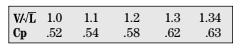
Unfortunately, the majority of sailboats are designed with Cps of .54 to .58 for the obvious reason that the designer is far more concerned with speed under sail than performance under power. To achieve the Cp of .60 to .63 necessary for maximum displacement-hull speeds would require a hull form similar to that of a low-speed motor yacht or trawler, one with a fairly wide and deep transom, to reduce squatting at the stern as the speed increases. This may suit some motorsailers but is not a good hull form for the usual sailing yacht where speed under sail is paramount, because it increases resistance at lower speeds, those speeds that most of us achieve when sailing.
Speed under sail
Due to the vagaries of the wind, the speed under sail of the average monohull auxiliary varies widely, from a speed/length ratio of 0.0 to 1.2, and probably averages somewhere in the range of .8 to 1.1 on a good day. Obviously, a hull designed for these speeds is not suited to the higher speed/length ratios without undue squatting when under power. So the vessel’s potential speed is the first variable and, since owners rarely know their yacht’s Cp, they can only estimate the appropriate speed/length ratio when planning to repower the yacht.
Having guesstimated the desired — or possibly achievable — hull speed, the next problem is to calculate the resistance. For the auxiliary yacht, this depends on the vessel’s displacement as well as the desired speed. The table below shows, very roughly, the resistance in pounds per ton of displacement for the various speed/length ratios assuming the hull has the proper Cp. You’ll note that the resistance (R) increases slowly up to a speed/length ratio of 1.10 and then begins to increase more rapidly with each increase in speed.

At these speeds, the frictional resistance is 20 to 30 percent of the total and residuary resistance (wave making) is 70 to 80 percent. Obviously a fin-keel/spade-rudder yacht with minimal wetted surface will have less frictional resistance than a full-keel yacht so the table can be only reasonably accurate. A practical approach might be to add 5 percent to the resistance for a full-keel yacht and deduct 5 percent for a fin-keel boat.
More resistance
Again, the table assumes the yacht has the correct Cp for the speed/length ratio. I must point out that a yacht with too low a Cp for the desired speed will develop considerably more resistance per ton than one that is correctly designed, and this can amount to a penalty of 25 percent or more!
Fortunately, the penalty for a yacht with a high Cp sailing at a lower speed is not nearly as serious, so designers usually favor slightly high Cps, in the range of .55 to .56. And, of course, the resistance table also assumes a clean, smooth bottom. So the owner who knows the waterline length and the displacement of his sailboat can now roughly estimate her resistance at any desired, and reasonable, speed.
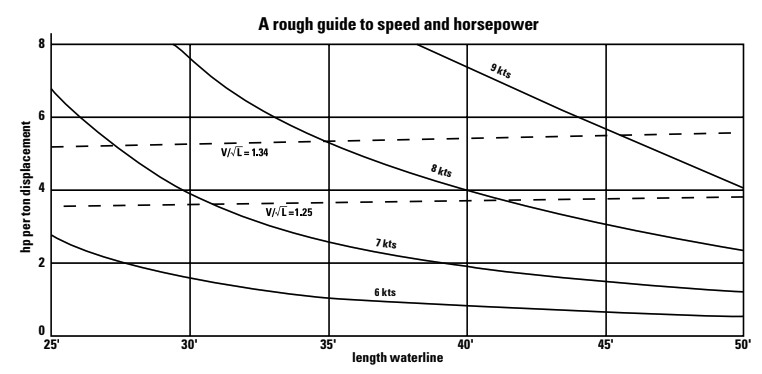
For example, consider a 30-foot-waterline, full-keel sailboat of 20,000 pounds displacement and a Cp of .55. The owner wants to power her to a speed/length ratio of 1.20, 6.6 knots, so we’ll figure on about 33 pounds of resistance per ton. With 8.93 tons displacement (20,000/2,240) the resistance is 295 pounds. With 5 percent added for the full keel, the result is 309 pounds total resistance.
Effective horsepower
With that information, the owner can work out the effective horsepower (the power put out by the propeller) required from the formula EHP = R x V x .0031, where R equals resistance in pounds and V equals velocity, or boat speed, in knots. So the EHP for the 30-footer = 309 x 6.6 x .0031 = 6.32 EHP. Now that sounds ridiculously small to move such a large yacht at 7 knots, and it is. This brings in another variable: propeller efficiency.
The efficiency of the typical propeller will differ with the type, and it can vary widely, as shown below:
- Folding two-blade propeller: 10 to 15 percent effi ciency.
- Fixed two-blade propeller: 35 to 45 percent effi ciency.
- Fixed three-blade propeller: 50 to 55 percent effi ciency.
Most efficient
The highest efficiency would be that of a three-blade wheel with big, wide Mickey Mouse-ear blades, the type of wheel that you might find on a motorsailer but only rarely on an auxiliary cruising yacht. Of course, the location of the propeller also affects its efficiency. A blade in the clear will have the higher of the efficiencies shown above while one stuck behind a wide, unfaired deadwood will have minimal efficiency, perhaps even less than noted.
Also affecting propeller efficiency is the available maximum diameter. The larger the prop diameter, the larger the slipstream and, for any given turning speed, the greater the volume of water that will be set in motion. There is an ideal propeller diameter for a given power, shaft speed, and hull speed, but this ideal is more likely to be found on a tugboat than a sailing yacht. Unfortunately, undersized propellers are too often the norm for auxiliary cruisers.
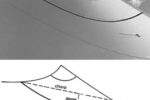
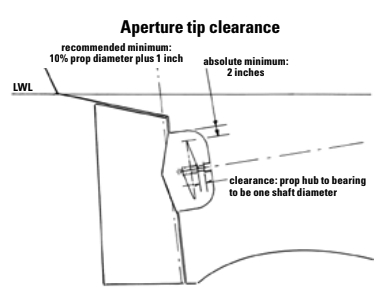
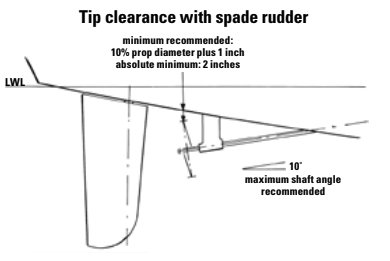
According to Caterpillar, the absolute minimum distance that the blade tip must be below the hull is 2 inches and the ideal clearance is one-third of the blade diameter. This is almost never achievable as the resulting prop would then be too small for good performance. My rule for blade-tip clearance, either below the hull or in an aperture, has usually been 10 percent of the diameter plus 1 inch (see illustrations on Page 34). In the case of a wheel in an aperture, both the size of the aperture and the distance of the propeller from the deadwood or sternpost can greatly affect efficiency. The designer is always of two minds when laying out the aperture; he wants the smallest possible aperture to reduce drag for efficiency under sail and a nice big aperture for efficiency under power. As a rule, efficiency under sail wins out with most cruising yacht designers. The result can be a performance as bad as that of a propeller the size of an eggbeater working in a very small aperture.
Two-blade prop
So, assuming our skipper wants to swing a two-blade propeller to reduce drag under sail, the required horsepower would be EHP/e where e = prop efficiency, or 6.32/.35 = 18.06 hp. Note that an efficiency of 35 percent was selected because the yacht is of full-keel type with the prop in an aperture. So we have 18.06 hp required to drive the yacht in calm water.
However, another variable raises its viperous head: choppy seas and headwinds. We don’t want to slow to a crawl when the conditions turn sour so it is usual to increase the horsepower by up to 35 percent or so to allow for weather, and now we are looking at a 24.4 hp requirement.
One more variable is the power losses in the stern gear from the gearbox, stuffing box, and stern bearing, so we’ll add 10 percent to cover that, and now we have 24.4 x 1.0 = 26.84 hp.
And, for the final variable, since it is not uncommon for engine manufacturers to rate their engine on a stand without all the usual pumps, alternators, etc., working, we’ll add a final 10 percent to allow for that, and look for an engine of about 29.5, say, 30 hp. Simple, eh?
Of course, if you don’t want to go through all those calculations, there is an easier way, and that is to base the power requirement on the yacht’s displacement in tons. Phillips-Birt suggests that 1 hp per ton will provide performance close to a speed/length ratio of 1.0; for yachts of 25-foot LWL, that gives a reasonable 5 knots speed. I can agree with that theory provided the engine is putting out real Clydesdale power and not Shetland-pony power. Phillips-Birt does point out that smaller yachts, say of 20- to 24-foot LWL, may require additional power, perhaps 1.5 to 2.0 hp per ton (the reasoning being that a yacht of 20-foot LWL will usually be operating in a slightly higher speed/length ratio in order to achieve a reasonable rate of knots and, as we have seen, that increases the power requirement).
Chunk of iron
I can recall sailing on Bill Luders’ Storm, of 27-foot LWL and about 8 tons displacement. Her 8-hp diesel (1 hp per ton) was a British, slow-turning chunk of iron, chosen more for its 450-pound deadweight as uncounted ballast than its power output. Still, once we got out the can of ether and fired up that reluctant hunk, those eight Clydesdales probably moved the yacht along at speeds close to Storm’s theoretical speed/length ratio of 1.0, or 5.2 knots; surprisingly good considering the narrow two-blade prop was fitted in an aperture abaft her full keel. Unfortunately, there was no speedometer aboard so it is impossible to say how closely we approached that velocity, but it certainly felt close to 5 knots on a calm day. Well, maybe 4.5 knots.
Of course, that 8 hp would not drive the yacht to 5 knots in choppy seas and headwinds. Slowing to 3 knots would have been normal under power in adverse conditions but, certainly, it was always faster to sail when things turned nasty. Probably Storm would have been better with 1.5 to 2.0 hp per ton if the skipper had wanted to power, but that was unlikely with Bill Luders aboard. If it blew, we sailed.
One yacht of my design that proved the rule of moderate horsepower per ton was the Sophia Christina. This 38-foot-waterline, 20-ton, full-keel schooner powers beautifully through Northwest waters, despite headwinds and adverse tides, with only a 30-hp Saab engine, just 1.5 hp per ton. Admittedly that slow-turning Saab, with its large-diameter, variable-pitch propeller, produces Percheron power, not pony power. But that illustrates what can be done when proper gearing reduces the engine speed to a reasonable shaft speed so that a good-sized prop can be swung, provided the designer leaves room for that big diameter wheel.
No real reason
Even allowing for the inefficiencies of modern high-speed engines, too high a gearing, minimal-sized propellers, adverse weather, and all the other variables, there is no real reason to power an auxiliary cruiser with more than 3 to 5 hp per ton of displacement. The upper figure is probably on the high side, except for motorsailers and sailing yachts with less than optimum hull forms. And then we might look for as much as 6 hp per ton.
Our theoretical 30-foot LWL yacht required 30 hp for 6.6 knots, or about 3.35 hp per ton of displacement, and that does not seem unreasonable based on the above. Another very useful rule of thumb for powering is by the engine size, in cubic inches per ton of displacement, as below.
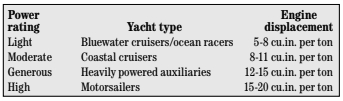
By this rule our 9-ton, 30-foot-LWL coastal cruiser could use an engine of 72 to 99 cubic inches and, at 60 cubic inches per liter, that works out to be in the 1.2- to 1.65-liter range. A check in a catalog of a well-known engine manufacturer shows that its 1.3-liter diesel engine will produce 38 hp at a rather high 3,600 rpm, but an easy 30 hp at a more reasonable 2,800-rpm range. Perfect for our theoretical yacht. As you can see, there is more than one way to skin a cat or select a new engine when repowering.
Having selected an engine, the skipper’s next problem will be the propeller size and the gear ratio. That subject I will leave to the experts at the various propeller manufacturers, as they have the knowledge and experience to provide the necessary guidance on what is, always, a very tricky question.
Thank you to Sailrite Enterprises, Inc., for providing free access to back issues of Good Old Boat through intellectual property rights. Sailrite.com