The debate over outboard engines continues
Issue 37 : Jul/Aug 2004
So you’ve finally decided to retire that old 7.5 Merc you have hanging off the transom of your beloved sailboat. The smoke and noise were bad enough, but having one arm twice the size of the other from all that hauling on the starter rope was the final straw. Time to upgrade to something new.
You’ll be glad you did. Compared to the old gravel crusher, the new outboards are quieter and pollute far less. And just think: instead of all that sawing back and forth on the pull rope (enough to fell the average giant sequoia), now you can get an electric start. Just push and listen to a quiet buzz as the motor comes to life. You’ll wonder why you waited so long.
Things have changed in the world of auxiliary power. In the old days, your only real concern was horse-power choice. With the introduction of four-stroke outboard motors, an ongoing debate has emerged regarding the merits of the two kinds of power plants.
There are two basic types of internal combustion (IC) engines: two-stroke and four-stroke. The “stroke” refers to the movement of the piston through the cylinder of the engine. Every IC engine has four distinct cycles that it moves through while running: intake, compression, ignition, and exhaust. In a four-stroke engine, one cycle occurs with each passage of the piston through the cylinder. Four strokes, four cycles. Note that only the ignition cycle actually gives power; inertia moves the engine through the other three.
Smaller and simpler
In a two-stroke engine, clever engineers figured out that you could accomplish the same four cycles with only two strokes of the piston through the cylinder. The result was an engine that could be smaller, lighter, simpler (fewer parts, no valve train), and more powerful (one ignition for every two strokes instead of every four strokes of the piston). But the universe always balances its books, and there are significant drawbacks to the two-stroke: noise, lack of fuel efficiency, and pollution.
The biggest problem for the two-stroke outboard concerns emissions. They are dirty engines. No way around it. Approximately 20 to 30 percent of the fuel/oil mixture from conventionally carbureted two-stroke engines passes unburned into the air and water. The next time you fill up your fuel tank, try to imagine that a quarter to a third of it will be dumped overboard. One source claims that almost 1 billion liters of unburned oil and gas flows straight into North America’s lakes and waterways via recreational watercraft. That’s equivalent to about 15 Exxon Valdez disasters annually. Four-stroke outboards have emissions 75 to 90 percent lower than conventional two-stroke engines.
Don’t think that the powers that be haven’t noticed this either. Some North American lakes have banned the use of two-stroke motors. In 1996, the Environmental Protection Agency (EPA) adopted a new standard, requiring a 75 percent reduction in outboard and personal watercraft engine hydrocarbon emissions from 1996 levels by the year The government’s intention is that boatowners will eventually require a compliance sticker for their engines or face fines up to $500.
Phasing out
What this means for the industry is not clear, but many are predicting the ultimate phasing out of the two-stroke motor, at least the smaller ones. A quick examination of manufacturer’s websites will show a lot of boasting about how their four-stroke engines meet the tough new EPA requirements, but they’ll have little comment on their two-strokes. Most emission improvements for two-strokes (such as direct injection) have been implemented on the really big engines, not the ones used as auxiliary power-plants on sailboats. Manufacturers are emphasizing their four-stroke lines and are producing far fewer two-stroke engines than in the past.
Four-stroke engines are far more fuel-efficient than two-strokes, burning 30 to 40 percent less fuel. Obviously this is more of a concern if you’re hanging twin 300s off the back of your 14-foot runabout, but even with a little 9.9-hp, the difference can add up over time. In addition, there is no need to add oil to the fuel of a four-stroke. Folks at Honda assured me that the cost difference between the two types of engines can be made up by this difference in fuel efficiency within a couple of seasons of normal use.
A four-stroke is notably quieter than a two-stroke. Again, this is more of an issue with some of the really big engines, but remember how you had to shout to be heard when you revved up that old 7.5 Merc?
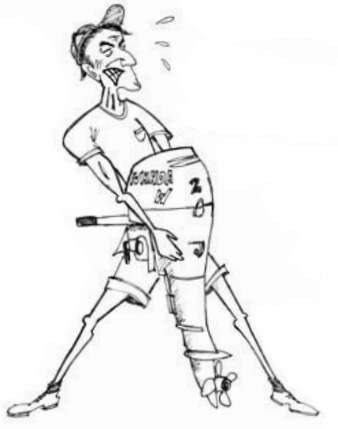
Because they have more parts, four-strokes are significantly heavier. For example, the Yamaha 9.9 two-stroke weighs 79 pounds while the four-stroke equivalent weighs 91 pounds. Honda’s 9.9 can reach a whopping 107 pounds. I hope you have a good chiropractor, especially if your boat has an extending transom mount. For this reason alone, many sailboat owners won’t touch a four-stroke.
Physically larger
For the same reasons listed above, in a horsepower-to-horsepower comparison, four-stroke engines are physically quite a bit larger. For a lot of vessels, this probably isn’t an issue. I sail a Thunderbird, however, and there is no way I could get a 9.9 four-stroke in the enclosed motor well.
Four-strokes used to be considerably pricier than their two-stroke cousins, but the difference in price is declining. Currently, the difference is approximately 10 percent, which can add a few hundred dollars to the purchase of a new outboard. I checked at a local Mercury dealer where a 9.9-hp four-stroke sells for $1,757, while the two-stroke version goes for $1,582.
There is no doubt about it, with the absence of a valve train, camshaft, and timing gears, a two-stroke is mechanically far simpler than a four-stroke. Talk to the dealers, and they will claim that both engine types are exceptionally reliable. This makes sense. Given how dependent we are on our outboard motors (less so for us smug sailors out there), if these engines had a habit of leaving us stranded in the middle of a lake or out in some saltwater bay with a riptide carrying us away from shore, we would quickly stop using them. There are outboards out there more than 30 years old that are still being used.
Lubrication problem
But there are other issues, and I’m not sure how far to take this. One dealer I spoke to whispered behind his hand that he is starting to see increased reliability problems with two-stroke engines. The cause? Not a fault with the engines themselves, but apparently the new generation of gasolines have oxygenators added to decrease automotive engine emissions. The oxygenators include alcohol, and this alcohol can inhibit proper mixing of the two-stroke oil with the fuel, which can lead to premature component failure.
Intrigued by this information, I phoned several marine mechanics in my area for their opinion, and to a man, each one told me that he believed four-stroke engines greatly outlast and are more reliable than the two-strokes. The reason given? It’s a lubrication issue. Having to mix the engine oil with the fuel in a two-stroke greatly reduces lubrication efficiency, increasing wear on moving components.
From everything I could gather, it would seem that four-stroke engines would be the more thoughtful choice for the modern boater. In terms of environmental and fuel-efficiency factors, there is no comparison. And after the new EPA regulations come into effect in 2006, the argument may be moot.
The cost difference is not terribly significant. Four-stroke engines are quieter and smell better. The importance of this should not be underestimated. We’ve all been awakened in the middle of the night by a late arrival in the anchorage — the noise and smoke so bad you’d think something the size of the Queen Mary had pulled alongside. You open the curtains and find a little 18-foot daysailer busily dropping anchor, grandpa’s beloved 1947 Iron Horse outboard rattling away on the transom, belching out more noxious gas than all hell can muster in a single day.
Size and weight seem to be the only real disadvantages to the new generation of motors and have to be weighed against all the other benefits.
Thank you to Sailrite Enterprises, Inc., for providing free access to back issues of Good Old Boat through intellectual property rights. Sailrite.com