Expert advice on choosing the right caulk or bedding
Issue 39 : Nov/Dec 2004
During a visit to the local home improvement center, I chanced to meet a fellow sailing-club member. Barnacle Bob, as he’s sometimes called, had a shopping basket containing about a half dozen 10-ounce tubes of sealants/adhesives. Among them were an automotive windshield urethane adhesive, a rubber-based gutter sealant, and a siliconized latex caulk. After a cursory examination of his purchases, I suggested that some, if not most, of the items might not be well suited for the marine environment where he was planning to use them.
I continued by saying something like: “It’s not that marine products are simply superior to similar products found in hardware and home-improvement stores, but the fact that adhesive/sealant manufacturers formulate their products for specific applications and environments.
“The reactives, additives, and solvents, as well as the grades of ingredients in a product, are selected for specific applications. For example, marine-grade urethanes are considered structurally permanent, yet automotive windshield urethanes repeatedly flex with temperature changes and vehicle motion and are routinely removed for windshield replacement.
“A rubber-based gutter sealant is not constantly exposed to water and after curing shrinks excessively and becomes brittle. Latex caulks not only shrink and become brittle, but have limited adhesive strength and are more cosmetic than structural.”
Somewhere in the middle of this speech he was gone, having retorted, “It all comes from the same factory; just the packaging and price are different.”
Most important part
It was this chance meeting, combined with my 17 years in the specialty chemical industry, that prompted the following discussion.
Selecting the proper sealant or adhesive need not be the most confusing part of a job, but it is definitely the most important part. If the wrong product is used, or if the right product is used incorrectly, failure is inevitable. Don’t rely totally on the manufacturer’s labels. Some companies include helpful job-specific information; however many provide little help or even overstate performance claims.
Despite the dizzying selection, sealants and adhesives are all made from one of five base or backbone polymers: rubber, latex, silicone, polysulfide, or polyurethane. For the most part, the base polymer determines what general characteristics the product will exhibit, such as what substrate materials it will adhere to, how easily the joints can be smoothed, its paintability, and its durability.
Sealants, often referred to as caulk, are lower-performing materials than adhesives. That is, they are not expected to do as much work. Caulks are generally designed to weatherproof, while adhesives are designed to both weather-proof and bond. Some of this bonding or adhesion of an adhesive is mechanical, but most of it is chemical. This is achieved in the following three steps:
- The adhesive is wet out and spread to obtain intimate
- polysulfide molecular contact with the substrate.
- During the setting, the solvents (water, organics . . . ) are released.
- A chemical reaction occurs during the curing, and a cross-linking or in situ polymerization takes place.
The quality of the sealant or adhesive joint depends very strongly upon the nature of the substrate (composition, structure, morphology, and cleanliness). Even the right product, when used incorrectly, will fail.
First, a broad look at what’s available. Through the process of education and subsequent elimination, you should be able to select the right product for the job.
Rubber (elastomers)
Manufacturers often use the terms elastomer and rubber interchangeably. In actuality, any material that exhibits elastomeric properties (stretches and bounces back) is an elastomer. For this discussion, we’ll use the term “rubber-based.”
Materials in this group are stretchy and non-structural. Contact cement falls into this category. These products are generally made with any of the following synthetic rubber compounds:
- Isoprene (synthetic natural rubber)
- Butadiene (SBR or styrene butadiene rubber)
- Nitrile (acrylonitrile butadiene)
- Polychloroprene (neoprene, the first widely used synthetic rubber)
Rubber-based caulks will adhere to almost everything, even damp and oily materials. Their solvents are highly flammable, dangerous to breathe, and will melt styrofoam, which is sometimes used for flotation or insulation. Once the solvent evaporates, rubber-based caulks can shrink as much as 35 percent. They are resistant to hydrocarbons (oil and gasoline), water, and many solvents. If (and a big if at that) used aboard ship, they are limited to special-purpose applications, such as creating seals and gaskets for fuel tanks/systems.
Latex
Latex originally referred to the milk-white substance occurring in certain trees and plants. This natural rubber latex occurs in the Hevea brasiliensis tree and the guayule plant. Prior to the advent of the synthetic latices, the foregoing definition may have been adequate; it is no longer adequate. A more suitable definition is: latex is a stable dispersion of a polymeric substance in an essentially aqueous medium (a dispersion in water — the final product of emulsion polymerization).
Some latex-based sealants are also labeled acrylic caulk or vinyl caulk. In the first instance, the product contains an acrylic polymer (polymethyl methacrylate) and in the second a vinyl polymer (ethylene-vinylacetate). In either case, the chemistry is a C=C polymer dispersed in water; and it is through the addition of these polymers that the products’ performance characteristics are enhanced.
About 5 to 7 years ago new technology resulted in siliconized latex. Siliconized latex caulks are acrylic and contain a small amount of silane (a silicon-based material). This combination promotes better adhesion. Do not confuse siliconized latex with 100-percent silicone.
Unlike the vast majority of sealants and adhesives, latex caulks do not contain volatile solvents. This allows them to be smoothed out with a wet finger and the excess cleaned up with soap and water. They are inexpensive, fast drying, and paintable (some are even pre-tinted). However, they can mildew, have limited adhesive strength and flexibility, and often shrink after curing. They should be relegated to household use only, not marine applications.
Silicone
Silicone is derived from silicon, the non-metallic element commonly found in sand. This sealant is available in two types. Each type is based on the specific curing agent employed. One type is acetoxy-cure silicone, whose technology was developed in France in the 1950s. It is also called acid-cure or moisture-cure silicone. Acetic acid is the catalyst in the formula, thus the characteristic vinegar smell. Even though many marine silicone sealants are of this variety, be aware that this “acid” version can be corrosive to metal, particularly aluminum. The neutral-cure or natural-cure variety of silicone sealant is newer technology and is ammonia-based. It gives off little or no odor and is not corrosive.
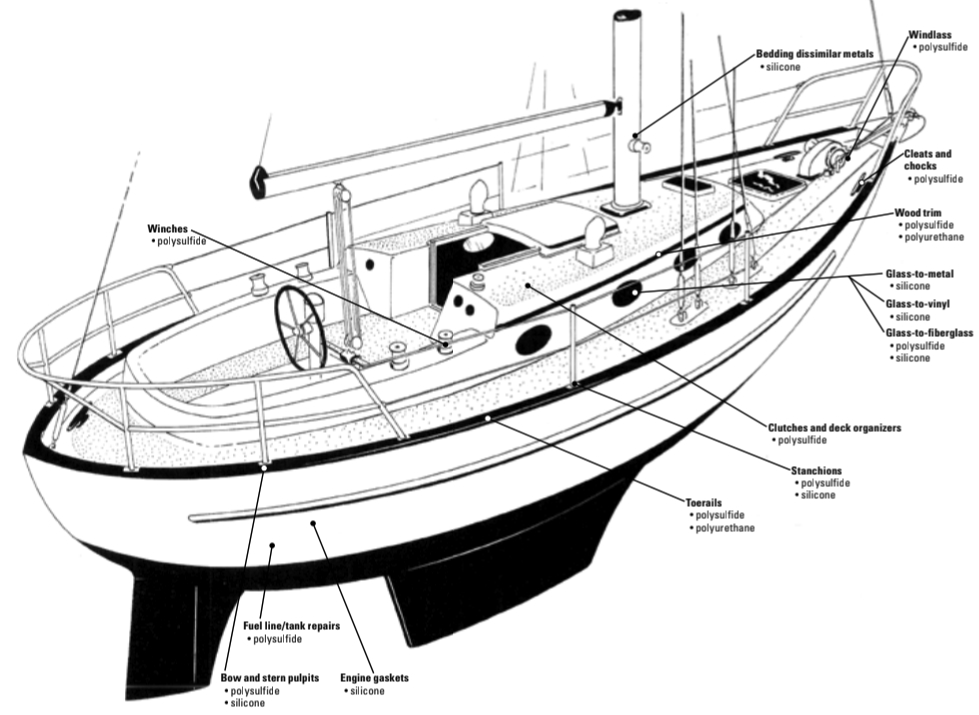
Silicone sealants cure fast (they skin over in a half-hour to an hour and completely cure in 24 hours). They are virtually non-shrinking, soft, elastic, resistant to solvent and fuels, can withstand high temperatures (recommended for form-in-place engine gaskets), and have a long service life (20 years is often given by manufacturers). They afford excellent insulating properties, making them ideal for bedding dissimilar metals and potting electrical junctions (insulation and corrosion prevention).
Silicone sealants are also compatible with plastics. They exhibit very tight cohesive qualities; that is, once they are cured, they form a tough resilient gasket that is difficult to tear apart. This quality makes silicone sealants most suitable for use as a form-in-place gasket under compression, such as the bedding of a stanchion base, which is then held in place by mechanical fasteners.
Painters’ scourge
However, silicone sealants are not perfect. For starters, they are difficult to smooth and will not hold paint. In fact, silicone in any of its forms (sealant, wax, lubricant) is a scourge to painters. Should silicone be used on or even near a surface that may be painted or varnished (in some cases even years later), contamination can occur and all attempts to paint or varnish will be repelled.
In addition to a product, called Release, from BoatLIFE, there are cleaners one can borrow from the auto painting business that will help to remove silicone residue (DuPont’s Prep Sol and Martin Senour’s Kleanz Easy), but the silicone residue can continue to leach out of the substrate for years. The use of silicone is one reason why an epoxy barrier coat or an epoxy primer is almost universally recommended under polyurethane paints on fiberglass hulls and decks (both were exposed to silicone mold-release agents during manufacturing). When silicones are involved, it is always recommended to paint the substrate before applying them. By the way, silicones come in clear and a variety of colors.
Paint and varnish are not the only materials that do not adhere to silicone. Silicone does not adhere well to silicone. A damaged seam or seal made of silicone must be completely removed, the surface cleaned, and fresh material applied. With silicone sealants, applying a little dab of new material over the damaged old material will be a short-lived solution.
Not good glue
Silicone sealants lack significant adhesive strength and rely on mechanical compression to maintain a seal when used as a bedding compound. This makes them suspect when applied in bead form to working seams or in applications where it is necessary to fill a large void.
Naturally occurring bacteria (Bacillus niger) attack silicone. This microorganism can cause discoloration (mildew) and deterioration. Silicone sealants sold in hardware stores and home centers contain mildewcides; however, they yellow when exposed to sunlight (ultraviolet rays). To help prevent yellowing, marine silicone sealants also contain a UV inhibitor in addition to a mildewcide.
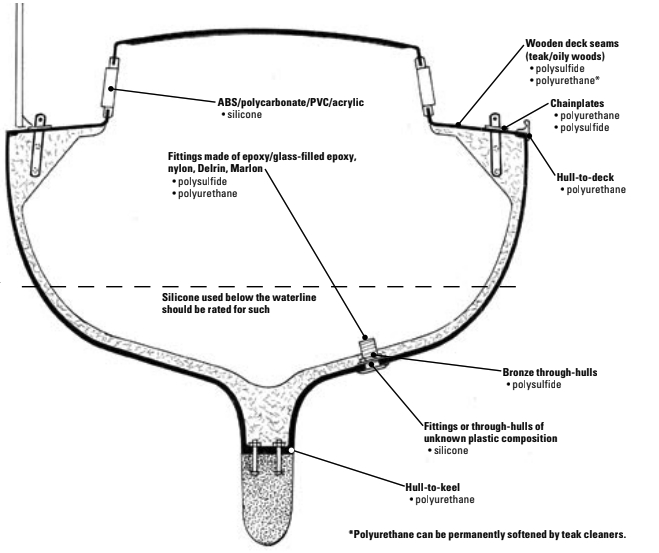
Silicone sealants are universally not recommended for use below the waterline as seam sealers. This stems from the fact of their low adhesion coefficient, making them extremely poor seam sealers, especially under water. With prolonged continuous exposure to water, they become even poorer. However, poor adhesion is not an issue and therefore not a problem when silicone is used in conjunction with compression.
Unlike polysulfide and polyurethane (two major marine adhesives/ sealants), silicone is compatible with plastics. By default, silicone becomes the sealant of choice for use under mechanically fastened plastic through-hulls.
Before it sets, silicone can be worked by smoothing it with a wet finger. Clean up with soap and water before it has cured; after curing, mineral spirits will help soften the sealant prior to mechanical removal.
Consumer products that are commonly available at marine centers that fall into this category include: BoatLIFE Marine Silicone Sealant; GE 8200 Bedding & Trim Sealant; 3M Marine Grade Silicone Sealant; and Marine Silicone Sealant offered by West Marine.
Polysulfide
With its technology dating back to the 1940s when, under the name Thiokol, it was used to patch bullet holes in airplanes as well as to make aircraft fuel tanks leak- and explosion-proof, polysulfide is perhaps the most versatile marine adhesive-sealant combination available.
Polysulfide adhesive sealants exhibit strong adhesion, high elasticity, a resistance to fuels and solvents, are toolable, sandable, and paintable, and are generally unaffected by movement associated with stress and temperature change. Because of their high bonding strength, high elasticity, and resistance to fuel and solvents, including harsh teak cleaners, polysulfide adhesive sealants are the choice for bedding oily woods, such as teak, to a variety of substrata including fiberglass, wood, and steel, regardless of whether or not mechanical fasteners are used. The black caulking between planks of a teak deck is invariably polysulfide.
Polysulfide adhesive sealants are available in both one- and two-part formulations. They are also available in a variety of consistencies from pourable (thickness of honey) to gun-grade (applied through a caulking cartridge) to a knife-grade (applied with a putty knife). Depending upon the formulation, polysulfides can contain a variety of solvents (xylene, toluene, acetates, alcohols, ketones, petroleum distillates, chlorinated solvents, or a combination of these).
The average boatowner seldom runs across the two-part types, which are more commonly marketed to boat manufacturers and commercial boatyards. Typically available at marine centers are the one-part, gun-grade versions; however, depending on the manufacturer, the solvent package may vary.
Not for plastics
The one significant weakness associated with polysulfide adhesive sealants can be directly attributed to the solvent package. Polysulfide adhesive sealants are incompatible with most plastics, mainly rigid thermoplastics such as acrylic (Plexiglas), polycarbonate (Lexan), ABS, and PVC. The solvent(s) can leach the plasticizer from this class of plastics and cause them to harden and crack. Higher-quality fittings made from epoxy, glass-filled epoxy, nylon, Delrin, or Marelon (glass-reinforced nylon), are unaffected and can be safely bedded with polysulfide adhesive sealants.
When compared to silicones and polyurethanes, polysulfide adhesive sealants cure the slowest (tack-free from 30 minutes to 72 hours, with a full-cure time ranging from 2 to 10 days depending upon formulation/manufacturer). Exposure to moisture in the air is what cures polysulfides; higher humidity levels will cause them to set more quickly. Polysulfides will continue to cure under water and, in an emergency, can even be applied under water as a temporary repair. Ambient temperature also affects the rate of cure (the warmer the temperature, the more rapid the cure).
Polysulfide adhesive sealants are readily paintable with no special priming required. The primers for polysulfide that are often seen on chandlery shelves are not for priming the adhesive sealant prior to painting, but for priming oily woods (be it teak or woods exposed to oily bilge water) prior to applying the polysulfide, when no mechanical fasteners will be used. In this instance, the polysulfide will be the sole bonding agent. If mechanical fasteners will be used, no priming is required. In this instance, the sealant will be functioning as a gasket.
Although the adhesion of polysulfide is less than that of polyurethane, this is an advantage, especially when polysulfide is used on fittings that might have to be removed sometime in the future. When it comes to removal or cleanup, uncured polysulfide can be cleaned up with mineral spirits, lacquer thinner, or naptha (lighter fluid). However, once it begins to set, methyl ethyl ketone, toluene, or xylene must be employed. Mechanical removal (cutting, scraping, or sanding) is required on fully cured material.
Polysulfide-based products that are commonly available at marine centers include: BoatLIFE Life Calk Sealant; BoatLIFE Life Calk Deck Sealant (this is a two-part product); 3M Marine Sealant 101; and West Marine MultiCaulk Sealant.
Polyurethane
What is this stuff that we call polyurethane? In general chemical terms, it is any polymer that has been extended by the reaction with di- or poly-isocyanate. And since isocyanates can react with any compound containing an active hydrogen molecule, the door’s open for the creation of materials possessing a wide range of properties.
For the average boatowner, polyurethanes are state-of-the-art adhesive sealants, with the accent strongly placed on the word adhesive. They are tough, waterproof, flexible (ranging from less flexible than silicones to about the same as, or close to, polysulfide), permanent adhesives much like epoxy.
Polyurethanes are excellent for hull-to-hull, hull-to-keel, chainplate, and centerboard trunk installations. Since they are considered permanent, polyurethanes should not be used in any applications where future disassembly may be required. Polyurethanes are not just difficult to remove, it is nearly impossible to remove them without the part or substrate or both sustaining damage.
With a few exceptions and subtleties, polyurethanes exhibit a lot in common with polysulfides. For example, like polysulfides, polyurethanes can be tooled, sanded, and painted. Wet sanding of cured material is often recommended, which suggests that polyurethanes are not easily sanded. Also, since polyurethanes are not generally UV-stable, it is best to paint or otherwise protect any exposed material.
Not as tolerant
Polyurethanes bond to a variety of substrata, much like polysulfides, including wood (oily or not), fiberglass, and metal. However, unlike polysulfides, polyurethanes are not as tolerant of fuel and solvents, including some teak cleaners (most notably the two-part teak cleaners). Repeated or continuous exposure to any of these will permanently soften polyurethanes.
The warning against using polyurethanes with thermoplastics is the same as for polysulfides. However, instead of the polyurethanes’ solvent leaching the plasticizer from the plastic, the problem is the opposite. Solvents leaching from the plastic can react with the polyurethanes and weaken the bond.
Polyurethanes are also available in both one- and two-part formulations. One-part formulas are commonly available at retail marine outlets, while two-part polyurethanes are relegated solely to boat manufacturers. While polyurethanes cure faster than polysulfides, like polysulfides, their cure times are a function of ambient temperature and humidity as well as the volume of surface area of the adhesive. Tack-free time ranges from 30 minutes to 48 hours, while 3 to 7 days is the range expressed for a full cure, depending upon formulation/manufacturer. Even though polyurethanes can be used above and below the waterline, their use as an underwater temporary fix is not recommended.
Lastly, uncured polyurethane can be cleaned up with acetone. However, once the material begins to set, the same industrial solvents recommended for polysulfide cleanup (mineral spirits, lacquer thinner, naptha) as well as 1,1,1-trichloroethane are needed to remove it. Once cured, these solvents may help soften polyurethane prior to mechanical removal. A relatively new product introduced by JWB Environmental called Anti-Bond 2015 is said to assist in removing fully cured polyurethane. Another called DeBond 2000 is said to remove cured 5200, the highly touted 3M product.
Products whose chemistry is based on polyurethane and are routinely available at marine centers are: BoatLIFE Life Seal; 3M 4200 Fast Cure; 3M 5200; 3M 5200 Fast Cure; Sikaflex 291 LOT; Sikaflex 291; Sikaflex 292; and West Marine Quick Cure Polyurethane Adhesive/Sealant.
Of special note
As indicated early on in this discussion, sealants and adhesives are polymers. And it is this polymer base or backbone that determines the product’s general characteristics. The specific characteristics, such as UV-stability and compatibility with various substrata, to name two, are dependent upon two things:
- The compound or compounds the base polymer has been combined (chemically reacted) with. For example, an aliphatic polyurethane (one that does not contain benzene rings) is UV-resistant; however, an aromatic polyurethane (one that does contain benzene rings) is not UV-stable.
- The additives that may have been incorporated into the product’s formulation. Typical additives include:
- Fillers that increase modulus and provide reinforcement.
- A catalyst package to speed up or retard reaction rate.
- Rheology modifiers to control viscosity for dispensability, also sag characteristics (nonsag/selfleveling).
- Moisture scavengers, pigments, flame retardants, and UV stabilizers.
Simply stated, the reactives and the additives are the two reasons why there are different types of silicones, different types of polysulfides, and different types of polyurethanes, each exhibiting different characteristics. This then leads to a few marine sealants/adhesives worthy of special note:
- GE 8100 Hatch & Window Silicone Sealant. This is the only silicone sealant recommended by GE for sealing polycarbonate (Lexan).
- BoatLIFE Sandable Silicone is a blend of silicone rubber and a proprietary ingredient.
- BoatLIFE Life Seal is a combination of polyurethane and silicone
- 3M 4000 UV is a polyether-based cosmetic sealant for applications where aesthetic appeal is a priority. It is UV stable and can be used with plastics, including ABS and polycarbonate (Lexan).
- Sikaflex 295 UV is a polyurethane adhesive sealant for bedding and sealing acrylic (Plexiglas) and polycarbonate (Lexan).
Summing it up
So, what should you use the next time you need to “glue” something together and keep the water out?
For bedding applications, choose between silicone and polysulfide. Keep in mind that silicone is a good gasket material and electric insulator, while polysulfide is great for bedding everything except plastic.
As for seam sealing, select either polysulfide or polyurethane.
If you want to take it apart in the future, use polysulfide. Polyurethane is permanent.
Thank you to Sailrite Enterprises, Inc., for providing free access to back issues of Good Old Boat through intellectual property rights. Sailrite.com