Keeping that drip-drip-drip under control
Issue 40 : Jan/Feb 2005
A shaft log guides the propeller shaft through the hull while keeping watertight integrity. It consists of two parts, a watertight seal and a bearing that supports the shaft. When inboard engines were initially installed in early wooden boats, the shaft exited through the sternpost and relied on a reasonably tight fit between the wood and propeller shaft to keep the water out. But since this usually meant regular pumping of the bilge, a better solution — the stuffing box and Cutless bearing — came into widespread use.
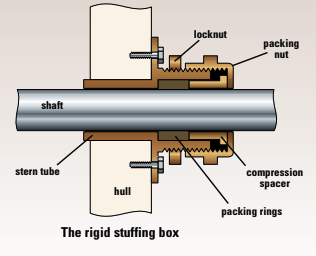
The stuffing box — sometimes called the packing gland — eliminated most of the leakage around the shaft by compressing stuffing, or grease-impregnated flax packing, tightly around the shaft. Some stuffing boxes have grease fittings, so this grease can be easily replaced.
The stuffing, which is a square, plaited material, usually flax, comes in various sizes to match your stuffing box. This flax is now usually impregnated with paraffin or Teflon. To keep the stuffing box cool and lubricated, a small amount of water from outside the hull is allowed passage through this compression seal. This cooling water should consist of about one drop every 10 seconds when the shaft is rotating. Although there is some disagreement as to the drip rate, the rule of thumb is that the stuffing box should feel warm, but never hot, after prolonged use.
Level of perfection
Although the stuffing box should not drip water when the shaft is not turning, this is only an ideal. Few stuffing boxes meet this level of perfection, so when a boat is left for long periods of time an automatic bilge pump is often necessary. Eventually, the packing in the stuffing box gets worn away and has to be replaced. To do this the old, hardened packing must be removed. Special tools are available for this purpose. The stuffing box can then be cleaned and new packing installed. When the vessel is relaunched, the drip rate must be checked and the compression nut adjusted as necessary. This drip rate should be checked again during the next few times out. There is also self-lubricating, low-friction packing available. A clay-like compound is inserted in the stuffing box and compressed by rings of conventional packing. Then the packing compression nut can be adjusted so there are no drips. Although more expensive than conventional packing, after the initial adjustment this system rarely needs readjustment.
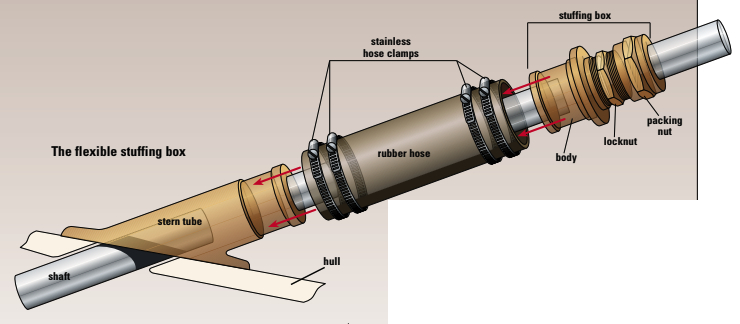
There are two basic styles of stuffing boxes, rigid and flexible. In the rigid style the stuffing box is bolted directly to the hull or stern tube. The flexible type connects the stuffing box to the stern tube or Cutless bearing by a short, flexible length of rubber hose double-clamped at both ends.
For those who find the constant drip of water into the bilge to be disconcerting or for those who find it difficult or impossible to accomplish the contortions required to adjust the compression and lock nuts on the stuffing box, a dripless seal is the answer.
Newer method
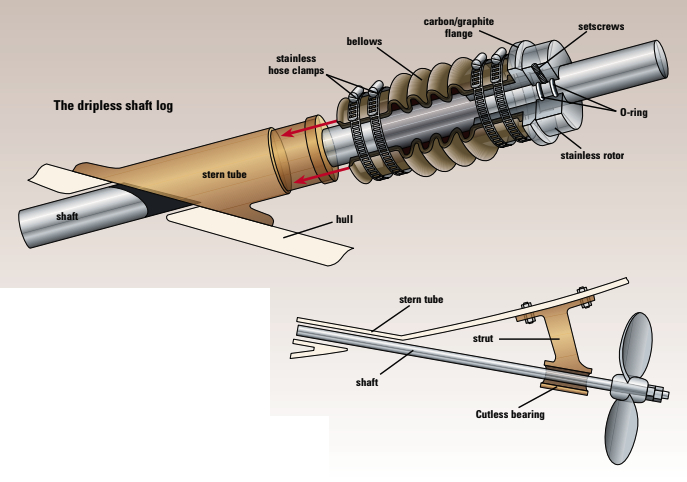
Dripless shaft seals replace the stuffing box and are a newer method of providing a seal that is completely watertight. A rubber bellows is used instead of the straight rubber hose to connect the dripless seal to the stern tube or Cutless bearing. At the forward end of this bellows is fastened a polished carbon flange, which is compressed by the bellows against a polished stainless-steel rotor attached to the shaft. Thus, the carbon flange remains fixed to the rubber bellows, while the stainless-steel rotor rotates with the shaft. The tolerances on this seal are so close that there is no drip, and heat from friction is reduced by the natural lubricating properties of the carbon and the cooling water just behind the seal. This seal does not require the frequent, awkward readjustments that are required by the conventional stuffing box or the periodic removal of the old packing and its replacement. It also prevents the scoring of the propeller shaft that is a long-term problem with stuffing boxes.
The Cutless bearing provides support and alignment for the propeller shaft. It is a bronze, stainless-steel, or fiberglass tube with a grooved nitrile-rubber or plastic liner inside. The propeller shaft is supported by this Cutless bearing inside the stern tube or in an external strut and, when new, should allow little or no play in the propeller shaft. The grooves in the liner allow outside cooling water to enter the Cutless bearing to cool both the propeller shaft and seal.
Signs that a Cutless bearing needs replacement are vibration when in gear and a propeller shaft that shows 1⁄16 inch or more of play. Replacing a Cutless bearing can be quite a task. Although the bearing itself is relatively inexpensive, the replacement process can be complicated and frustrating. It usually requires the removal of the propeller shaft that, in turn, often means removal of the rudder. The setscrews holding the Cutless bearing to the stern tube are then removed, and a Cutless-bearing puller is used to remove the old bearing. A new bearing can then be slid in place. If it’s a tight fit, keeping it in the refrigerator or freezer overnight will usually shrink it enough to make the job easier. Then the greased propeller shaft can be slid into place, coupled to the engine, the propeller and rudder installed, and the engine’s alignment checked.
A properly aligned Cutless bearing should last for several thousand hours.
Thank you to Sailrite Enterprises, Inc., for providing free access to back issues of Good Old Boat through intellectual property rights. Sailrite.com