A designer compares four sturdy, solidly performing cruising yachts
Issue 40 : Jan/Feb 2005
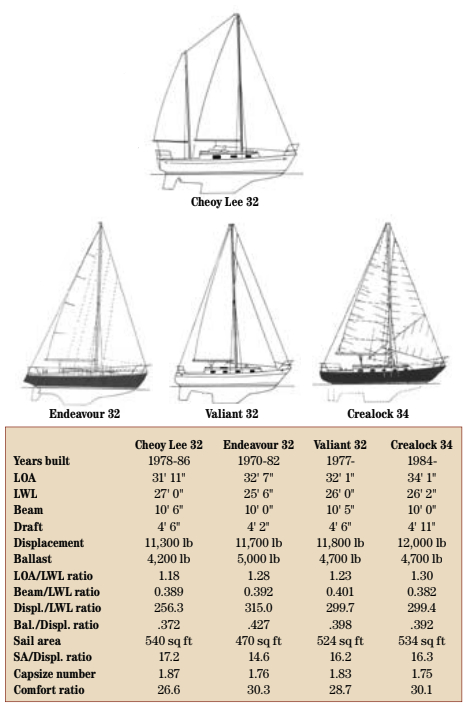
The four yachts under discussion here cover a 14-year design period, from the 1970 Endeavour to the 1984 Crealock. Although two of the boats — the Valiant and the Crealock — are double-enders, they are all remarkably similar in many ways. The Endeavour is the most extreme, perhaps, having the shortest waterline and shoalest draft by a few inches and the smallest sail area of the group. Designed by Ted Irwin as a cruiser/racer, its Floridian heritage explains the shoal draft. Because it was designed at the end of the Cruising Club of America (CCA) era, its low rig and moderate sail area are understandable. Regardless, it fits in nicely with this company as a comfortable family cruiser with offshore aspirations.
Here are the numbers. We had a bit of trouble obtaining some of the figures, and I’m still not 100 percent sure of the dates, so readers might correct me if I’m wrong on any of the facts.
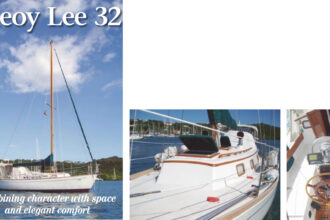
To my mind, Ray Richards’ handsome Cheoy Lee 32 has one advantage over the rest of the pack and that is its optional ketch rig. This increases sail area to 540 square feet and the SA/Displ. ratio to 17.2. The drag of the mizzen-mast could reduce windward performance slightly, perhaps, but the added sail area should improve off-wind performance, particularly when the mizzen staysail is set. And, as you know, gentlemen never sail to windward! As well, the ketch rig offers a wide variety of reduced sail combinations for heavy-weather conditions and can be easily trimmed for hands-off sailing to weather.
In any case, I’ve long been enamored of ketches and yawls. I expect that comes from my teenage years when I read, and dreamed about, William A. Robinson’s Ten Thousand Leagues Over the Sea, the story of his circumnavigation aboard the Svaap, a 32-foot Phil Rhodes ketch, in the late 1920s and early ’30s. It is still a great book and, if you can fi nd a copy, well worth reading even in these days of GPS, radar, depth sounders, SSB radio, and the other modern conveniences that Robinson managed without so successfully.
As to performance, I think we have to consider the Endeavour to be the “tail-end Charlie” under most conditions. I expect it’ll make a bit more leeway than the others, due to its lesser draft, and prove to be a tad slower in light air, under 10 knots or so, due to its smaller rig. However, the Endeavour could well be the heavy-weather champion of the group thanks to its high ballast ratio, high comfort ratio, and moderate rig. The other three are more evenly matched for performance; I would not want to be the one to handicap them for a race around a triangular course.
In any case, racing performance is not what these boats are about. Rather, they are four sturdy, solidly performing cruising yachts. A study of the numbers indicates that they are all quite capable of comfortable coastal cruising and offshore island-hopping. Indeed, lesser yachts make happy and successful ocean voyages every year, and there is no reason these boats could not do the same, given good condition, proper equipment, an experienced crew, and the usual run of luck.
Thank you to Sailrite Enterprises, Inc., for providing free access to back issues of Good Old Boat through intellectual property rights. Sailrite.com