Youth and poverty turn a stock Cal 25 into a world cruiser

Issue 40 : Jan/Feb 2005
My decision to rebuild a Cal 25 for a voyage around the world was inspired by one basic fact: I was broke. A 25-foot boat was all I could afford. But at age 22, I had a lot of energy and big dreams. When wise adults (hereafter known as The Skeptics) tried to dissuade me from going — saying it was a dangerous plan — I politely explained the reasoning behind my overall scheme, about how I was beefing up the flimsy hull with extra fiberglass.
I smiled, they smiled; each of us thinking the other an idiot for not seeing the obvious. Eighteen months down the road, as the project neared completion and I was getting ready to set off, the flak increased. I finally realized that people who are scared to be in your shoes will call you a fool.
A stock Cal 25 was never intended for long-distance ocean sailing. I discovered that while sailing the boat more than 10,000 miles between Seattle and New York via the Panama Canal. Bulkheads tore loose. The hull and rudder cracked. The problem with taking any older daysailer cruising is that the extra gear and provisions required for a lengthy voyage overburden the boat in ways that were never anticipated during construction. For example, an empty cardboard box can be dropped and remain intact. Fill the same box with heavy cans, and it will split wide open when dropped.
Although inadequately constructed, the hull has a superb design. The reason I entertained the notion of rebuilding the boat was due to its sailing characteristics. Designer Bill Lapworth knew what he was doing when he penned the Cal 25. With its long fin keel, spade rudder, and flat sections, the boat boogied.
Deck not normal
Some people had a problem with the way the boat looked. The trend-setting flush deck was definitely not normal. More than a gimmick for providing extra space below, however, the flush deck was the boat’s saving grace during a circumnavigation. In severe sea conditions it provided extra free-board. During knockdowns, the boat lay on its side and bounced down the faces of waves like a beach ball. In the same circumstances, traditional designs with sidedecks and cabin trunks tend to dig in.
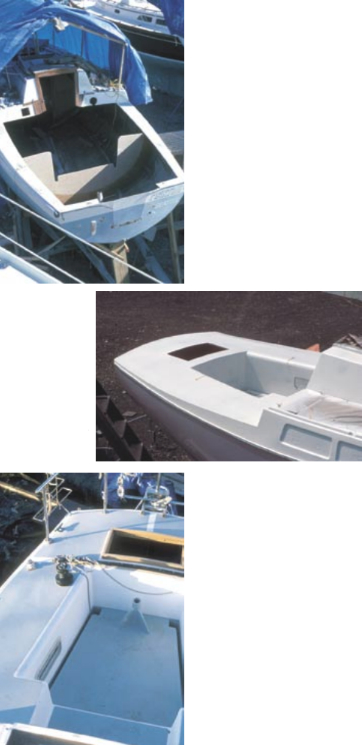
The boat’s major design flaw was its enormous cockpit. The gunwales, in particular, were too narrow. During a gentle knockdown, half the sea poured over the rail like a bucket dipped in a well. The companionway was also enormously wide, and the Cal sported a sloppy innovation called the pop-top — quite possibly the largest, leaking, fiberglass deck hatch in the world. Prior to the Seattle-to-New York trip, I had reduced the size of the companionway opening and replaced the pop-top with a hard doghouse to make the boat watertight. Now that I was doing a major overhaul, however, the cockpit had to go.
The most difficult aspect of any project is beginning. Apprehensions stymie action and large cash outlays cause shortness of breath. The best way to get started on any rebuild project is to rip the boat to pieces as quickly as possible — before you know what has hit you. Then the only alternative is to put it back together again.
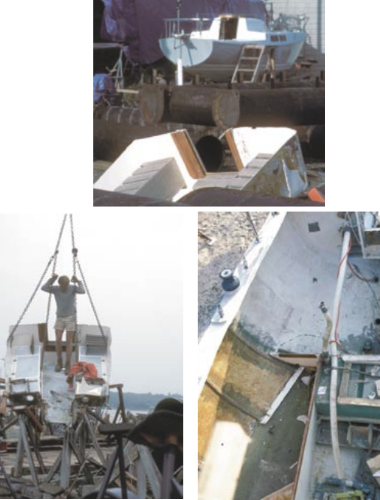
On a quiet Sunday in November 1985, I ran an air hose out to Direction, hooked up a cutting tool, and slipped on a dust mask. In less than two hours the cockpit was severed from the hull and lying on the ground nearby. During the week that followed I ripped out the V-berth, the galley, dinette, and quarter berths. I left the main bulkhead intact. I sanded the hull back to clean fiberglass.
Rocked the keel
I now had a bare hull and deck, minus a cockpit. To find out where the hull needed stiffening, I blocked the boat high enough so the keel was an inch off the ground. I then sat inside the empty hull with a 6-foot 2 x 4. Using it as a lever, I put the 2 x 4 into the deep bilge and began rocking the keel. Once enough momentum had built up, the keel swung freely from side to side, simulating its motion when sailing to windward. Without any interior to obstruct my view, I was able to observe that the transom twisted, the sides of the boat moved in and out, and the bottom of the hull flexed up and down. Using a magic marker, I put circles in all the areas that were contorting. Having completed the “research phase” of construction, I was able to map out my “structural scheme” to keep the hull rigid.
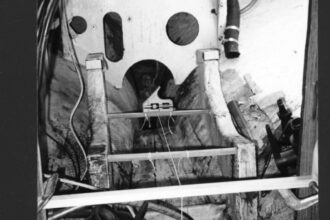
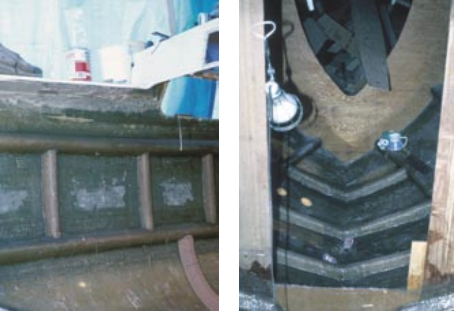
To curb the twisting and flexing, I chose to run three longitudinal stringers from stem to stern. I placed one of the stringers at the sheer to act as a clamp. Another followed the waterline. The third went across the flatter areas of the hull between the waterline and the garboard. After those were in place I added a thwartship bulkhead between the main bulkhead and the stem and another bulkhead 5 feet forward of the transom. Last, I curbed the keel movement by adding five box-section keel floors that were tied into the lower stringer. When I was finished with the boat’s structural additions, the interior resembled the inside of a DC-3 fuselage (see photos on Page 31).
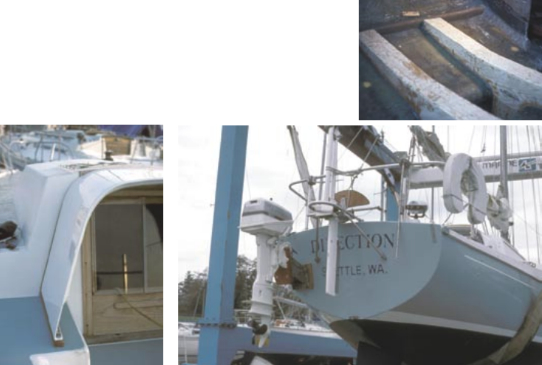
I designed the new cockpit with wider gunwales, a shallow footwell, and a long stern deck. This new aft deck not only prevented the hull from twisting, it kept following seas from slopping into the cockpit. A hatch provided access to the newly formed watertight aft lazarette. I also rebuilt the companionway. It was an 18- by 24-inch opening surrounded by a hard, fiberglass dodger. There was no sliding hatch. It was an extremely small opening for humans to wriggle in and out of, but it also presented a challenge for breaking waves (see photo on Page 31). Direction would prove herself to be a very dry boat.
Attacked her size
By the time I was finished with this structural phase of construction, I had invested 500 hours of my time, spread out over six months. The Skeptics still prowled, offering their advice and wisdom. They could no longer argue that the boat was not strong enough for a sea voyage so they attacked her size instead.
“Too small,” they claimed. “She’ll be overcome by large seas.”
“We’ll see,” I said.
I did not want an interior that resembled the inside of an oak coffin. I wanted an interior that was light and airy, cheap to build, with enough room for two people to live in relative comfort. Although I was planning to begin my voyage alone, I was hoping to find a partner en route. Never in my wildest dreams would I have imagined that children would one day prowl the deck and enliven the cabin with their frantic energy. Fortunately that was a few years off, and I still had some energy of my own left to complete the project and get moving toward my destiny of meeting my wife-to-be, Jaja.
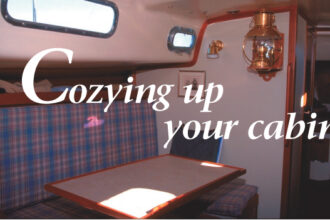
I designed extra wide settees in the main cabin to provide maximum food and water storage capabilities over the keel. The advantage with these wide settees is they were also comfortable berths. I hate narrow bunks — even at sea. I want to be able to move my arms and legs and to be able to curl up in a fetal position when I’m seasick. By inserting two plywood boards with cushions between the settees, the entire main cabin was transformed into a 6- by 7-foot double bed.
Dishwater back
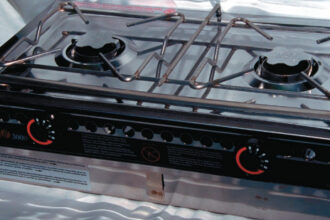
The galley sink was to port and the stainless-steel Hillerange two-burner kerosene stove, with oven, was to starboard. There was not standing headroom in the galley, but it was easy to sit on the settees and cook, which worked well in rough conditions. Washing up was a different matter. You had to stand and bend over the sink in order to operate the hand pump. This created a syndrome Jaja would later term “dishwater back.”
Instead of a traditional V-berth, I ran the cabin sole all the way to the new forward bulkhead. I built vertical lockers for hand tools, clothes, a sewing machine, and dry stores. In time, this area would be remodeled and become the nursery. The 5-foot space between the forward bulkhead and the stem was storage for sails and charts.
Building an enclosed head on a small boat is a colossal waste of space compared to how much use it receives. I installed the head on Direction at the foot of the sail locker. Since it was located at the bow, it was a fairly miserable experience to use it while at sea. But the boat had a head, and it did not take up any valuable space.
Compromises are the main theme when designing small-boat interiors. You have to weigh the pros and cons of each situation and pick the lesser of two (or perhaps more) evils. My main drive was to create maximum storage in the middle of the boat. When fully provisioned, Direction could carry 60 gallons of water and 15 gallons of kerosene. Most important, we could stock enough food to last a family of four for three months. As a rule of thumb while provisioning, we knew that six shopping carts brimming with supplies would somehow find a place aboard.
Got through gales
Direction proved herself to be an able sea boat, especially in severe conditions. Her extra freeboard and wide-gunwaled cockpit (and virtually leakproof companionway) were battlements against breaking waves. She got us through many gales, the worst of which was an 11-day blow in the Indian Ocean. And she held together during a 90-degree knockdown on the Coral Sea. In seven years we logged more than 45,000 miles on her without a single, structural mishap. Not bad for a boat that cost less than $15,000 to rebuild and fit out.
That’s not to say we zoomed around the globe always reveling in cushy comfort. Far from it. At sea when the wind blew more than 20 knots, the constant and unforgiving motion would sometimes chafe our nerves to distraction. Making a cup of coffee was akin to a high-wire act. And then there was the reality of a boat battened down tight for sea while holding a load of dirty diapers. But we survived and the children thrived. We knew we would be more comfortable living ashore, but would we be happier? Not on your life.
Well, it’s been 20 years, three kids, and a voyage to the Arctic on a different boat since that Sunday in November 1985 when I tore Direction to pieces. If I have learned anything useful over the years it is this: unless you have unlimited funds, do not place “comfort and convenience” at the top of the priority list. None of us wants to sleep on a bed of nails or use canvas soaked in cod liver oil for rain gear, but attempting to bring all the perks of shore life onto the boat will get complicated and costly. Prioritize. Buy only the stuff to make the boat safe and performance-oriented. Comfort is a relative state. I can adjust to anything and be happy about it — especially when a dream is being lived out.
Looking back, I would not have changed a thing. I chose cruising over college and incorporated a family into the general sailing plans. It really is true that the most difficult aspect of any project is getting started. You must be bold, hold firm to your aspirations, and not allow the questioning looks from others to hold you back. Do what you have to do, because time will charge on regardless.
Incidentally, not long ago I met a few of The Skeptics from my youth — the ones who had offered less-than-positive encouragement when Direction was little more than a boatyard disaster area. Now my aged adversaries clapped me on the back. They said, “I remember when you were just a kid, Dave, rebuilding that boat. Oh my goodness! I would have given anything to be in your shoes. What adventures you’ve had!”
I just smiled.
Thank you to Sailrite Enterprises, Inc., for providing free access to back issues of Good Old Boat through intellectual property rights. Sailrite.com