Built for comfort with Robert Perry performance
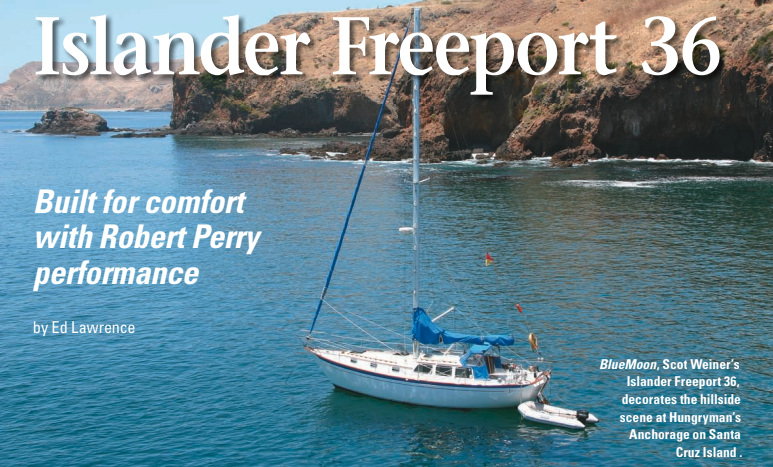
Issue 46 : Jan/Feb 2006
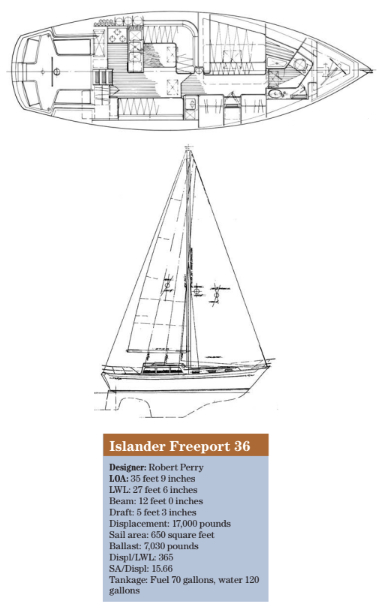
If you and your spouse have ever designed and built a house (one of the few activities that rivals a married couple trying to anchor a boat in tight quarters amid a large audience), you may have learned that the process starts from the inside and works outward. First figure out how much living space you want, then decide where to put the fireplace and the shape of the roofline. Designer Bob Perry faced the same challenge when he designed the Islander Freeport 36 for Buster Hammond, president of Islander Yachts, in October 1976.
Not to be confused with the Islander 36, an Alan Gurney design, the Freeport 36 is numbered among a gaggle of designs Bob Perry did for the company. Included are the Islander 28 (among his favorites), 32, and 34. All three of these had “typical” (read: flat) cabintops. The molds for the Islander 34 were eventually sold to Nordic Yachts, and the boat was relaunched as the Nordic 34.
“The IF-36 was designed around the Pullman berth, which meant that the head would be located forward,” Bob says. “There also was the requirement that the engine be located amidships,” rather than farther aft, a more conventional approach. Actually, having the engine located amidships places weight in a more favorable location, and the non-traditional location may ease maintenance chores, especially when compared to working in a tight area below the cockpit sole.
“The Pullman was not an earth-shatteringly novel idea, or necessarily unique,” Bob says. “But at the time there were a lot of newcomers to sailing who were quite taken with the concept. The difference was that, to that point, no one had done it particularly successfully.”
Straws for Pullman
Putting the double bed in the middle of the boat will increase the odds of a good night’s sleep, especially in an unstable anchorage or on an ocean passage, as I learned during a San Francisco-to-Hawaii race when the offwatch drew straws to see who would sleep in the Pullman. In the case of the Freeport 36, lee cloths will keep crew in the berth on an extended port tack.
“Locating the head forward also meant that the cabin trunk had to be extended, which produced a longer cabintop than a traditional V-berth forward/head amidships design,” Bob says. He notes that heads are not typically located forward by production builders “ . . . because it’s hard to do. That’s the pinchy part of the boat, and it’s odd shaped and hard to work in.”
However, the cabintop isn’t just long, its aft section is tall enough to produce 6 feet 7 inches of headroom in the saloon. The interior headroom produces tall cabinsides, too, that are accented by large, dark, acrylic ports. At first glance the ports may overwhelm her profile, especially if she happens to be gliding along next to a flush-decked racing sled. However, give her another look, and you’ll see that her forward-sloping, double-rail bow pulpit and sheerline slopes downward en route to the stern. This, coupled with a generous masthead sailplan (650 square feet of sail area), and she becomes softer on the eyes. That’s especially true when a 150-percent genoa fills the gap between headstay and mast.
Locate three additional ports per side, as Bob Perry did, and spaces below are filled with light, light, light, even on the cloudiest Seattle day.
B came before A
Buster Hammond was unable to resist the urge to tinker with Bob’s design, perhaps in response to the pressure of the marketplace. In the process he created a chicken-and-egg question. The first Freeport 36 produced was Bob Perry’s original design which, for unknown reasons, was called Layout B. Buster’s revised version, known as Layout A, offered the typical V‐berth-in-the-bow configuration. Bob’s recollection is that sales were split approximately 50/50 between the two. To further confound shoppers, a third model with a center cockpit was added which, Bob says, “ . . . is very scarce. I’ve never seen one.”
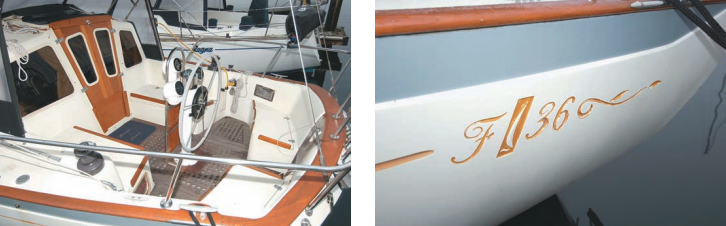
The Freeport also had a roomy cockpit that introduced a feature not seen on sailboats to that point. “We designed a transom door that was the only one of its kind at the time,” Bob says. This device has since been copied by many manufacturers and is standard on some 2000-era production models (see photo on Page 9).
Her underbody featured a low-aspect-ratio fin keel that “is more full than a Valiant because of the location of the engine and a full-skeg rudder,” according to her designer. The combination caused Bob to be overjoyed with the boat’s performance. “When fitted with a good suit of sails, we were surprised that she’s as fast as the Islander 36. She is the boat that outperformed our expectations more than any other.
“A lot of people love her,” Bob says. This is evidenced by an owner’s group that today ranges from San Diego to Massachusetts, San Francisco to Texas, Washington to Mexico, and Alabama to Toronto.
She sparkles
It was a pleasant experience to step aboard our test boat, Puget Sounder, and discover that owners Dennis and Kathy Oelrich of Kirkland, Washington, have maintained her in near-new condition. She sparkles.
As Bob says, these boats have a generous cockpit, a T-shaped area with seats for two port and starboard, and one more on each of the corners, the latter concealing a storage area and propane tank. Seats are 40 inches long and 18 inches wide with 14-inch-high backrests. The distance between seats in the footwell is 38 inches, so it’s possible to stretch out comfortably without playing tootsies with other crewmembers. Cockpit lockers port and starboard are 39 inches long and 35 inches wide, the port compartment having a space Dennis Oelrich describes as “a beverage storage area.”
A 40-inch wheel provides the driver with plenty of leverage on her rudder and puts his fingertips within close reach of primary winches. Boats of this era typically were equipped with winches and cleats for halyards and sail controls on the mast, but there’s plenty of space on the cabintop for stoppers if a skipper would rather have lines in the cockpit. The only downside of the arrangement is that, without a helm seat, the driver will spend a lot of time standing.
The cockpit also has two large acrylic ports on the bulkhead and two in the teak companionway doors, so light is unimpeded on its way belowdecks, even when a Bimini protects the crew from the elements. Her stern rail is large enough to house a barbecue and an outboard motor without interfering with crew comfort.
Belowdecks
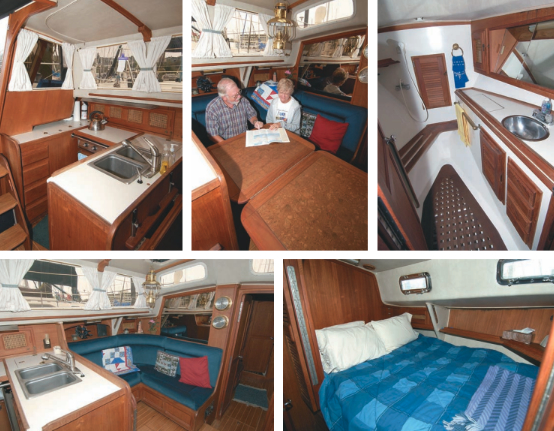
Take four steps down the companionway ladder, and you will feel as though you have descended into a bigger boat. With nearly 7 feet of headroom, 10 feet of distance between companionway and the forward bulkhead, and 10 feet of space separating settee backs, the saloon has the interior volume of a storage container.
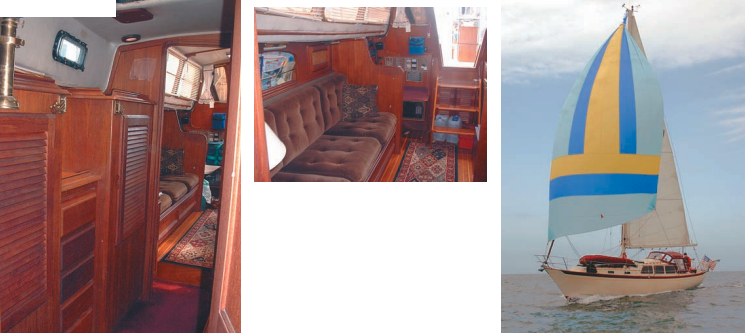
Add those six large ports to the equation and a large mirror on the bulkhead that reflects light and creates the illusion of space, and even a claustrophobic will feel at ease. Unlike many of today’s mostly gelcoat interiors, a forest of teak, including a full-length, teak handrail to starboard (an excellent safety device) and shelving along the starboard hull, combine to create a downright comfy area in which to lounge. Woodwork and joinery were top-drawer when the company built the boat, as evidenced by Puget Sounder’s finely finished surfaces.
An L-shaped settee to port offers either:
- an open area large enough for lounging on thick cushions
- a dining area for 2 to 3 adults when a (nearly invisible) table hinged to galley cabinetry is elevated, or
- a space large enough for three to six when the wing leaf of the table is extended across the aisle to starboard. So, take your pick: the table can be used for Solitaire, Gin Rummy, or four-handed Texas Hold ’Em. (Actually, you could organize a bridge game if seating could be located for South.)
Naviguesser’s table
For the non-card-playing member of the crew, the nav station offers a space in which to naviguess at a table large enough for proper charts. Since the boat was designed before GPS and other electronics became handheld devices and satellite radios became standard equipment on automobiles, cabinetry is large enough to house a VHF radio, a radar screen and, for sentimentalists, an eight-track cassette player along with a niche for pens, pencils, and the car keys. Because the electric panel is located on the aft bulkhead, changing fuses is a simple matter, even underway.
The U-shaped galley is a different story, one owner having described it as “a one-butt kitchen.” Galley counters are 48, 56, and 52 inches long, respectively, when a wood cover is placed over the stove burners, so there’s plenty of counter space in which to operate. However, if two people attempt to occupy the middle of the “U” simultaneously, it would be thoughtful to keep sharp knives safely secured for obvious reasons.
On the flip side, double sinks allow an assistant galley slave to rinse and dry dishes without interfering with the scrub person. There’s plenty of room for dry storage in drawers and cabinetry.
A solid teak door provides access to the stateroom, a well-appointed area in which the skipper can ponder the events of the day or play the viola. Ventilation is provided by opening ports.
The Pullman berth is 78 inches long and 5 feet wide, so the head of a tall skipper shall touch neither the saloon ceiling nor the end of the berth. Storage is in a sliding drawer below the berth, in enclosed shelves, and in a hanging locker to starboard.
Farther forward, the head is enclosed by a louvered door. Except for occasional traffic through the state-room by the off watch, placing the head in the bow makes sense. The area is large enough for showering comfortably without banging your elbows.
Performance
Lest you forget — given the amount of space herein devoted to creature comforts — the Freeport 36 is a vessel designed to transport crew under sail. It is not a dockside condominium.
I have two reports. The yin is that I signed on for a short cruise of Puget Sound on a day when winds were blowing like stink (20 to 30 knots), accompanied by 3- to 4-foot waves close enough to run into each other. Dennis and Kathy showed no reluctance to head out into these conditions, though we shortened the headsail to the size of a hanky and tucked a reef in the main.
It’s a good thing that Puget Sounder is equipped with a dodger that kept waves and spray off her occupants as we sailed hard on the breeze with the rail tantalizingly close to the sea despite her high freeboard. (Even at that, my favorite 49ers hat still ended up in the drink.) Boat speed ranged between 5 and 6 knots in these conditions. Our comfort level increased dramatically when we eased sheets and sailed on a broad reach, her shoulder tucked into the waves. She tracked well in those conditions.
On a second trip, when a high-pressure system blanketed the sound, the Oelricks sailed in light breezes en route to a rendezvous. Despite having only 4 to 5 knots of wind, Puget Sounder managed 3 to 4 knots and tacked without losing way. It wasn’t long before she was over the horizon.
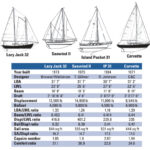
Many boats are evaluated on paper on the basis of mathematical ratios. In this case, those ratios would lead to the erroneous conclusion that the Islander Freeport will bring new meaning to the term “extended cruising.” I was pleasantly surprised that she’s capable of sailing fast.
Bob Perry says, “She’s been a good old boat for a lot of people.”
Still is.
Thank you to Sailrite Enterprises, Inc., for providing free access to back issues of Good Old Boat through intellectual property rights. Sailrite.com