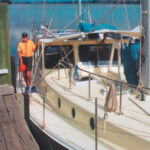
Certainly not twins, the 33 and 36 share characteristics
Issue 47 : Mar/Apr 2006
Our subjects are two sloops manufactured by the Columbia Yacht Company during its heyday in the 1960s when it was the pre-eminent builder of fiberglass production boats. From a company that first carved a niche in the construction of portable outhouses, Dick Valdes and friends developed the Number One fiberglass boatbuilding company long before the likes of Frank Butler and Roger MacGregor arrived on the scene.
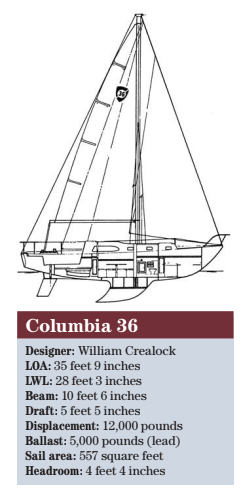
The Columbia 36
Though the boats are not twins, the Columbia 36 and 33 share many characteristics and are easily identifiable as Columbia models.
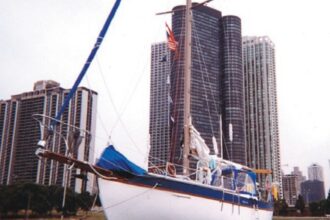
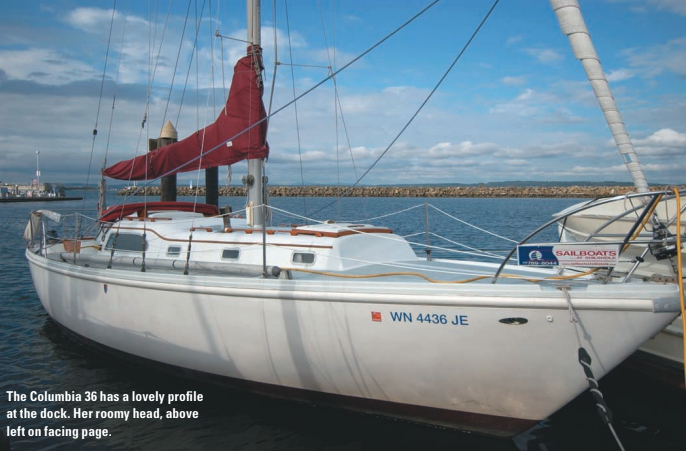
In profile, the 36-footer is a not-quite-sleek, but still comely, version of a traditional 1960s sailboat with rounded chine and a tall freeboard typical of the era. She’ll spray water away from the hull, rather than dousing the cockpit crew.
Her cabintop is a slightly-more-than-one-story affair that mirrors many of her contemporaries, with the aft section elevated just enough to increase headroom in the main saloon but low enough to avoid being unsightly.
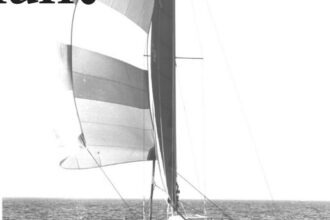
A massive single-spreader rig towers overhead. She fl ies oversized headsails and masthead spinnakers and, for the adventurous, a blooper. The massive rig is supported by double sets of shrouds. In comparison with the 33, she has a more modern underbody with a fin keel and spade rudder.
When you step aboard it takes about four seconds to realize that this is a Bill Crealock design. The tipoff? The cockpit sole, though totally watertight, is easily removed, allowing access to the engine from above, a marvelous arrangement for anyone who is changing filters, belts, and the like. If the opening is large enough it’s also a joy for anyone who must remove the engine. Like the other 99.9 percent of sailboats on the water, the engine is also accessible from the foot of the companionway.
Though the 36 is only 8 inches wider at the beam than the 33-footer, her girth is more like that of a middle linebacker than a ballerina, though not unfashionably so. The cabin sides are higher than her little sister’s, and there’s a big step over the companionway to access the companionway ladder. A “Watch Your Step” sign might be in order. The flip side of that is the prevention of water slopping belowdecks.
No encumbrance
The cockpit is a slender area with 7-foot-long seats that are wide and deep with large aft storage areas. The tiller is located at the aft end of the footwell, so it is not an encumbrance, and the aft deck is large enough for a sunbather. Storage is in a large cave spanning the stern: 2 feet x 4 feet x 30 inches deep.
The absence of cockpit lockers reduces exterior storage but offers more space in the quarter berths. Speaking of space, moving about is easier than it is on today’s boats. The cabin is narrow enough to produce 24-inch-wide sidedecks; it’s not necessary to tiptoe from cockpit to the bow, and the fore- deck is large.
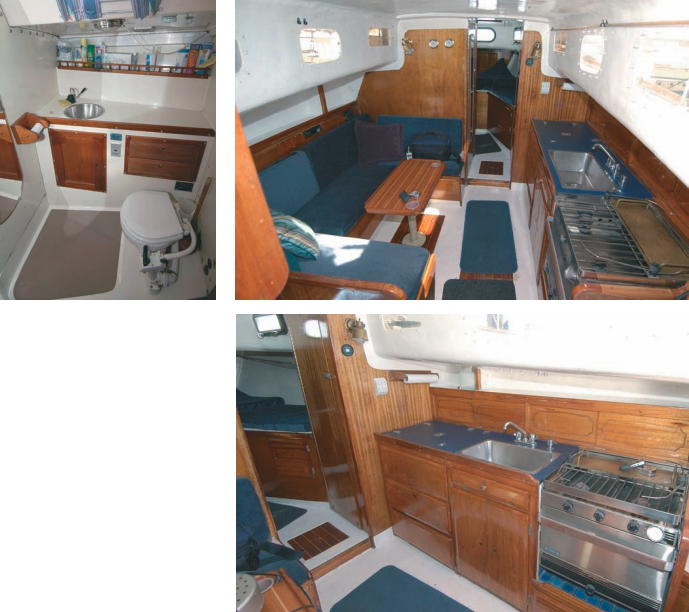
The space down below is a no-compromise, make-yourself-comfortable area in which to lounge, cook, sleep, or play the ukulele. A C-shaped settee is located to port, the galley with propane stove and stainless-steel sink are to starboard.
Elongated galley
C- and L-shaped galleys seem to be the rule these days, but there’s much to be said for placing the galley — with its stove, sink, and icebox — length-wise along one side of the cabin. This arrangement was a favored design feature in the narrower boats of the ’60s. For one thing, it reduces the intrusion of 27-inch-wide counters in the main saloon and, if properly equipped, still provides the cook with a safe area in which to operate.
This arrangement allows the crew to sit at a proper table measuring 36 x 42 inches, rather than seating two across the aisle. (A note: the cabinets are enclosed by solid wooden doors. When the boat begins rocking sideways, these doors can produce a cacophony of noise. To stop the knocking, insert tiny shims between them.)
The head and nav station are located forward in what serves as a buffer zone between crew and skipper, whose dominion is the forward stateroom. The head is large enough in which to open up the New York Times or shower, shave, and attend to other personal matters. Similarly, the nav station is a nicely appointed area in which the person responsible for piloting the vessel can work. The chart table is a 27-inch square platform surrounded by bookshelves.
Aft, quarter berths on both sides of the hull are 28 inches wide and 7 feet long. They offer a modicum of storage for storage-hogging-but-rarely-needed items such as paper towels and the like.
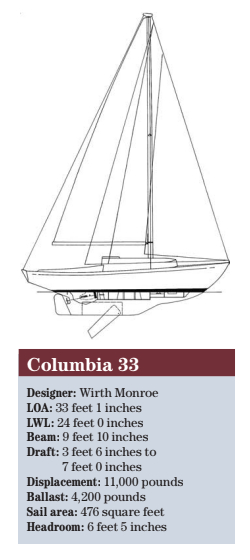
The Columbia 33
This nifty cruiser has an interior layout similar to that of the Columbia 36. The big difference (because of her earlier design) is her traditional underbody with a full keel, attached rudder, and a centerboard which takes her draft from 3 feet 6 inches to 7 feet. She was designed by Wirth Monroe, a noted Floridian who produced a number of designs that did well on the Southern Ocean Racing Conference (SORC) when, in the 1960s and ’70s, that series was considered the major league of amateur sailboat racing. The 33 was designed and built between the years 1963 and 1965, while the 36 was designed and built between 1969 and 1973.
The layouts are similar: a long, slim cockpit that’s large enough for the cruising crew, tiller, and scuppers to drain the occasional rogue wave. Seats are 9 feet long and 16 inches deep, with 14-inch backrests, so they provide excellent support on a long reach. Three steps down the companionway provide access to an arrangement that is a cookie-cutter version of the 36 but smaller: settee and table to port, long galley to starboard with a 4-burner stove and sink, 20- x 22-inch working surfaces, and icebox situated in cabinetry below. Cabinets outboard are enclosed by wooden doors. This adds to the ambiance as do bookshelves on both sides of the hull. There’s no nav station; a cocktail table is substituted. This can be lowered to produce a kiddie-sized berth.
The trend in modern production boats is to produce dance-floor-sized spaces belowdecks. That’s not the case with these older boats, which tend to be narrower than their contemporary counterparts. Nonetheless, settees are 40 inches long, large enough to seat four adults, though the space is reduced by a table. There’s plenty of headroom.
As you might expect on a 33-footer, the head is narrow (30 inches wide) and fitted with just a toilet and sink. Since the sink is located under the deck, those who are brushing their teeth risk banging their heads on the overhang.
One can sleep well
The V-berth is a large double measuring 6 feet on the centerline; at least one of the two occupants should have a good night’s sleep. As with boats of this era, the anchor rode is stored in the bow. If a dirty chain comes aboard, the compartment will smell like a beach at low tide.
A history of Columbia Yachts was published in Good Old Boat in May 2002. This is the short version. Dick Valdes, who formed Columbia, started his sailing career as a Sea Scout. The skipper of the fleet was an expatriate Dane, named Paul Johnson. Dick helped Paul in the construction of a 35-foot sloop in Paul’s back yard, and a career was in the making.
Dick learned to sail by hitching rides on a number of raceboats, including the famous Santana, owned by Humphrey Bogart. “Bogie used to warn us that we might hear some blue language during the day and that we should forget it when we returned to the dock,” Dick recalls.
During a stint at UCLA, where he studied engineering and business, Dick built a Viking Senior and became a big man on campus by virtue of sailboat ownership. He left UCLA in 1957 and took a position at the Fiber Resin Company, which was designing tools and epoxy parts for the aircraft industry.
“Joe Thompson, who owned the company, wanted to get into the marine business. Since I was the only person in the company with any experience, he put me in charge,” Dick says.
Tough sale
A year later, he and Maurie Therinen formed a company that specialized in the construction of fiberglass parts. “It was a tough sale,” he recalls, “because people used to say that if God wanted fiberglass parts, He would have built fiberglass trees.” Operating as Glas Laminates, the duo began fabricating outhouses (portable restrooms, as he calls them) and the first patented fiberglass shower stalls and shower pans.
Eventually gravitating toward the boatbuilding business, their first sailboat was the Islander 24. This was followed by the Columbia 29.
Aside from building boats ranging in size from 24 to 50 feet, perhaps their most fortuitous venture was the development of the fiberglass interior. “We were building hulls and decks of fiberglass and marrying them, but we still had carpenters building wood interiors,” Dick says. He took a great leap forward, and the world changed.
“That method reduced the labor cost of building an interior by 30 percent,” he says, “so we dropped our prices accordingly and commandeered the marketplace.”
With some searching, Columbia 33- and 36-footers can be found in the used marketplace, along with their contemporaries, the Cal 40 and Ericson 35. Expect to pay, for either boat, between $18,000 and $30,000, depending upon the condition.
Though the Columbias are more cruise-ready than a Cal 40, they are capable of making 150-mile-a-day passages, the standard when they were built. Given a clean hull and new sails, either boat will perform to her expectations.
En route, the crew will be comfortable, whether lounging in the spacious cockpit or napping belowdecks.
Thank you to Sailrite Enterprises, Inc., for providing free access to back issues of Good Old Boat through intellectual property rights. Sailrite.com