A better way to keep the crew on board
Issue 47 : Mar/Apr 2006
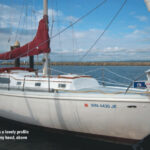
Commercial vessels have a lot to teach their recreational cousins, yet many of their lessons go unheeded. A prime example is cabintop handrail systems. Recreational boats’ handrails along the trunk cabin are generally too low to properly complement the dynamics of the human body, forcing us to reach down in such a way that instability, rather than security, can result. Most cabintop handrails on yachts and small motorboats become little more than convenient stowage sites for such items as a rolled awning, a boathook, and the tender’s oars, instead of something to wrap your hand around and hang onto for dear life.
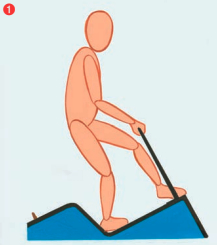
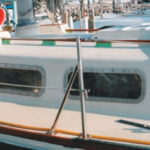
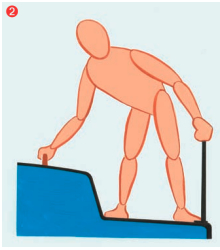
Alternative handholds on these vessels, such as shrouds and stanchions, are mostly outboard of the person seeking security when walking around the sidedecks. However, the most secure grip should be inboard. Outboard handholds ➊ are much appreciated at times, but they are containment devices rather than truly useful means of hanging on. The best way to really hang on securely while moving around the deck is to reach inboard ➋, and most cabintop rails tend to defeat this object by being much too low (unless you crawl).
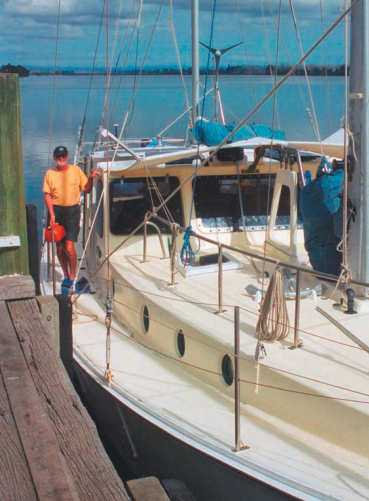
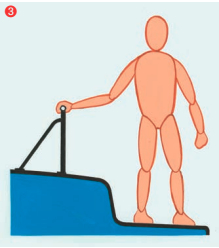
This is where commercial vessels can teach us so much. The next time you see a pilot boat at work, note how the pilot manages to hang on without a lifeline, regardless of sea conditions, yet is clear to leap directly from the sidedeck onto a ship’s ladder. The rail he uses (aptly named the pilot rail) ➌ is inboard of the sidedeck and, most importantly, is around waist height where it complements the human frame by not obliging him to bend down to hang on. Holding a deck-hugging rail near knee level is an unstable and unsafe position for a person who depends on absolute security while executing vessel transfers. By extension of that simple logic, anything less than a pilot rail on any type of vessel gives little more than a false sense of security.
Compatibility question
Comparing the pilot rail to the standard cabintop version raises the question of its compatibility with a small recreational vessel, especially a sailboat whose boom cannot be raised without too great a loss of sail area. The answer is a compromise between a normal roof-hugging handrail and one so high it interferes with the boom. Anywhere between the two is far superior to one too low, especially if you use it as a storage rack. If it is only high enough to give clear and immediate hand access above the stowed items, then an advantage has been gained. However, a much higher rail, reaching close to waist level, is the ideal system and is possible on most vessels, especially those of more than 35 feet.
Presuming your vessel lends itself to the fitting of a pilot rail, consider its need for bracing. Generally speaking, the average pilot rail only needs one brace at each end, with its longitudinal curvature adding plenty of rigidity to its overall strength. The governing factors here: curvature of the rail (following the cabin’s shape on each side), height of rail, the diameter of tubing used, and stanchion spacing.
In the design and fabrication of a pilot rail, there are no hard-and-fast standards, but the experienced worker in stainless steel will instinctively know sensible tube diameters and stanchion spacing related to length and height of the system. The rail’s length will be subject to cabin length; its height will be a factor of cabin height plus the remaining distance between cabintop and a person’s waist. The total height is typically around 3 feet 6 inches, but this can be lowered a foot if necessary and still produce a rail that will be infinitely superior to what is on most sailboats.
Spread of sealant
Regardless of precise overall dimensions, stanchion bases should have enough area to accommodate a good spread of sealant between them and the cabintop. Through-bolts are the preferred fasteners on glass and wooden cabintops. These should be complemented with under-deck plywood or solid glass pads of maximum area to spread the stanchion’s loading. If an existing traditional, cabin-hugging handrail is being replaced with a pilot rail, then its route can be followed using the doubling that should be already in place.
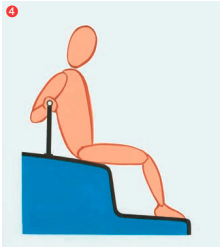
This presumes that the old route is far enough inboard to satisfy another virtue of the system (presuming it is wanted and is possible). This virtue is the way in which a pilot rail can also produce a very secure seating area along the cabin ➍ for those needing to rest while working the foredeck but who are unwilling to return to the cockpit between bursts of exertion. Depending on the distance inboard of the pilot rail, a person can sit on the cabin edge with arms hooked back over the rail, which then becomes a backrest as well as a very firm handhold. It is an ideal place to seat guests in port or fair weather when the cockpit reaches capacity.
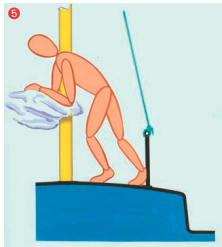
Not only does the pilot rail provide security for standing and seated persons, it also acts as a secure cabintop pulpit against which feet can be braced while furling the mainsail in a seaway. ➎ It is true that when returning to the deck it can also trip the unwary, but this is a matter of familiarization and it is, in any case, an accident that should not happen, thanks to yet another advantage of this multi- purpose rail.
This advantage is the way in which it can be used as an alternative place to tie off extra halyards when not in use. By tying them around the rail (or perhaps to a small crossbar cleat under the rail on one or more of its stanchions), the halyards are not only handy when needed but, because they are restrained away from the mast, slapping is minimized or eliminated. Because a pilot rail invariably becomes festooned with a number of halyards, they provide secure handholds when climbing over the rails to handle the mainsail.
Pilot rails are such an intrinsically safe and secure means of working the deck of a small boat that, once tried, the traditional cabin-hugging grabrail will be abandoned forever. If your sailboat is too small to adapt to the system, consider losing a foot of mainsail. In most cases the loss is more than compensated for by that wonderfully confident feeling of being a real part of the vessel, rather than an irritant she constantly endeavors to reject.
Thank you to Sailrite Enterprises, Inc., for providing free access to back issues of Good Old Boat through intellectual property rights. Sailrite.com