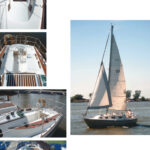
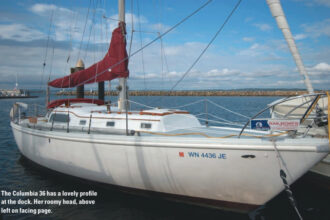
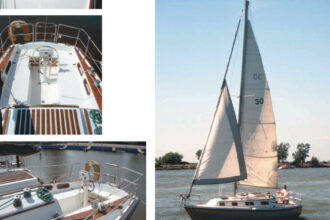
Four very similar 30-footers
Issue 47 : Mar/Apr 2006
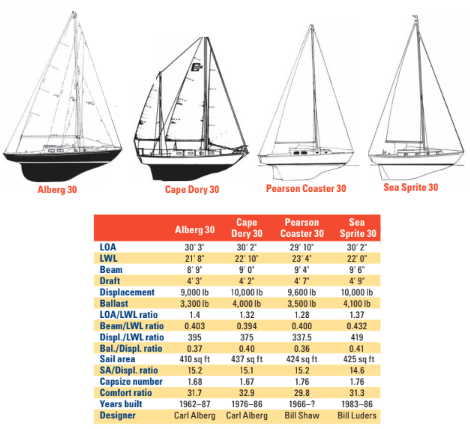
I try to select similar boats for my comparisons, but this time I seem to have selected four peas from the same pod. There certainly are more similarities than differences between them. It’s interesting to note that the designs are spread over 21 years from the oldest to the newest, and the oldest design, the Alberg 30, was in production for an incredible 25 years, with 700 built. That says a lot for her qualities, both the design and the construction.
Although the yachts are alike in many ways, they are not alike in appearance. I much prefer the springy sheerline of the Sea Sprite to the flat sheer of the Cape Dory and the low freeboard and long ends of the Alberg 30 to the chunkier appearance of the Pearson. But beauty is in the eye of the beholder and high freeboard does have its advantages.
The table shows their similarities as well as the few areas where one boat stands out from the group. Numbers can be misleading though. The Sea Sprite 30, with a sail area/displacement ratio of 14.6, might seem undercanvassed when compared to the Cape Dory’s 15.1 ratio, but both yachts are of the same displacement and the difference in actual sail area is only 12 square feet. It’s truly inconsequential in the overall performance picture, particularly considering that the Sea Sprite’s mainsail has a much higher aspect ratio.
The Sea Sprite could easily carry another 30 square feet of sail but, regardless, I think she would have the edge in weatherliness. With her slightly greater beam, deeper draft, and higher ballast ratio she appears to stack up as the most powerful of the four boats. Combine that with her taller, more efficient, rig, and the result should be a definite advantage to windward.
Light and narrow
However, the boats are so close in their general characteristics that their performance on a reach could be a tossup, although the Alberg 30, being the lightest and narrowest, might show well in the gentler breezes. Even so, none of this group can be considered a performance cruiser by contemporary standards. If you live in the Toronto or Chesapeake regions and are interested in a boat for class racing as well as cruising, the Alberg 30 deserves serious consideration, as both areas have large active fleets.
All four of these 30-footers will have a relatively easy motion in a seaway, due to their combination of husky displacement, narrow beam, and short waterline. Indeed, their motion comfort figures are right up there with the Whitby 42 and similar yachts. That makes them an excellent choice for family cruising in coastal waters, despite accommodations that are rather tight, to say the least, when compared to today’s beamy long waterline cruisers.
Their heavy displacement and narrow beam also work to create commendably low capsize numbers. This would indicate that these yachts are quite up to making serious bluewater crossings, given good condition, good equipment, and a small, experienced crew. Certainly many well-found yachts this size and smaller have made adventurous voyages, survived storms at sea, and taken their crew to distant harbors.
On older yachts it is essential that an experienced, professional surveyor go over every inch thoroughly, with particular emphasis on hull-to-deck joints, steering gear, chainplates, rig, and machinery. Then, any recommendations made by the surveyor must be followed up before you even think about heading offshore to those exotic ports. Bon voyage!
Thank you to Sailrite Enterprises, Inc., for providing free access to back issues of Good Old Boat through intellectual property rights. Sailrite.com