A classic plastic racer/cruiser with looks to turn your head
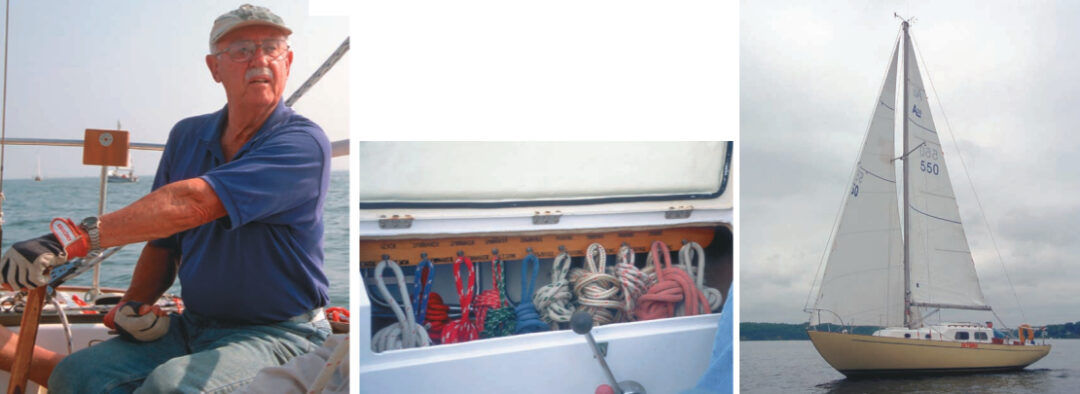
Issue 47 : Mar/Apr 2006
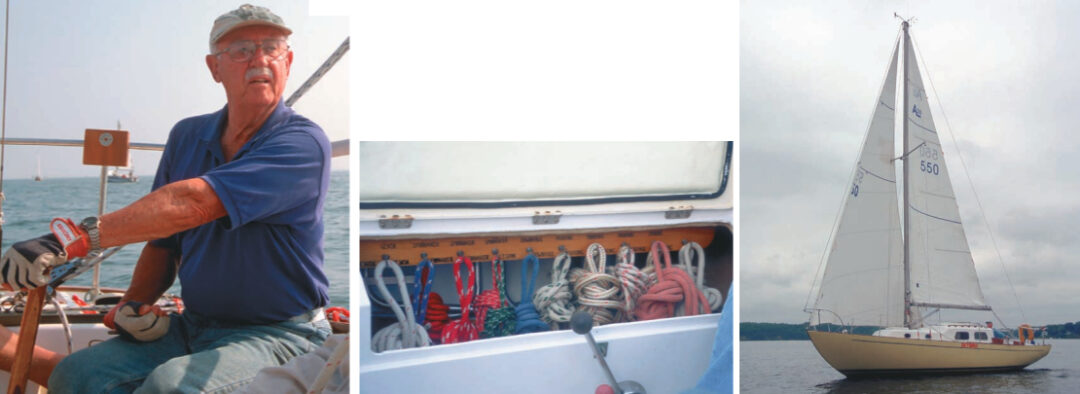
Magic. We drove east to witness the magic touch, but instead we were treated to a love story. It wasn’t a bad tradeoff at all. For several years I have wanted to be aboard when Rolph Townshend skippered Skybird, his Alberg 30, to win another race. He’s one of the most winning skippers I know. But first, the love story.
Rolph Townshend has been known as Towney most of his life. And most of his life he has been a sailor, growing up as he did on the eastern shore of the Chesapeake. His earliest sails were made with friends, although he admits to — at a very early age — having built himself a boat that resembled a coffin made of scrap plywood. That it disintegrated during its first season was a blessing.
But Towney’s sailing friends had Hamptons, 18-foot wooden racing one-designs. Envying these, he wanted his own Hampton, but his parents couldn’t spend more than $100 on a sailboat for a young boy. The Hamptons were priced closer to $400. So his fi rst sailboat, at 10 years of age, was an 18-foot Skipjack. By the age of 12, Towney was working a plan that would result in ownership of that coveted Hampton.
“I’d buy a derelict boat for $25 or convince someone to give it to me,” he says. “Then I’d repair it in our garage and sell it at a profit. I learned about fixing boats, and ultimately I got my Hampton #500 . . . and later another one, #520.”
During the same time that Towney was discovering his talent for messing about in boats, he was supporting the war effort as a young teenager in shop class by building aids for civil-defense spotters. In the process, another skill was born.
Model airplanes
“I was 12 when World War II started in 1941,” he recalls. “The schools had shop classes which were asked to build models of German and Japanese planes. Every kid made model Messerschmitts or P-38s which were painted black and used all over the country to train civil-defense spotters.”
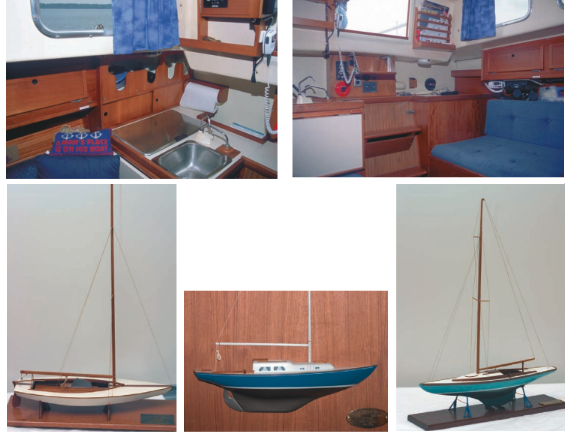
Towney learned the skills required to carve these models and soon had transferred that interest to carving boats. “Eventually I carved models of all the boats I’d owned,” he notes. Later he carved models for friends and then wound up restoring historical museum pieces, such as an 1840 model of a Baltimore clipper, working as a volunteer for the Annapolis Naval Academy. Over the years, building models of boats has been a love affair of sorts. But his ongoing love affair has been with the Alberg 30. Towney was ready, but first Carl Alberg had to design her.
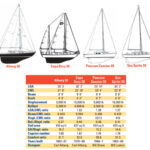
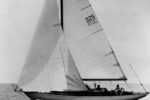
That didn’t happen until the early 1960s. The short story is that Kurt Hansen of Whitby Boat Works in Ontario, Canada, commissioned Carl Alberg to design a 30-foot version of his popular Pearson Triton. The kinship is obvious, although some changes were made to the 30-footer, such as a masthead rig and using cast iron for ballast. The first Alberg 30 was launched in 1962.
So what’s a guy to do in the meantime? College, marriage, and a move to Annapolis came along in 1952, when Towney was offered a job with Westinghouse. There was an active Hampton racing fleet in Annapolis, and Towney and his new wife, Jean, did well in these races.
Wanted larger boats
“But we grew a little larger, got a little older, and had children,” he smiles. “All the Hampton sailors wanted larger boats with toilets, places to sleep, and room for the kids. But we still wanted a boat we could race.” The group members settled on Nat Herreshoff’s Fishers Island 23 Knockabout, a daysailer also known as the H23, which is 34 feet on deck and 23 feet on the waterline. Towney describes the gorgeous long overhangs of the Fishers Island as being “like a miniature America’s Cup boat from years back.”
The Hampton sailing friends bought five of the 15 that had been built and sailed them home to Annapolis from Bristol, Rhode Island. “Then we overhauled them and raced them for five years,” he says. “But we got tired of maintaining wooden boats. And we couldn’t find more than five (which was tough on a racing fleet that wanted to grow). We were making a bit more money by then and began to look for a fiberglass boat roughly the same length. We wanted bunks, a full toilet, a sink, a stove, a V-berth. We were thinking of the Pearson Triton (introduced in 1959) and the Gladiator, and a couple of others.”
Drumroll, please. In 1964 an Alberg 30 showed up at an Annapolis boatyard. Towney says, “Jack Martin called me at work and said, ‘A really neat boat just arrived. You’ve gotta’ get down there and take a look at it. It may be the boat we’re looking for.’ Once I’d seen it, I said, ‘Jack, that’s going to cost an arm and a leg!’ ”
But it was indeed the boat of their dreams, so these two negotiated with boatyard owner Arnie Gay to give them a discount if they could come up with 10 buyers. The deal was $10,000 each. This order would keep the Whitby Boat Works busy through the coming winter.
Similar group purchase
Unbeknownst to them, another group of 15 sailors in Washington, D.C., also Chesapeake Bay sailors, made a similar group purchase of 15 boats in 1963, so the area was to be blessed with enough of these boats to carry on as a strong one-design class for years to come. As noted in an article by Jay Livingston in Chesapeake Bay Magazine in March 2000, “Up to that point, the only one-design racing done on the Chesapeake was on much smaller, non-cruising boats such as Hamptons, Lightnings, and Chesapeake 20s. The Bay had never seen the likes of today’s cruising one-design fleets, with waterlines stretching past 40 feet . . . But it was about to.” Towney and fellow “Albergers” in Washington, D.C., and Annapolis were truly at the forefront of something big.
“Now (that we had ordered 10 boats),” Towney recalls, “we had to find eight more buyers . . . and we had them within a week. We took out loans and did whatever we had to do.” Alberg 30 hull #50 arrived around Christmastime. That boat was to be Jack’s.
Towney’s took a bit longer because he wanted a yellow hull. Kittiwake, hull #76, was delivered in June. It was among the last of the 10 ordered. The group members may have bought these boats for one-design racing, but they realized immediately that they also had sweet cruising boats and planned a group cruise to the New York World’s Fair that summer. By the time Towney’s boat was delivered he had about a week to commission and launch her in order to join the fun. He and his family were not left behind. Of that cruise, he says, “We were racers. We had no instruments, knot meters, depth finders. We hadn’t thought about bad weather or storms. We just went. And we had a wonderful time.”
Close association
So several decades later the Hampton sailors, who became H23 sailors and then Alberg 30 sailors, continued their close association centered on sailing, racing, and family activities. The roots of perhaps the most active sailboat owners’ association anywhere — the Chesapeake Bay Alberg 30 One-Design Association, Inc. — go deep and wide. “We tell people, ‘You are not just buying a boat, you are joining a family,’ ” Towney says. This is true. The organization, still strong after all these years, celebrated its 40th anniversary in 2004, but its roots go back even farther than that, back to a group of Hampton sailors racing around the buoys in 1952. These days, the Alberg 30 Association has approximately 250 members who race, cruise, and party together like one big family.
Somewhere, while Towney’s Westinghouse career advanced from quality department manager to manufacturing manager, while three children grew up, and while the sailing continued unabated, Towney and Jean grew apart and divorced. Kittiwake, that beloved Alberg 30, was sold so Towney could make a down payment on a run-down house. “I spent four years fixing it up inside and outside,” he says. “That was my therapy.”
When he met Joan, the woman destined to become his second wife, they had five children and two homes between them. By the time the kids had gone to college, Towney says, he bought a 28-foot Bertram in need of fixing and spent the winter turning this powerboat into a gem. When spring came at last he says, “I couldn’t believe how much noise it made . . . and the exhaust smell . . . ” When he and Joan took some friends out for cocktails and their own returning wake knocked over the wine glasses, Towney put this boat up for sale. “Joan,” he told her soon afterward, “I need one more sailboat.” It had to be an Alberg 30.
Went more places
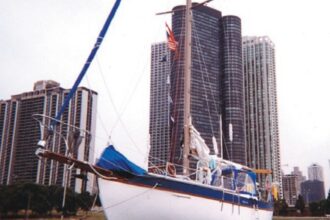
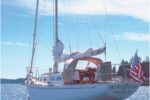
Towney told Joan, “The one I had the most fun with was the Alberg. I went more places, made more friends, and had more fun. It has to be an Alberg 30.” There were 12 available at the time. Towney narrowed it down to three. One was yellow, like Kittiwake had been, and it was to become his. It was hull #550. He named her Skybird, and she became one of the winningest Alberg 30s ever.
The year was 1995. Towney was 66 years old . . . a time when some are having second thoughts about hull maintenance and the work required to sail a boat. Racing a sailboat adds yet another level of effort and risk. Towney went right back to racing as if he’d never left the Alberg association. Before long, the man who’d helped found the association, but whose name was recorded only in the archives, began winning more than his fair share of the races.
That’s what inspired my interest. I heard rumors about how Towney won the club’s high-point trophy. And won it again. Eight times in a row. So far. And the fall racing season Maple Leaf trophy during most of those years. And the trophy for the skipper who attains the best cumulative score in the day point-to-point races for most of those years. Then I read about Towney in the Great Lakes Alberg Association newsletter. He was winning honors in Ontario, team racing in other people’s Alberg 30s.
I couldn’t stand it anymore. We drove to the Chesapeake hoping to catch Towney in the act of winning a race. Would he be a screamer . . . or never raise his voice? Would it be his experienced crew of Ken and Roberta Liddick who have been racing with him, Ken in particular, for 10 years? Did Towney have an intuitive knack for racing that can’t be defined or quantified? Would it be nothing more than the many years he’s spent racing? Or did Skybird have wings?
We’ll never know for sure. The race we attended was called off due to lack of wind. We had a good time on the course awaiting the start with others and a good time motoring to the race and home again. In the future it will be even harder to catch him at it. Now, at age 76, Towney’s cutting back a bit on his heavy racing schedule to just one Wednesday-night race a week plus the minimum six CBYRA races needed to qualify for the season. After showing them how it’s done, it looks like he’s going to give the other folks in the association a chance at winning the major trophies. It’s only fair. But we still don’t know what tricks Towney has up his sleeve.
Perhaps that’s best. If we knew, I’d include them here, and then they wouldn’t be secrets anymore, would they? Secret magic isn’t meant to be exposed by someone who buys ink by the barrel. We drove east to witness the magic touch, but instead we were treated to a love story. It wasn’t a bad tradeoff at all.
Thank you to Sailrite Enterprises, Inc., for providing free access to back issues of Good Old Boat through intellectual property rights. Sailrite.com