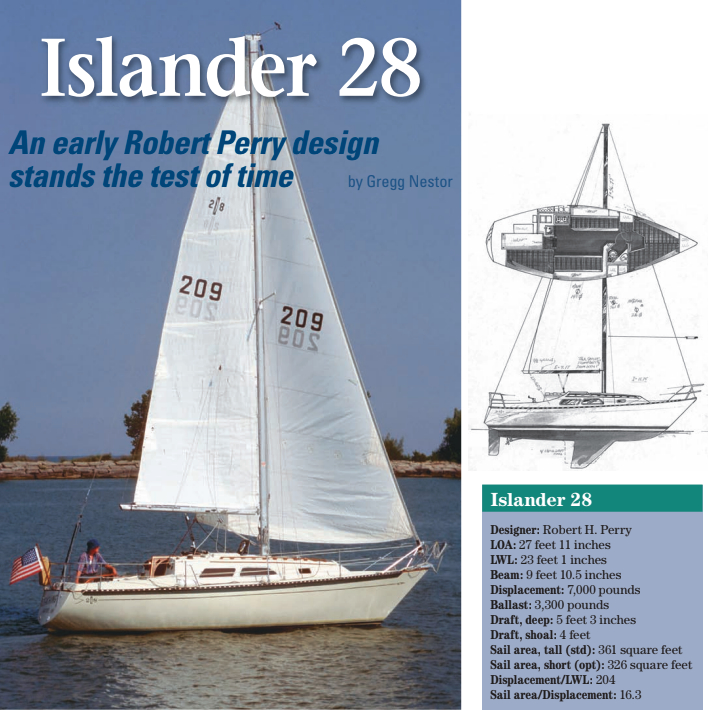
An early Robert Perry design stands the test of time
Issue 51 : Nov/Dec 2006
Around 1975, Robert Perry Drew the lines of the Islander 28. And as critical as he is of his own work, he nevertheless considers it to be one of those rare designs that has surpassed all his expectations. The boat was in production for 10 years.
With a finely raked bow and a reverse transom, the hull has relatively short overhangs. To please the eye, there is a subtle sheer and a cabin that carries its lines and that of its portlights’ delicate teak eyebrow trim piece harmoniously out to the stemhead. The maximum beam is well aft and there is a good amount of flare to the topsides.
These last two design elements work together to ensure light displacement and minimum wetted surface. The reverse transom is wider than the normal International Offshore Rule (IOR) transom, which was popular at that time. In doing this, Bob created a more comfortable cockpit and added power and reserve stability.
Under water, the leading edge of the deep (5 feet 3 inches) fin keel is raked aft. In addition to the deep-keel version, the boat also was offered with an optional 4-foot shoal draft keel. On both versions, the semi-balanced rudder is faired into a partial skeg. This arrangement results in better response and tracking.
Construction
The construction of our review boat, Reaching, owned by Dave Vance, of Thompson, Ohio, is typical of the 1970s. The hull is a solid, hand-laid laminate of fiberglass and polyester resin. To add stiffness and compression strength, the deck is cored with marine-grade plywood. This sandwiching is especially beneficial for all walking surfaces, including the cabintop, sidedecks, and cockpit sole, where the weight of crew otherwise might cause oilcanning.
The hull-to-deck joint is an inwardfacing flange that is chemically bonded and mechanically fastened, incorporating a slotted black anodized aluminum toerail.
The keel is externally mounted and the 3,300 pounds of ballast is lead. The first Islander 28s had a 5-foot keel and carried 3,000 pounds of ballast. They were thought to be a bit tender. After adding 300 pounds of lead and increasing the draft by 3 inches, stiffness improved significantly. The rudder post is sleeved in a fiberglass tube that incorporates a zerk fitting for lubrication of the bearing.
There is no fiberglass pan bonded in-place, instead the interiors of the Islander 28s were built in. The bulkheads are marine-grade plywood with teak veneers and are tabbed to the hull. Portions of the hull that are exposed are covered with a padded vinyl liner. Overhead is a zippered vinyl headliner backed with foam insulation. The zippers are strategically located to make it possible to reach throughbolted deck hardware and electrical wiring.
Deck features
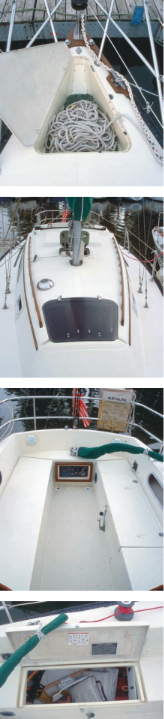
A single anchor roller is incorporated in the boat’s stemhead fitting. And to accommodate some chain, a reasonable length of nylon rode, and possibly another anchor, there’s an adequately sized anchor locker built into the foredeck. With the forward mooring cleats mounted outboard, the foredeck is free of toe-stubbing fittings and feels quite expansive. For a boat of this size, the sidedecks are generous at an average width of 17 inches.
The cabintop features a tinted acrylic forward hatch that is flush-mounted, a pair of full-length teak handrails, and a molded-in sea hood. For additional ventilation and light, our review boat was fitted with an optional tinted hatch over the saloon. A total of six portlights are mounted in the cabin trunk. The forward two are small, but able to open; the aft four are significantly larger, but fixed. Other noteworthy deck features include a handy pair of breast cleats amidships, a substantial full-length slotted toerail, and double-rail bow and stern pulpits with dual lifelines.
The cockpit, at 6 feet 2 inches long, allows off-watch crew to lie down. It lacks, however, a bridge deck with which to keep a flooded footwell from spilling below. The generously large companionway and two relatively small scuppers exacerbate this potential danger. On the plus side, the absence of a bridge deck makes it easier to step below. The compromise solution is to sail with at least the lower weather board in place, positively secured with deadbolts or some other mechanism.
The cockpit coamings are straight and a foot high. They offer reasonable back support and good bracing when the boat is heeled. For stowage, there’s a large seat locker on the port side.
Tiller steering was standard, with wheel steering offered as an option. The auxiliary engine’s instrument panel is situated low on the inside of the transom and may be subject to water damage.
Belowdecks
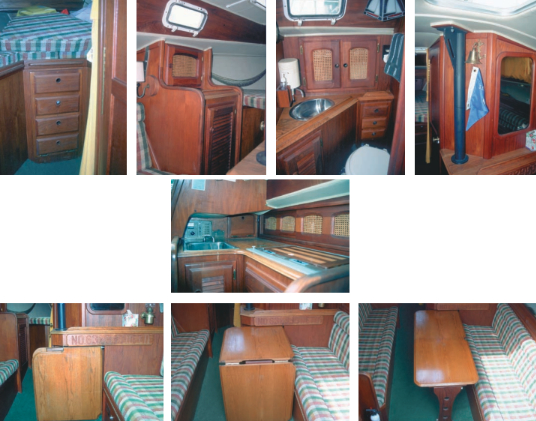
The interior of the Islander 28 is really the high point of the boat. Most of the interior is finished in teak and built into the boat, rather than created as fiberglass modules with molded berth flats, galley, and other features that have been dropped into the hull and secured. A built-up wood interior ensures better structural integrity and makes better use of available space. It also makes for a quieter, drier interior. One would think that with all this wood, the main cabin would be dark and gloomy, but this is not so. The large portlights and the expansive companionway allow in a great deal of light.
The forward cabin has a smallish V-berth that is best left for shorter crewmembers — namely, the kids. There’s ample stowage in the drawers and bins beneath the berth and in the port bureau and hanging locker.
With the forward/aft access offset to port, the head (located to starboard) is quite large, especially considering that it’s not situated at the boat’s maximum beam. This compartment is entirely wood and very attractive, although a bit dark. The sole source of light and air is from a small opening port. The stainless-steel washbasin has a manual cold-water pump. There is no shower, but there’s a ton of stowage in several drawers, bins, and cane-fronted lockers.
The saloon features the traditional opposing settee arrangement. However, the port settee has been moved forward about a third of its length in order to accommodate the galley. For dining, there’s a unique bulkhead-mounted table that slides out, swings-up, and unfolds. When not in use, it’s cleverly stowed between the starboard bulkhead and settee. There’s fiddled shelving outboard of both settees and there are bins beneath the port settee.
The 20-gallon holding tank and the 20-gallon water tank with fill fitting are mounted beneath the starboard settee. For sleeping, the port settee functions as a single, the starboard converts to a double, and there’s a 7-foot-long quarter berth on the starboard side.
The L-shaped galley is aft and to port. Amenities include a two-burner alcohol stove, a single stainless-steel sink with manual cold water, and a top-loading icebox. Stowage in the form of drawers, bins, and cane-fronted lockers is excellent.
The sole is carpeted. Headroom measures a comfortable 6 feet. There are no overhead grabrails in the cabin. There are handholds at the companionway, and taking three steps up puts you in the cockpit.
The rig
The Islander 28 is a masthead sloop that was originally offered with two rigs. The standard is a tall rig and the optional or San Francisco rig (owing to strong prevailing winds there) is shorter. The idea was to ensure that the boat would perform well in a variety of sailing grounds, especially those with light air. Sail area for the standard rig is 361 square feet; the San Francisco rig measures 326 square feet.
The mast is stepped on deck and features a single set of spreaders. It’s supported by a pair of cap shrouds, dual lower shrouds, a headstay, and a split backstay. The shrouds are connected to chainplates mounted inboard and secured to the bulkheads. Beneath the mast step is a two-component compression post, comprised of a massive steel pipe mounted on top of a wooden 4 x 4 beam that rests on the keel.
The mainsail is sheeted at midboom and fastened to a traveler mounted on the cabintop. Islander Yachts offered its customers the option of selecting winches from a variety of manufacturers. One could order any combination of primary, secondary, and halyard winches; one- or two-speed; in aluminum, bronze, chrome, or stainless; self-tailing or not.
Reaching’s original owner selected a pair of Merriman #20 primaries, a Barient #10 halyard winch mounted on the cabintop, and a pair of Merriman 16s on the mast.
Under way
The Islander 28 is fast in light air and very responsive. It accelerates quickly and is a lively boat to sail. The boat points high, tracks well, and the helm is normally light and well-balanced. As the wind increases, weather helm develops. At this juncture, the boat will heel excessively if not reefed. Take a tuck in the main at around 15 knots and the boat will sail on its feet and balance nicely.
PHRF ratings for standard-draft Islander 28s in fleets around the country range from a low of 192 to a high of 210. By comparison, a slightly older Columbia 28 rates around 222, and the heavier Cape Dory 28 (albeit a real cruiser) at 228. The more modern Ranger 28 rates on average about 180.
The standard gasoline engine was the 30-hp Universal Atomic 4. A 13-hp Volvo Penta diesel also was offered as an option, as was a folding propeller. Fuel is drawn from a 20-gallon aluminum tank nestled beneath the cockpit sole. Our review boat was equipped with the Volvo MD7A and a left-handed screw. When backing up, the boat noticeably walks to starboard. This takes some practice to overcome. Access to the engine for routine maintenance is good.
Things to check out
When looking at Islander 28s, remember that the deck is cored with plywood. Sound the deck, especially around hardware (the stanchions in particular) looking for water intrusion.
The boat has a very shallow bilge. Excess water can easily soak the cabin carpet and damage the lower portions of the wooden cabinetry, settee bases, and bulkheads.
Closely examine the chainplate attachment areas at the main bulkhead. Look for signs of water staining and/or delamination of the plywood. The poor location of the engine’s instrument panel (low on the inside of the transom) lends itself to potential damage.
If the boat is equipped with an Atomic 4, don’t discount it. The boat is borderline underpowered with the 13-hp Volvo. Parts for the heftier Atomic 4 are still available from Moyer Marine.
The large companionway has advantages and disadvantages. While it allows light, air, and the smell of sea air to perk up the cabin, it is a large opening through which water can flow below. Keep the lower weather board secured and consider increasing the size of the cockpit drains.
Conclusion
The Islander 28 is a well thought-out, well-designed, and strongly built coastal cruiser and club racer. It’s a lively boat to sail. When used in the areas they were intended for, the rigs are powerful but you wouldn’t want the short rig on the Chesapeake Bay. The boat’s interior is its strongest point, with the exception of the over-berthing typical of so many boats. Workmanship is above average and deficiencies are easily addressed. Expect to pay about $10,000 for an early model and up to $25,000 for a later version.
Thank you to Sailrite Enterprises, Inc., for providing free access to back issues of Good Old Boat through intellectual property rights. Sailrite.com