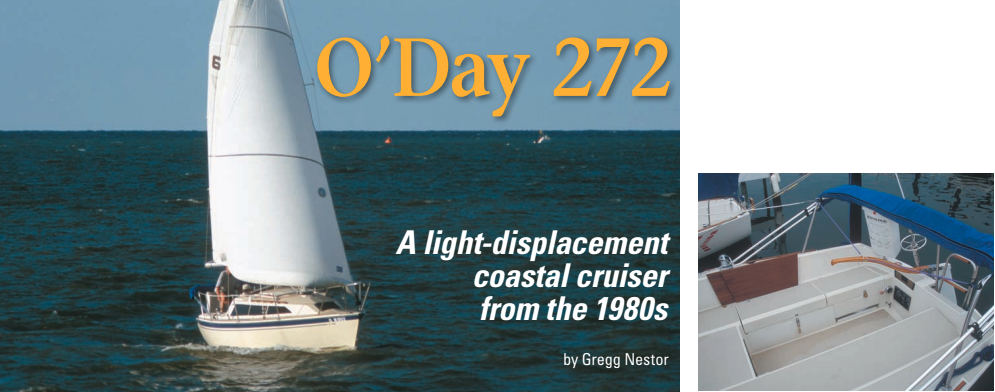
A light-displacement coastal cruiser from the 1980s
Issue 53 : Mar/Apr 2007
George O’Day was the only sailor to win both an Olympic gold medal and the America’s Cup. He won the 5.5-Meter class in the 1960 games held in Rome, and he crewed for Bus Mosbacher aboard Intrepid in the successful America’s Cup defense of 1967. His love of sailing also prompted him to open a sailboat dealership and to move from there to building boats more to his own liking.
Design
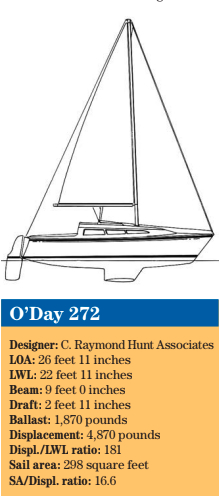
The O’Day Corporation’s early product line featured boats designed by a variety of naval architects, including Philip Rhodes, Uffa Fox, Robert Baker, and Andrew Kostanecki. Designed in 1972 and introduced in 1973, the original O’Day 27 was drafted by Allen Gurney. It accounted for 724 hulls and was in production through 1982. Once the company’s emphasis was redirected from small boats to larger vessels, the firm of C. Raymond Hunt Associates became O’Day’s sole provider of boat designs, including the O’Day 272, our review boat. Introduced in 1986, this boat was produced until the company ceased operation in 1989.
The O’Day 272 is a coastal cruiser designed to be fast and nimble, moderately light and lively, and easily sailed by a crew of two or even single-handed. It was manufactured in two versions: the standard 272 and the 272 LE, which offers additional refinements such as an inboard engine.
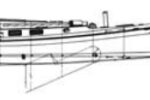
The O’Day 272 displays little sheer, moderate freeboard and bow overhang, and a slightly rounded reverse transom. Possessing a streamlined appearance, the low-profile cabin slopes forward with its roofline converging with the boat’s other lines at the stemhead fitting. This — along with its “visually connected” Euro-style portlights — gives the boat the appearance of forward movement whether at rest or underway.
Construction
The one-piece hull is a solid, handlaid fiberglass laminate, while the decks, cabintop, and cockpit sole are a sandwich of two layers of fiberglass with a core of end-grained balsa wood. The hull-to-deck joint is lapped, sealed with a marine adhesive/sealant, mechanically fastened, and covered with an aluminum-and-vinyl gunwale guard. A molded fiberglass pan, which designates the various cabin features — such as sole and berth foundations — extends throughout the boat’s interior. It’s bonded to the hull at two levels to increase stiffness and hull strength. Its top edge terminates at seat height. A foam-backed fabric hull liner begins where the pan leaves off and continues upward, eventually merging with a similar fabric headliner. These fabric liners provide insulation and reduce noise and condensation.
The boat’s wing keel is a solid lead casting fastened onto the bilge sump with stainless-steel bolts and sealed with a polyurethane compound. The boat’s draft is just 35 inches, yet it has 1,870 pounds of ballast. This wing-keel design keeps the center of gravity low, which counteracts heeling. The rudder is foam-cored fiberglass. It is transom-mounted and connected to a varnished ash tiller. The LE version of the O’Day 272 came standard with pedestal wheel steering engineered by Edson.
Dual lifelines were standard on the 272 LE; singles on the 272. Other deck hardware is of good quality and adequately sized. Backing plates can be found behind major hardware, such as stanchions, traveler, and winches. The handrails, deck organizer, and rope clutches are backed with large stainless-steel fender washers.
Deck features
The deck surface features molded non-skid for sure footing and a two-tone color scheme to ease the effects of sun glare. On the foredeck, amenities include a pair of 7-inch mooring cleats, an anchor locker, and a stainless-steel bow pulpit. The sidedecks are 12 inches wide and bordered by a molded fiberglass toerail capped with teak. Lifelines run aft from the bow pulpit and connect to a split stern pulpit.
Forward, on the sloping portion of the cabintop, is a large translucent hatch. A fixed skylight, just aft of the mast, is situated over the main cabin. On the cabintop are teak handrails of a contemporary design mounted on custom-molded bases. There are three Euro-style smoked acrylic portlights on each side. The forward portlight on each side opens; the others are fixed.
The cockpit is spacious, with seats measuring 6 1⁄2 feet long. The seat bottoms are properly sloped, as are the 11-inch high coamings. This configuration affords reasonable back support and good bracing. There’s a generous bridge deck and a single, undersized 1 1⁄2-inch scupper. Beneath the starboard cockpit seat is a deep locker that houses the batteries and the manual bilge pump. In order to operate the bilge pump, the locker must be in the open position. This is not a good arrangement. Just aft of the large locker is a small, vented locker for stowage of a remote gas tank.
Our review boat is equipped with the optional inboard diesel engine. Its control panel is situated low on the inside of the transom and is subject to potential water damage. Just above the panel is a small cubbyhole built into the taffrail, which is billed as “stowage for small items” in the O’Day literature. The side facing into the cockpit is covered with a smoked acrylic panel and the top is open. Since no one seems to know what “small items” are best kept there, Terry Hynds, the owner of our review boat, uses it as a beverage holder. A swimming/boarding platform with a stainless-steel swimming ladder is molded into the port side of the transom. If the boat is not equipped with the optional inboard diesel, a multi-position outboard motor bracket is mounted on the starboard side.
Belowdecks
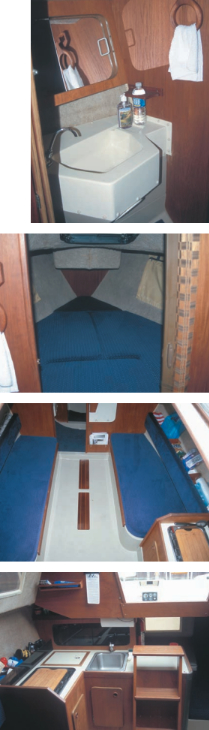
Going below, especially when carrying bulky sailbags and gear, is easy because of the wide companionway opening. It is 34 inches at its widest and narrows to 24 inches. There is no sea hood. With an opening of this size, it’s prudent to keep the sliding hatch and hatchboards in place when sailing, especially in foul weather. A three-step companionway ladder leads below to accommodations that are very straightforward.
While the V-berth initially appears to be on the smallish side, verging on claustrophobic, it measures a surprising 6 feet 10 inches long and 5 feet 6 inches wide. There’s a removable insert, which provides some standing space (compliments of the forward hatch), and a wooden accordion-fold door for privacy. Beneath is bin-type stowage and the optional holding tank. Our review boat is fitted with optional V-berth storage pouches. These removable and transportable zippered pouches are made of nylon and are mounted on the hull above the berth on both sides.
Aft of the forward cabin is the athwartship head compartment. To port is the molded fiberglass vanity and sink with manual cold water, a locker, and a cabinet with mirror. Its one-piece construction is easy to clean. On the starboard side is a portable toilet or, in the case of our review boat, the optional marine head. Behind the head is a hanging locker. There is no shower. The boat’s two opening portlights provide light and ventilation.
The main cabin is separated from the head area by means of a bi-fold wooden door. Mounted to the starboard bulkhead is a folding, dropleaf table. The saloon, which is open, airy, and simple, consists of a pair of opposing settee berths, each 2 feet wide. The starboard one measures 5 feet 6 inches long, while the port settee measures 6 feet 8 inches. There are shelves behind both settee backs and stowage beneath the starboard settee. Under the port settee is the 25-gallon potable water tank. There are no overhead handholds.
Two-burner cooktop
Further aft on the starboard side is the L-shaped galley, equipped with a two-burner Origo alcohol cooktop, a deep stainless-steel sink, a top-loading 3.5-cubic-foot icebox, and lockers for provisions, utensils, and cookware. On the 272 base model water from the icebox drains to the bilge. On the LE version of the 272 there’s an icebox pump that discharges to the galley sink. The LE version also came standard with pressurized hot and cold water. There are four fixed port-lights in the cabin trunk and a fifth in the footwell panel of the bridge deck. The companionway provides additional illumination and fresh air.
Across from the galley, on the port side, is a cabinet with a fiddled countertop and bin stowage beneath. This provides the galley with additional counter space and separates the saloon from the port quarter berth.
At more than 7 feet long and 4 feet wide, the quarter berth is generous. There’s stowage beneath it along with a full-length fiddled shelf above. On the LE version, but not on the standard model, a screened opening portlight opens to the cockpit footwell.
The bulkheads and cabinetry are teak-veneered marine plywood, while the companionway ladder and the bi-fold door are solid teak. The table and countertops are surfaced with an off-white plastic laminate. On the standard model the cabin sole is fiberglass with small teak-and-holly access hatches. The LE version has a varnished teak-and-holly sole. Headroom ranges from 6 feet 1 inch beneath the companionway hatch to 5 feet 10 inches at the forward bulkhead.
The rig
The O’Day 272 is a masthead sloop with a bridge clearance of 34 feet 10 inches above the waterline. The mast is stepped on deck in a tabernacle. Both the mast and boom are anodized aluminum and incorporate internal sail tracks as part of the extrusions. The mast has a single pair of airfoil spreaders and is supported by a pair of cap shrouds, single lower shrouds, a headstay, and a single backstay. The shrouds terminate at inboard chainplates that are fastened to the forward bulkhead. Sail area is 298 square feet, which gives the 272 a sail area/displacement ratio of 16.6, typical of a coastal cruiser.
The mainsail came standard with one reef point and a single-line reefing system. The reefing line is led aft to the cockpit and terminates at a line stopper on the port side. Both halyards are double-braided polyester and run inside the mast. They lead aft to the cockpit through rope clutches on the starboard side. Also situated on the starboard side is a cabintop-mounted Barlow #15 halyard/mainsheet winch. Additional running rigging, all of which has the option of being led aft, consists of a topping lift, internal outhaul, and a 4:1 vang. Barlow winches haven’t been made for a long time, and replacement parts may be difficult to find. The best bet, if you need parts, is to scavenge parts from old winches for sale in marine consignment shops.
The tracks and cars for the genoa are on the sidedecks and lead to a pair of Barlow #16 winches located on the port and starboard cockpit coamings. In lieu of the standard #16s, our review boat was fitted with the optional Barlow #19 single-speed self-tailing winches. The mainsail is sheeted mid-boom and fastened to a cabintop traveler.
Under way
This boat is quite user-friendly. With all lines led aft to the cockpit, raising, trimming, and reefing the sails is easily managed by a single sailor or a small crew. The O’Day 272 is a coastal cruiser, rather than a bluewater boat. It is perfectly at home in fairly sheltered waters. Its light-air performance is very good and, as the wind increases, the boat begins to sparkle.
However, weather helm becomes a concern at around 15 knots. Take a tuck in the main and maybe a couple of wraps on the genoa so the boat will sail on its feet. The O’Day 272 is responsive to its helm and displays respectable performance on all points of sail although it is perhaps not as close-winded as one might like. The shallow wing keel is probably the culprit here.
Being mainly a family boat, the O’Day 272 is not raced much. No fleet is larger than two, so the established PHRF ratings may not be that accurate for this boat. Most of the O’Day 272s rate around 228 seconds per mile. (Remember that this means 228 seconds per mile longer to complete a mile based on a specific reference point. For more on the PHRF rating system, see the July 2006 issue.) This 228 is slower than the older O’Day 27 at 204. For comparison, a Catalina 27 inboard also rates 204 and a newer Catalina 270 comes in at 201.
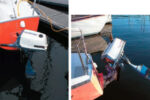
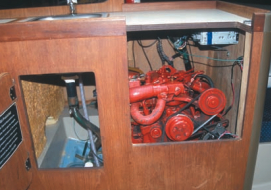
The typical O’Day 272 was not equipped with an inboard auxiliary engine, but rather fitted with an adjustable outboard motor bracket. The optional diesel engine was standard equipment on the LE version. Depending upon the year of production, one of two diesel engines was available: a 9-hp Yanmar or a 10-hp Westerbeke. Our review boat was fitted with the 2-cylinder, freshwater-cooled Westerbeke W102 turning a 1-inch shaft and 2-bladed propeller. Fuel is delivered from a 12-gallon aluminum tank that’s situated behind the engine on the boat’s centerline. Access to the engine for routine maintenance is good; simply remove the companionway ladder and the front panel of the engine enclosure. For greater access, the port and aft sides of the engine enclosure must be unscrewed. Access to the shaft and stuffing box is beneath the quarter berth.
Things to check out
As with any older boat, check the decks for delamination caused by a balsa core saturated with water. Pay keen attention around fittings. Delaminated areas sound dull and hollow when struck with a plastic hammer or the handle of a screwdriver.
Mast compression is another potential problem. Look for signs of cracking, bending, or movement of the supporting forward bulkhead. Also look for signs of water damage in the bulkheads where the chainplates are through-bolted.
While below, examine the hull and overhead fabric liner for telltale water stains. If present, stains can be traced to the source of the leaks.
Extensive cracking and crazing of the gelcoat on the cabintop has been a common complaint. The suspected cause is a thicker-than-necessary gelcoat layer, applied during manufacture. While this is primarily a cosmetic problem, if the cracking is deep, water can penetrate the laminate and result in delamination.
Conclusion
The O’Day 272 is an inexpensive, nicely equipped and appointed pocket cruiser designed for use in relatively protected waters. The boat is set up to be easily handled by a crew of one or two. Its wing keel enhances the boat’s stability and opens up thin-water sailing grounds. Enough stowage, elbowroom, and amenities make a weeklong summer cruise for a family of three or four possible. Prices range from $10,000 to $15,000 for a 272 and from $13,000 to $18,000 for a 272 LE, depending upon year, condition, and level of equipment.
Thank you to Sailrite Enterprises, Inc., for providing free access to back issues of Good Old Boat through intellectual property rights. Sailrite.com