Modern systems for stowing sails and reducing area
Issue 53 : Mar/Apr 2007
When the wind suddenly picks up or a squall line is approaching, the ability to furl or reef sails efficiently and safely is vital.
Furling means to completely drop, roll up, or gather a sail to its spar and to prevent it from blowing in the wind by securing it with gaskets.
Reefing means reducing the area of a sail so a boat can continue sailing in heavier winds.
Hanked-on (traditional) foresails
The traditional luff system for headsails is a flexible wire or rope luff with snap-fasteners to attach, or hank, it to the forestay. The jib is fastened to the forestay before being raised and remains attached when it is lowered.
Hanked-on jibs vary in size. The smallest is the storm, or spitfire, jib. Working jibs are often given numbers depending on their size, such as a No. 2 jib or a No. 3 jib, with the No. 1 jib being the largest. When a jib is large enough to overlap the mast, it is called a genoa jib or just a genoa, after Genoa, Italy, where it was introduced by a Swedish sailing team.
The advantage of a hanked-on headsail is that the luff is attached to the forestay, which is strong and relatively rigid. Because it is not rolled up and need not serve multiple purposes, this type of sail can be shaped for maximum efficiency. Some traditional jibs are set up to be reefed using reef points similar to those on mainsails using slab reefing. The downside of the hanked-on jibs is that in deteriorating conditions, when they must be reefed or a smaller jib must be substituted, working on the foredeck can be unpleasant.
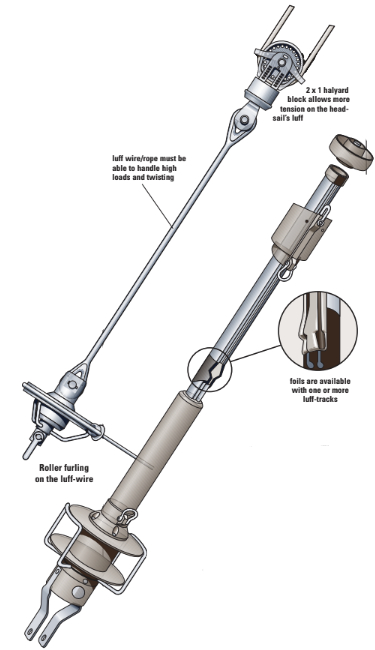
Roller furling on the luff-wire
The first roller-furling headsails were rolled up on their own luff-wire, just behind the forestay. The tack (forward lower corner) was attached to a deck-mounted drum and the head was attached to the halyard through a swivel aft of the forestay. Thus, the headsail could be furled from the cockpit without the need to go onto the foredeck. But the tension required on the halyard to reduce unwanted sagging of the center of the headsail was enormous.
That sag created a poor sail shape, so this system was shunned by racing sailors. Also, a fitting usually had to be installed to prevent the head of the sail from wrapping itself around the forestay. With this system, reefing is not practical, except in very light winds or for a short time just before rolling it up entirely when approaching a mooring, dock, or slip under sail.
Although this system is seldom used today, this roller gear is still available.
Roller furling on a foil
It wasn’t long before that early furling system was replaced with a grooved foil and roller drum enclosing the forestay. With this system, the sail’s luff is fed into a groove in the foil. There are swivels at the top of the foil and bottom of the roller drum. With this system, the headsail can be rolled up around the foil and, since it is on the forestay, sag is no greater than that of a hanked-on headsail. This system can accommodate a working jib, genoa, and even a large gennaker or Code-Zero (a new development which combines the laminate materials of a jib with some features of an asymmetrical spinnaker). With the added rigidity of the forestay and foil, it now becomes practical to reef a larger headsail, resulting in fewer required headsail changes. In addition to the convenience, these foils provide a more aerodynamically efficient leading edge.
Although roller-reefing jibs can be partially rolled up (reefed), they lose efficiency when rolled up more than 15 to 20 percent. In addition, the center of effort of a partially furled jib of this type is higher off the deck than that of a storm jib — something that doesn’t help the situation as the winds begin increasing. These jibs cannot replace a proper storm jib under really bad conditions.
Rotating systems
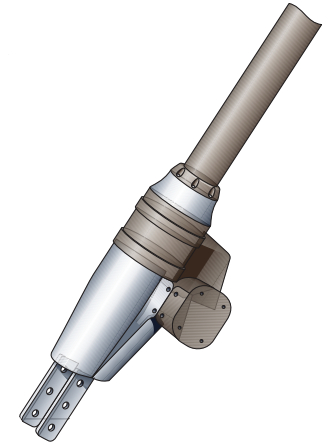
Rotating the foil to furl or reef the sail can be done in several ways. Most often it is with a single line that is wound around a drum at the base of the foil. This line leads back to the cockpit. It can also be done with a “continuous line,” a loop of line that leads back to the cockpit. This “continuous line” wraps around a large diameter drum, which is lighter, stronger, and safer than the traditional single-line drum system but a bit harder to handle. One advantage of this system is that, since there is no drum at the base of the sail to store the furling line, the headsail can be several inches closer to the deck.
In lieu of manually furling the headsail there are electric and hydraulic systems available. These have a motor at the base of the foil, replacing the drums of the manual systems. Most of these electric or hydraulic furlers have a winch-handle socket or a continuous line manual backup system in case of electrical or mechanical failure.
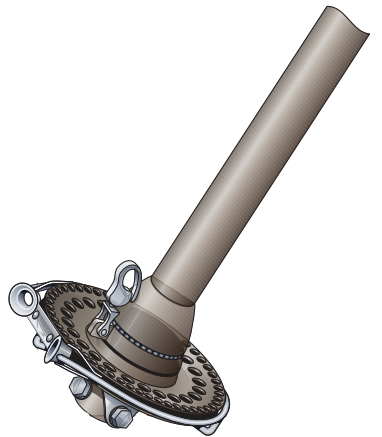
In modern furling systems the basic components are the lower swivel and drum assembly, including furling line; the foil extrusion; the upper swivel; and possibly a halyard retainer, which keeps the foresail halyard from wrapping around the forestay/foil.
Installation
The size of the furling system will depend on the length of the forestay and its wire diameter. Some roller-furler installations require that the forestay be cut and a new bottom terminal or forestay be purchased. Other manufacturers provide roller systems that can be installed without cutting the stay.
Modern furling systems are reliable and easy to use. They are increasingly finding their way aboard cruising and racing sailboats.
Thank you to Sailrite Enterprises, Inc., for providing free access to back issues of Good Old Boat through intellectual property rights. Sailrite.com