A coastal cruiser from the shores of Lake Michigan
Issue 61: July/Aug 2008
The S2 is one of a handful of small- to medium-sized sailboats built by Leon R. Slikkers, a Michigan man who has spent much more of his life building powerboats. But during its relatively short history, S2 Yachts produced several quality sailboats that continue to be much admired by their owners.
The Slikkers story
In 1946, 18-year-old Leon left the family farm in Diamond Springs, Michigan, for a job in the joiner department at the Chris-Craft Corporation in Holland, Michigan. During nearly 10 years with Chris-Craft, Leon refined his skills and was noted for his ability to create innovative designs.
During a 1952 company-wide labor strike, Leon decided to build power-boats of his own design and began pro-duction in his garage. While the strike was in progress, he fabricated about 10 15- and 17-foot plywood runabouts.
With labor strikes becoming increasingly common and his after-hours boatbuilding business becoming increasingly successful, Leon seriously considered going out on his own. His first step was to register the name SlickCraft in 1954; a year later he made his move. During the 1955 model year he built 35 boats, all of wood.
By 1956, Leon was experimenting with fiberglass hull construction and came to believe that fiberglass was the future; he switched to all-fiberglass construction after the 1962 model year. Innovation and success continued for his small family-oriented company, and SlickCraft became synonymous with quality and affordability.
After attracting the attention of a conglomerate with an interest in boats, the Slikkers family sold SlickCraft to the AMF Corporation in September 1969, the same year that AMF bought Alcort’s Sunfish and Sailfish brands. Leon was retained as president of the SlickCraft Division, staying with AMF four years. Upon leaving, he immediately began experimenting with a fiberglass sailboat design that would not violate his powerboat noncompete clause with AMF.
On February 18, 1974, S2 Yachts came into being. While Leon’s goal was to build a series of well-detailed, nicely built, high-quality trailerables, his first offerings weren’t particularly attractive, nor did they perform all that well. The joke was that S2 stood for “slowly sideways.” But he rapidly made adjustments, and by the late 1970s the company had developed an impressive line of cruising auxiliaries. As with the SlickCraft brand, S2 soon became synonymous with craftsmanship, styling, and performance.
Correctly anticipating a shrinking sailboat market, Leon added power-boats to his product line, now that his noncompete had ended, with the intro-duction of the Pursuit series of fishing boats in 1977, followed by the Tiara line of express cruisers in 1979. Leon reacquired the SlickCraft sportboat brand name from AMF in 1983 but, sadly, in 1987, S2 sailboat production ceased.
Design
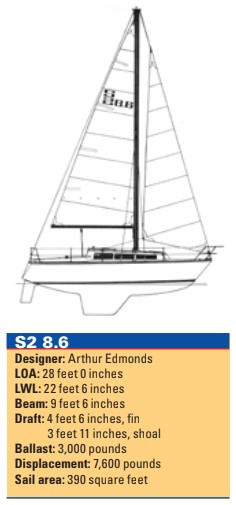
The S2 8.6 is a refinement of the S2 8.5 manufactured from 1981 to 1983. Introduced in 1983, the 8.6 remained in production until the company stopped making sailboats. Both boats were quite similar and were designed by naval architect Arthur Edmonds, whose best-known production sailboat is probably the Allied Princess 36.
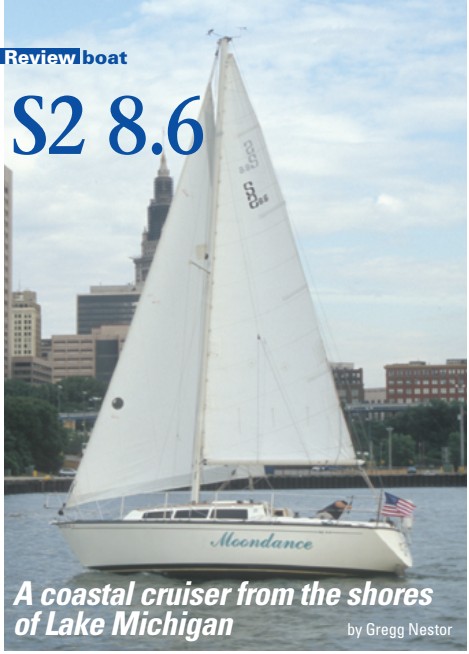
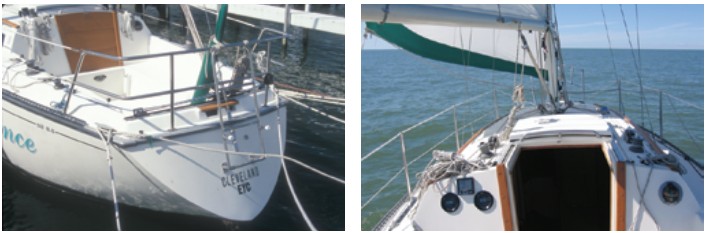
While the earlier Graham and Schlageter-designed Grand Slam series of S2s were high-performance sail-boats — including a two-time MORC (Midget Ocean Racing Club) champion — all of the Edmonds-designed S2s were cruisers and moderately designed ones at that. To achieve this end with the 8.6, Edmonds combined the design elements of a somewhat flat sheer, moderate fore and aft overhangs, a re-verse transom, and a slightly forward-leaning cabintop. Together, these elements produce a balanced and graceful appearance. For some traditionalists, however, the boat may look a little too modern, especially with its European-style cabin portlights.
Construction
The hull is solid hand-laid fiberglass laminate. Next to a high-quality gelcoat, the first fiberglass layer is chopped mat followed by a succession of cloth layers. The deck is also hand-laid fiberglass, with all horizontal areas cored with end-grain balsa. The hull-to-deck joint is an inward-facing flange arrangement, bonded with flexible adhesive and through-bolted on 6-inch centers by passing the bolt through the slotted aluminum toerail. The outboard seam is cosmetically hidden by a vinyl rubrail that S2 quite aptly termed a “crash rail.”
Underwater, the 8.6 is fitted with a spade rudder mounted on a 1 1/2-inch stainless-steel rudder post. This appendage is combined with either a deep-fin or a shoal-draft keel. Rather than being bolted externally to the hull, both keel configurations (which are lead castings) are encapsulated inside a hollow keel shell.
The chainplates are bolted to ply-wood gussets as well as to the bulk-head in the main cabin and are backed with stainless-steel plates. All deck hardware is through-bolted and backed with stainless-steel fender washers, rather than the preferred metal backing plates.
The majority of the boat’s interior structure is plywood, veneered with plastic laminate, trimmed with teak, and glassed to the hull. Hull and head-liner treatments are of moisture- and mildew-resistant fabric.
Overall, the construction of the S2 8.6 is very good, with excellent glasswork.
On deck
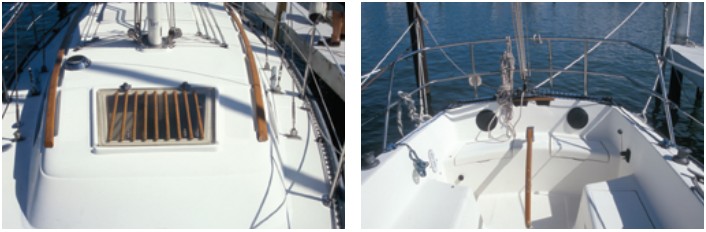
The foredeck of the S2 8.6 is relatively clutter-free. Mounted quite a bit aft of the stemhead fitting are a pair of large 8-inch mooring cleats positioned out-board on wide stainless-steel chafing strips. There are no chocks. This arrangement necessitates leading the anchor rode well off the boat’s center-line and is likely to result in the boat sailing around its anchor or mooring. The only other foredeck feature is the flush-mounted anchor locker. This leaves the foredeck, with its two-tone non-skid surface, clear of any obstructions. There are a stainless-steel bow pulpit and dual lifelines. The sidedecks are reasonably wide, but the shrouds are fastened to chainplates situated toward the center of the sidedecks, restricting fore-and-aft movement.
Forward on the cabintop is a flush-mounted, smoked-acrylic hatch covered with teak strips to protect it and provide better footing. Aft and to starboard is a vent over the head compartment. (Instead of a cowl vent, our review boat had been upgraded with a solar vent.) To port is a provision to add another vent — not a bad idea, since there are no opening portlights. A proper sea hood protects the companionway sliding hatch. A pair of teak handrails, one port and one starboard, span the full length of the 10-foot 6-inch cabintop and, since they are recessed, are promoted as being of a non-trip design. While they look great and are an interesting concept, they are not easily accessible and in actual use can be a “finger breaker.” On each side of the cabin trunk are three large fixed portlights.
The cockpit is T-shaped and comfortably sized, measuring 7 feet 6 inches long. The coamings are of a reasonable height and width and pro-vide decent back support. There is a deep locker beneath the port cockpit seat, plus an equally deep lazarette with access on either side of the tiller. A battery box is fitted at the forward end of the port cockpit seat locker. Wheel steering was optional, hence the T-shaped cockpit. The bridge deck is narrow. To provide cockpit drain-age, there are a pair of scuppers aft. Dual lifelines connect to the stainless-steel stern pulpit. The centerline swim ladder is a separate structure. Its use requires climbing over the stern pulpit, which is awkward, to say the least.
Belowdecks
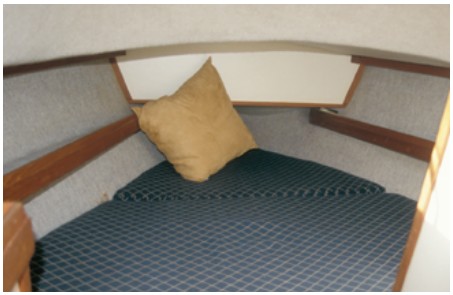
The accommodations of the S2 8.6 are fairly conventional. The forward cabin features a V-berth and a pair of deep bookshelves outboard and above. The cushion of the V-berth is divided athwartships, rather than down the centerline, into two manageable pieces. This unique feature allows for easy access to the forward locker. The remaining area beneath the V-berth houses the 37-gallon potable water tank and a couple of small lockers. A single fixed portlight and the forward hatch offer natural light and ventilation.
Aft and to port is a hanging locker with a trio of cubbies and a bureau top. To starboard is the head compartment with a teak-veneer door. The base portion of the head compartment is a single fiberglass unit that comprises the sink, vanity, medicine cabinet, sole, and toilet base, with adequate space for toilet articles. Manual cold water via a foot pump and no shower are standard. If equipped with a shower, the gray water drains to the bilge. A single fixed portlight and cowl vent service this compartment.
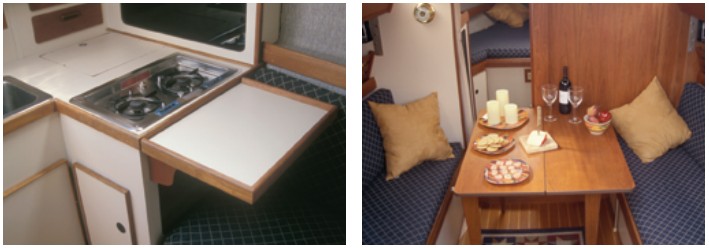
In the saloon are opposing settees/berths and a teak drop-leaf table mounted to the starboard bulkhead. The port settee is a short single with a foot well beneath the galley stove. To access this additional space, the galley counter extension must be flipped up. The star-board settee pulls out and converts to a double berth. While there is stowage beneath the port settee, the area beneath the starboard settee houses the holding tank. Outboard and above both settees is additional stowage in the form of cubbies and fiddled shelves.
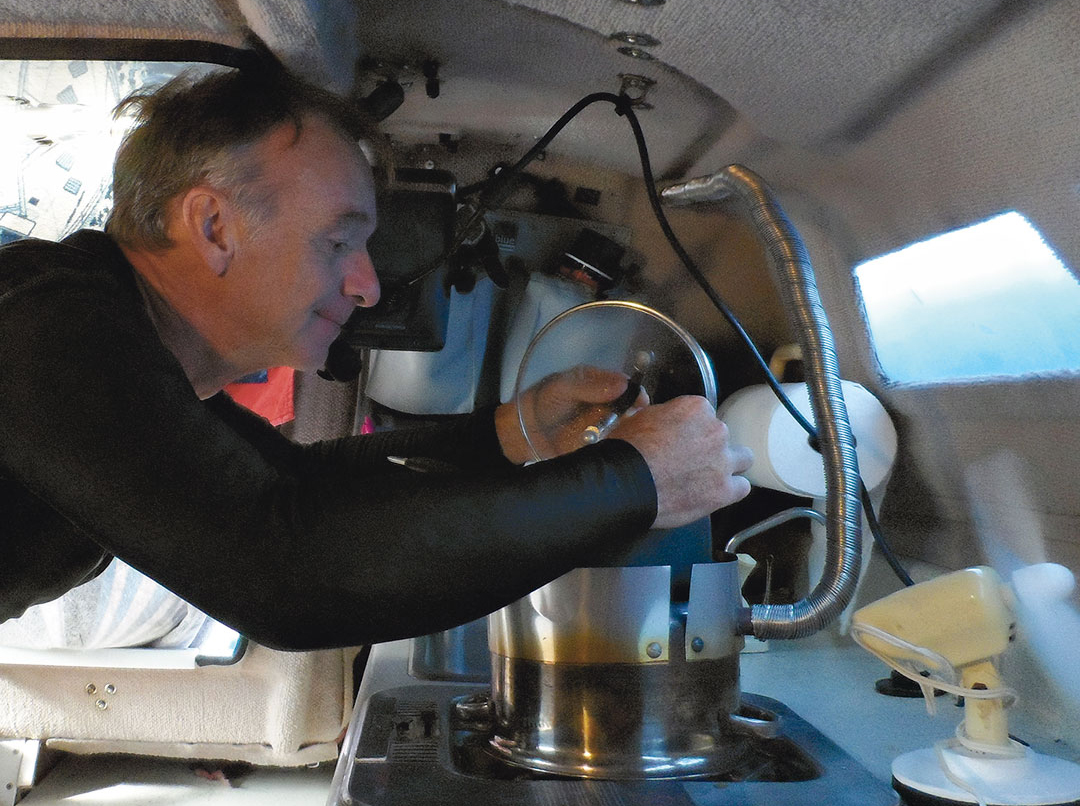
The L-shaped galley is aft and to port. Across the aft bulkhead and situated almost on the centerline is a single stainless-steel sink with foot-pump-operated cold water. Outboard and to port is a top-loading icebox that’s tiny, poorly insulated, and drains to the bilge. Behind the icebox and beneath the port cockpit seat is a convenient trash compartment. Forward, between the icebox and the flip-up counter extension, is a two-burner Kenyon alcohol stove with a cutting-board cover. While this initially appears to be a workable arrangement, the stove is situated athwartships rather than fore and aft. As such, it cannot be gimbaled. More importantly, when using both burners, the cook must either sit sidesaddle on the port settee or reach across the inboard burner to reach the outboard one, not the best of situations. On the plus side, however, there’s reasonable stowage space for galleyware and provisions.
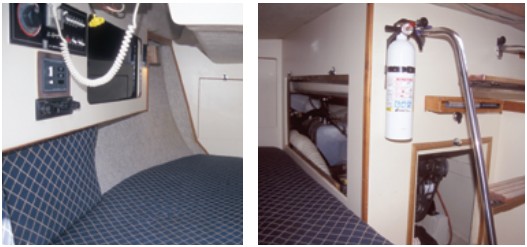
Across from the galley is the junction of the starboard settee and the spacious quarter berth. Most quarter berths tend to be a bit claustrophobic. But not on the 8.6. This one has sitting headroom, which comes in handy since there’s a large removable panel that allows for good access to the engine, transmission, stuffing box, and other associated parts. At the foot of the quarter berth is a smaller panel providing access to the lazarette.
An electrical panel and cabinet with sliding doors are mounted outboard and directly above the head of the quarter berth. The panel has a locking battery switch, two-battery test meter, and room for a dozen circuit breakers. There is also a reasonable amount of unused surface area on which additional marine electronics can be installed.
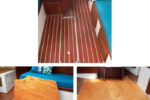
The remaining four fixed portlights and the companionway hatch provide light and air circulation to the balance of the boat. There are 6 feet of head-room and a teak-and-holly sole.
The rig
The S2 8.6 is a masthead sloop featuring a high-aspect-ratio sail plan with a small mainsail and an overlapping headsail. The mast is deck-stepped and has a bridge clearance of 41 feet. Both spars are painted aluminum extrusions, as is the single pair of airfoil spreaders. A pair of Lewmar #8 single-speed halyard winches are mounted aft on the cabintop, to port and starboard. Common today, but unique for its time, all sail controls are led aft through clutches. The arrangement includes the Cunningham, outhaul, reef, and halyards. All but the Cunningham are sheaved internally. Short tracks used for the smaller headsails are mounted on the side-decks and led aft to Lewmar #30 two-speed primary winches and cleats situated on the cockpit coamings. The sheets for larger head-sails are led through snatch blocks clipped to the slotted toerail. The mainsail is sheeted to the end of the boom and led to a traveler that spans the transom.
The standard Yanmar 2GM diesel moves the boat easily under power. Surprisingly, there is no strainer on the intake of this raw-water-cooled engine. (Adding one was among the first upgrades the owner of our review boat made.) Fuel capacity is 18 gallons in an aluminum tank beneath the cockpit sole, just aft of the stuffing box. Access to the engine for routine maintenance is excellent and is gained from several different areas: by removing the companionway stairs and a galley panel, through a panel in the quarter berth, and from inside the port cockpit seat locker.
Underway
The S2 8.6 is a comfortable, stable, and relatively stiff cruising boat. It’s no slouch either. It is easy to sail and generally performs well, exhibiting a balanced helm and good tracking. It is not the best light-air performer; however, on most points of sail it compares favorably to most other boats of similar size and type. The test boat is a strong competitor in local racing.
Not many 8.6s were built, so it’s not surprising that PHRF fleets are few — just two boats are listed, rating 189 and 201 seconds per mile. The more prevalent 8.5 rates in the mid-180s. For comparison, a Pearson 28 rates around 192 while the O’Day 28 and Catalina 28 both rate around 201.
Things to check out
Encapsulated keels pose a potential problem. In the event of a grounding or damage from an underwater obstruction hard enough to damage the leading edge of the keel, water can enter the space between the fiberglass outer skin and the lead ballast. Fixing this can require significant time and money. A drain plug isn’t a bad idea. The good news is that water shouldn’t enter the living spaces or compromise buoyancy.
Any boat with a balsa-cored deck is a candidate for deck delamination. The S2 8.6 is no exception. One area of chronic leakage is around the chain-plates. If you’ve got your eye on a used 8.6, sound out the deck and examine the fabric liner in these areas as well as around all deck fittings. Speaking of deck fittings, replace those fender washers with metal backing plates to better spread the load.
If there’s no strainer on the raw-water intake, have a mechanic determine whether the engine’s operating temperature is within specification. If not, the engine’s cooling passages may need to be cleaned and flushed. In any event, add a proper strainer.
Conclusion
The S2 8.6 is a comfortable, stable, and easily managed coastal cruiser and club racer. Despite having been designed more than two decades ago, the S2 8.6 styling is quite contemporary. The boat is well-built and finished with care. These boats tend to hold their value. Expect to pay between $15,000 and $23,000.
Gregg Nestor, a Good Old Boat contributing editor, developed a keen interest in sailing while growing up on the southern shore of Lake Erie. His third book, currently at the publisher and yet to be titled, is a comprehensive handbook for trailersailors. When not writing about sailing, Gregg and his wife, Joyce, cruise aboard Raconteur, their Pearson 28-2.
Thank you to Sailrite Enterprises, Inc., for providing free access to back issues of Good Old Boat through intellectual property rights. Sailrite.com