Using 16th-century trees for 21st-century boats
Issue 59 : Mar/Apr 2008
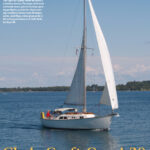
Bob Bethea is devoted to his Nonsuch 30, but he calls its clinker-built tender his “heart and soul.” The attachment seems almost reverential, so it is not surprising to find that Bob is an Episcopal minister as well as an avid cruising sailor.
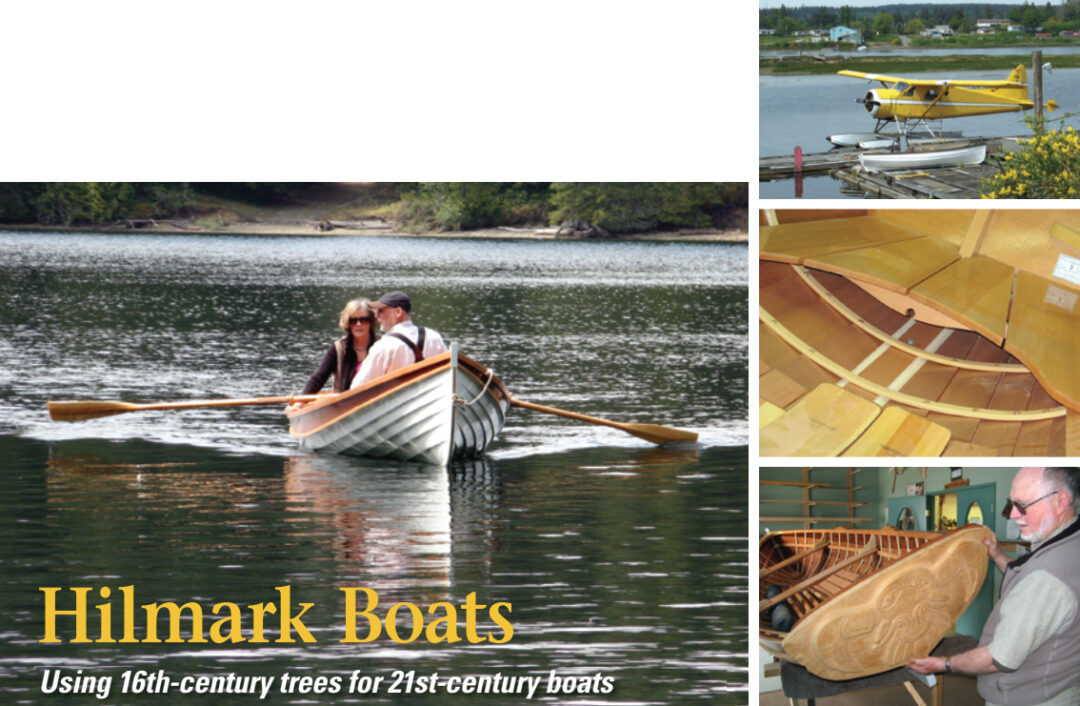
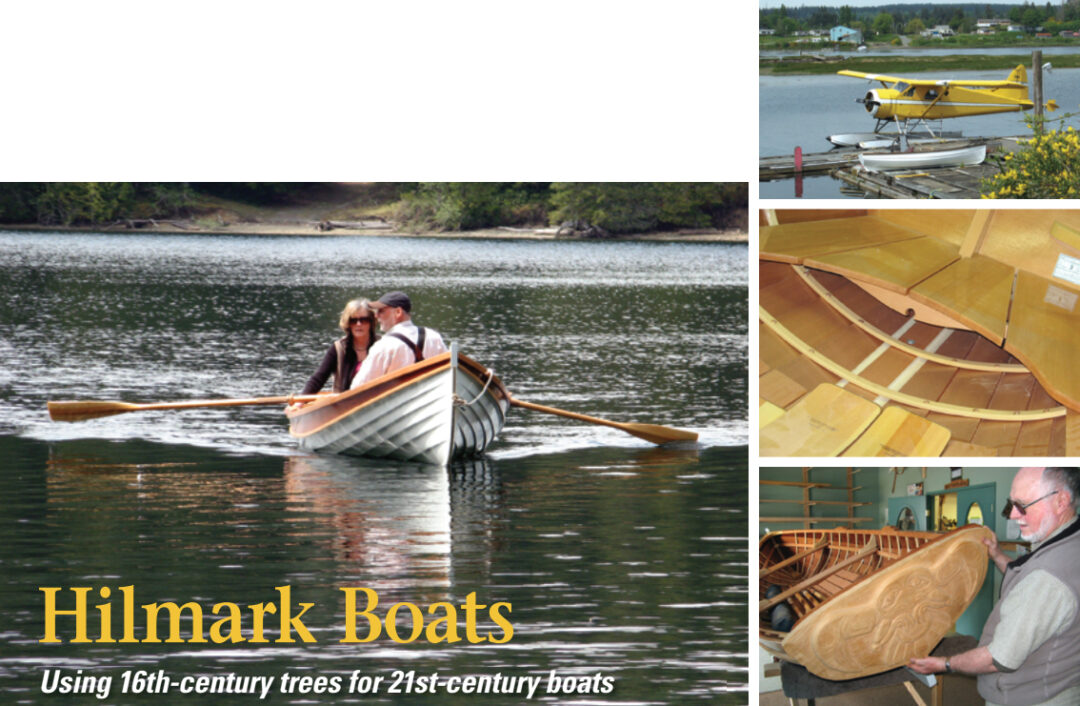
We launched the 10 1⁄2-foot sailing dinghy in Eagle Harbor on Bainbridge Island, Wash., and I stepped in for a trial row. The Shaw & Tenny leather-dressed oars had African mahogany- tipped blades to match the boat’s hand- some thwarts.
“Do you sail her much?” I asked, pulling away from the dock.
“No,” said Bob, “Why should I sail her when I can row?”
I quickly understood what he meant; Thekla (Greek for “servant”) is an absolute pleasure to row. There is enough weight in her 130 pounds to carry her way with confidence and style through the early morning cat’s-paws. All was quiet except for the characteristic poppling sounds of a clinker hull moving through water. It’s good to row a boat like this in such a place and take in the extraordinary attention to detail she has built into her. Alaskan yellow cedar frames tuck neatly between the western red cedar sheer strake and Douglas fir clamp. Thwarts are richly patterned African mahogany with yellow cedar knees. Plank is fastened to plank with copper clench nails and copper riveted through frames — the best materials, beautifully crafted.
Uncompromising
Bob needed a tender for his much-loved fiberglass Nonsuch — a tender that would complement the mother ship’s no-nonsense, uncompromising integrity and resolute character. He saw Hilmark Boats’ Sunshine Tender at the Wooden Boat Festival in Port Townsend, Wash., and knew immediately this was the one. The Sunshine Tender sells for about $12,000.
Hilford Burton came to building wooden boats in a second career that followed on from 43 years and 22,000 hours as a Canadian bush pilot. He had a private license before graduating from high school and subsequently flew all over Northern Ontario and above the Arctic Circle, back and forth across the Atlantic to the Sudan and back home by way of Hudson Bay. In the course of all this, he grew to admire the boats he landed among — boats that, just like the De Havilland Beaver and Twin Otter floatplanes he flew, made life in remote areas of the planet possible. Native boats and bush aircraft are tried and true, suited to the purposes they serve . . . and beautiful.
Eventually settling on the West Coast of Canada, Hilford found one of these native boats along the shores of Vancouver Island. It was a boat that met the demanding uses of fishermen in the Campbell River area and one that forms the basis of many of the Hilmark wooden boats, such as the Sunshine Tender. Hilford took the lines from a boat that Ned Painter built back in the 1920s. Many Painter boats have been replicated in fiberglass, but Hilford was determined to continue the traditional methods of the boat’s original builder.
Old-growth timber
One thing that sets a Hilmark boat apart from most good wooden boats is that Hilford can still obtain old-growth western red and yellow cedar and Douglas fir, the same woods that went into Ned Painter’s boats. Hilford knows several “ma-and-pa loggers” who find and mill 500-year-old trees to his specifications. He worries, though, that his short list of British Columbia loggers, with their small-scale sawmills, will find more to do with their time than find good trees for Hilmark Inc.
In addition to being an environ mentally responsible practice, the use of old-growth timber has several advantages for the boatbuilder. It has greater resistance to decay and, being air-dried, is more limber and workable. Hilford even steams yellow cedar frames and persuades them into shape. He has to be quick about it, though, because hot cedar unwinds much faster than white oak when cooling down.
The old-growth quarter-sawn fir thwarts, yellow cedar knees, and breast hooks have an exceedingly tight grain that almost disappears from view under several coats of varnish.
But like any boatbuilder out of another time, Hilford uses modern materials and methods when he’s convinced they will produce a better boat. He makes minimal use of epoxy and polyurethane sealants and adhesives, tries new tools occasionally, and will devise new methods of construction as befits a boatbuilder who is largely self-taught. A bush pilot is, by nature and training, practical and romantic, curious and disciplined. He is resourceful, inventive, and respectful of tradition. All of these qualities find a place in the boats of Hilford Burton.
Hilford works alongside his assistant, 25-year-old Brahm Thexton. Brahm’s love of boats and enthusiasm radiates through everything he does, from lofting and fastening cedar planks to launching, just as it does with his boss. Brahm tried to apprentice himself to several boatbuilders but Hilford was the only one who responded. They’ve been together now for three years and it is difficult to imagine Hilmark Boats without both of them.
Involving clients
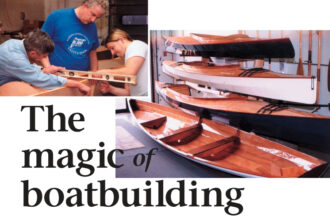
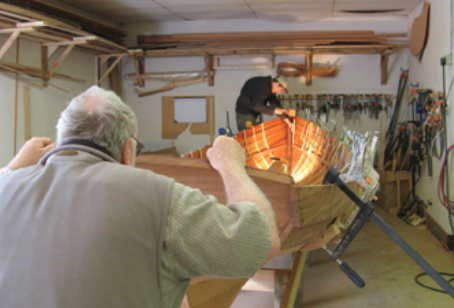
One of the keys to the company’s success is the way they’re able to involve their clients in every stage of the design and construction process. Everything that goes into a Hilmark boat is open to scrutiny by the potential owner, and dialogue is encouraged at every turn. Brahm maintains a weblog, accessed from their website, that features day-to-day commentary and progress reports, along with photographs and videos of every stage of the design and building process.
No matter how remote the owner is (and they are as far-flung as Martha’s Vineyard and Austria, Orcas Island and Antigua, Texas and Montreal, Miami and Minneapolis, as well as Campbell River), he or she is virtually in the shop observing what’s going on, asking questions, suggesting alternatives, musing over color schemes, kibitzing and otherwise entering the process. It’s not everyone’s cup of tea, but Hilford and Brahm thrive on this kind of open and honest rapport on all matters technical and aesthetic. They love these boats and expect that owners will too.
Before we headed back to Seattle, Hilford insisted that we launch a new 14-foot 3-inch by 4-foot 3-inch Tyee Rowboat. We drove through the forest to a freshwater lake a few minutes outside of town. Hilford backed the trailer behind his pickup down the ramp as he’s done hundreds of times until the boat floated off at the end of her tether. Brahm stepped aboard shoeless, all grins, and light as a mosquito, exuding the wonder of anyone who has ever launched a boat he’s built.
I watched her settle in the lake, watched the sweep of the sheer climb toward the stem as Brahm turned away from the shore, saw the varnished not-quite-heart-shaped transom and white gloss topsides quiver in the water before she sped away to a nearby island.
I looked over at Hilford, his eyes narrowed to slits, watching Brahm putting her through her paces, and asked what he thought.
“I don’t really think,” he said, “It’s just the way we build ’em.”
Richard Smith is a contributing editor with Good Old Boat. He has owned and built several boats, including an Atkin Red Onion sloop, a 30-foot Alan Pape steel cutter outfitted from a bare hull, an Atalanta 26, five dinghies, and an Ericson Cruising 31.
Thank you to Sailrite Enterprises, Inc., for providing free access to back issues of Good Old Boat through intellectual property rights. Sailrite.com