Try staining with the help of Scotch-Brite pads
Issue 59 : Mar/Apr 2008
Two years ago, I officially became a good old boatowner by purchasing a 1970 Hallberg-Rassy Mistral 33 with the intention of giving it a complete three-year overhaul. The fiberglass hull was in great shape, but the wood in the cabintop, cockpit coaming, and some interior areas had suffered some damage from rotting. It was going to be a great woodworking project. Like many of the other boats from this era, the interior was constructed of a gorgeous red Honduras mahogany that had faded in various degrees, based on location within the boat.
It was my intention to disassemble, refinish, and epoxy the original wood interior back together. However, some pieces were damaged beyond restoration and needed to be replaced. Now I had what must be a very common problem with other good old boaters: how do you replace a single piece of wood and make the mahogany available today (African or Philippine) match what was originally supplied from the old-growth forests (Honduras) of 35 years ago?
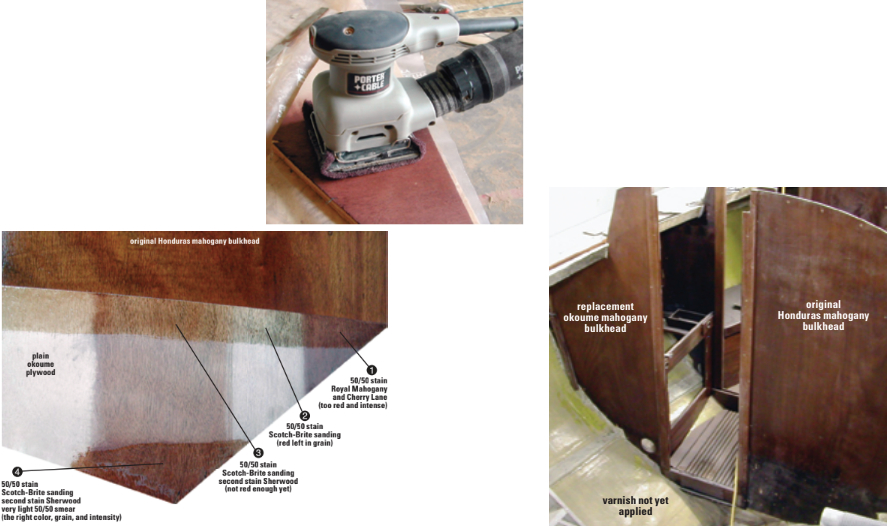
I decided to try blending stains in an attempt to make the readily available light-colored okoume plywood match the original boards. I found a number of red mahogany stains, but they didn’t match the various shades within my boat. There was not going to be a one-size-fi ts-all solution to my problem. I began playing around with various red- and brown-colored stains, looking for a matching blend, and found that a combination of Benjamin Moore interior wood stains (four parts Royal Mahogany to one part Cherry Lane) matched the red in the original wood. This stain was easy to work with, could be applied evenly to a large area, and dried fairly quickly. However, the color match was too intense for the entire surface area. I needed to lighten up the stain’s intensity in the higher areas of the wood but leave the darker red in the mahogany grain. I tried using 330- grit sandpaper, but it was removing material too fast. Furthermore, if the electric sander was not positioned correctly at all times, edge-loading would make nasty white patches.
I was looking for something finer to sand with when it hit me! Why not use Scotch-Brite pads with my Porter-Cable 1⁄4-inch sheet sander? After all, the size was right.
It took a little more time than sandpaper, but what a result! The thicker and softer Scotch-Brite surface eliminated the edge-loading problem and removed the surface of the wood gently enough that I could control the intensity of the stain. I was then able to epoxy the wood as is for many of the millwork replacements, or apply a light-brown stain from Sherwood to the treated surface to match any faded original wood on bulkheads and elsewhere. In this way, I was able to tailor the staining process for any new piece of wood so it would match the existing wood in grain, color, and intensity. I created a test board to determine the process required for each part.
The standard green Scotch-Brite is available at the big-box lumber stores, but industrial distributors such as Acklands-Grainger http://www.acklandsgrainger.com/ sell it in a variety of grades and sizes that are less-frequently available. The purple Type A Very Fine industrial product worked very well for me. I’ve enjoyed the ability to match the grain background and the overall color and intensity of each new piece I’m now staining for the interior, and I’m feeling better about using the okoume plywood for the cockpit coaming and bright areas of the cabintop. Even if I make a mistake in staining some of these large boards, I have a method of correcting my work and starting over. The difficulty of matching stains with older existing wood is no longer going to be a problem while refitting the Vera May.
Stephen Thompson is a professional mechanical engineer. Having sailed on inland lakes as a boy, he built a small sailing vessel from scratch when he reached 50 years of age. Now he has undertaken the restoration of a 1970 Hallberg-Rassy Mistral 33 in an Edmonton, Alberta, warehouse. He hopes to explore Vancouver Island with a gleaming Vera May.
Thank you to Sailrite Enterprises, Inc., for providing free access to back issues of Good Old Boat through intellectual property rights. Sailrite.com