Comparisons with the competition
Issue 59 : Mar/Apr 2008
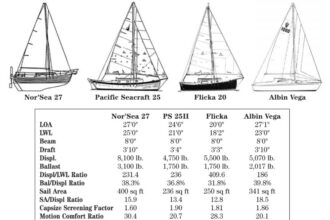
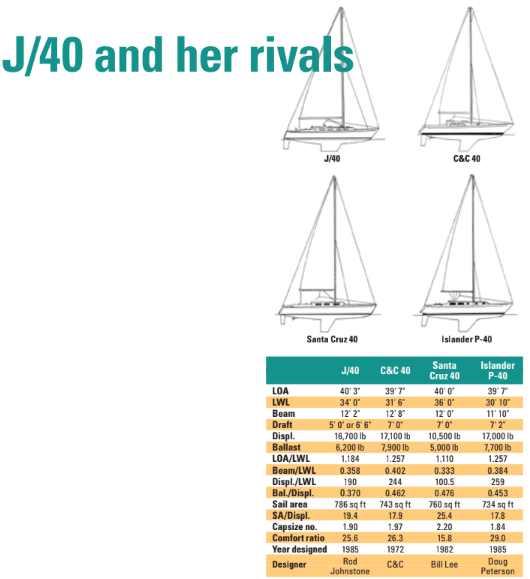
For this comparison I’ve selected four examples of fast light- and ultra-light-displacement yachts from some of North America’s top designers. They are quite different but each would be a delight under sail. A sail aboard any of them in a good breeze would be quite an eye-opener to those who believe heavy displacement is the only way to go to sea.
I recall being with a crew “road testing” one of Rod Johnstone’s J/44s. The light touch of the helm, the speed made good to windward, and the feel of the narrow hull and long waterline cutting through the light chop was a joy. The quality of the light and bright interior, finished in L. Francis Herreshoff-style, with beautiful varnished teak trim setting off broad expanses of gleaming white paint, was also a refreshing and handsome change from the all-too-common dark teak interior.
The oldest yacht in this group, the C&C, is moderate when compared with the very light J/40 and the ultra-light Santa Cruz 40. As she was designed years before either one, that could be expected. Nevertheless, she was, in her day, a rather advanced design. The surprise was the Peterson-designed Islander 40. She seems moderate for a competitive 1985 design although she is still undoubtedly an excellent performer.
The things I like about the C&C and the Peterson are their ample draft and high-aspect-ratio fins. Both have good displacement and a high ballast ratio, so their deep fins will provide great stability and make them superb weatherly boats when beating to windward in a stiff breeze. The heavy ballast and deep draft will also make them more forgiving when slightly overloaded for a long voyage, although the draft will limit the areas they can safely explore.
More stability
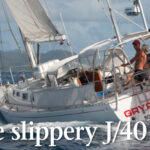
The J/40 offered a choice of drafts and, while her low-aspect-ratio fin is fine for harbor hopping and coastal cruising, the 6-foot 6-inch option would lower her center of gravity and add to her ultimate stability and her windward ability. The longer fin would be a good choice for blue water, whether the intent is racing or cruising.
Bill Lee has long been a proponent of ultra-light yachts, and his Santa Cruz 40 is no exception. I expect that she is the one yacht in the group that can reach planing speeds, given the proper conditions. Regardless, she has proven to be fast in any weather. Due to her ultra-light displacement, she will also be the corkiest of the group in a seaway and could be very uncomfortable in light weather if there were a big leftover slop and not much wind.
While a terrific downwind sleigh ride and a fun boat for coastal cruising, the Santa Cruz 40 would not be my choice for bluewater voyages. The major problem is that an ultralight boat is never at her best when overloaded. Bill Lee’s creation is at her best when sailing minimally laden and with a lean, sharp crew on a 10-day race to Hawaii.
A J/40 with a 5-foot draft would be a fine choice for coastal cruising, particularly if the cruising were in an area noted for shoal water — the Chesapeake, the Bahamas, and areas of Florida and the Gulf. She will prove comfortable, able, and quite capable of showing her heels to most boats her size. She will also cross oceans, of course, and is far more seaworthy than many boats that have done it before her.
With the deeper draft option, the J/40 is capable of extensive bluewater voyaging if you can resist taking along all the modern and electrical comforts. The J/40 is a yacht, not a floating house. As long as they recognize that fact, true sailors will find her to be an absolute thoroughbred in every way.
Ted Brewer is a contributing editor with Good Old Boat.
Thank you to Sailrite Enterprises, Inc., for providing free access to back issues of Good Old Boat through intellectual property rights. Sailrite.com