Ruggedly built, conservatively styled
Issue 62 : Sept/Oct 2008
Ericson Yachts began life in Costa Mesa, California. There, in the early 1960s, Ray Handy, along with several others, was building a Carl Alberg design from molds discarded by Pearson Yachts. In 1964, a pair of San Francisco Bay sailors, brothers Don and Gene Kohlmann, joined Handy’s group and, as its guiding force, formed Ericson Yachts.
Naval architect Bruce King of Newport Beach, California, was soon commissioned to design the company’s boats. Early on, this involved modifying a W.B. Crealock-designed 26-footer and a rework of the Alberg 35. After a few years, Ericson was producing original designs that ranged from 23 to 46 feet. For the most part, these were fairly heavily built family cruisers that often performed reasonably well in handicap racing.
In 1971, a holding company called the CML Group purchased Ericson and maintained its grip on the company for 13 years. Gene Kohlmann regained control in 1984, when CML offered Ericson stock to the public. The two brothers continued operating the company until 1990, when the business entered into Chapter 11 of the federal bankruptcy code. Pacific Seacraft then bought some of the molds, hired Gene as a vice president, and began producing Ericsons in 1991. Unfortunately, the older Ericson designs saw limited sales at Pacific Seacraft, and by mid-1999 production of the Ericson line was discontinued.
Design
Bruce King designed the bulk of the Ericson line, including the Ericson 27. Introduced in 1971, the Ericson 27 remained in production for nine years, accounting for 1,302 units. In many ways, the Ericson 27 is a fine representative of the Ericson line of the 1970s.
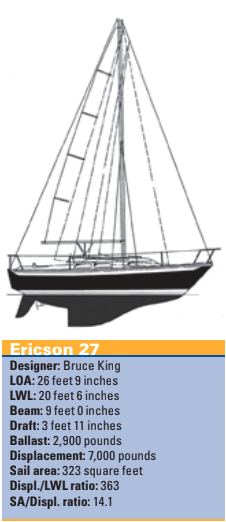
A review of the numbers shows that the Ericson 27 is conservative in every respect. Its sail area/displacement ratio is 14.1, and its displacement/length ratio is 363. These figures suggest a boat that is a somewhat sluggish performer. This is confirmed by the Ericson 27’s Performance Handicap Racing Fleet (PHRF) rating of 225 to 230 seconds per mile in fleets around the country. In comparison, a Pearson 26 rates 210 to 219, a Catalina 27 inboard rates 204, and a C&C 27 rates 200 to 210.
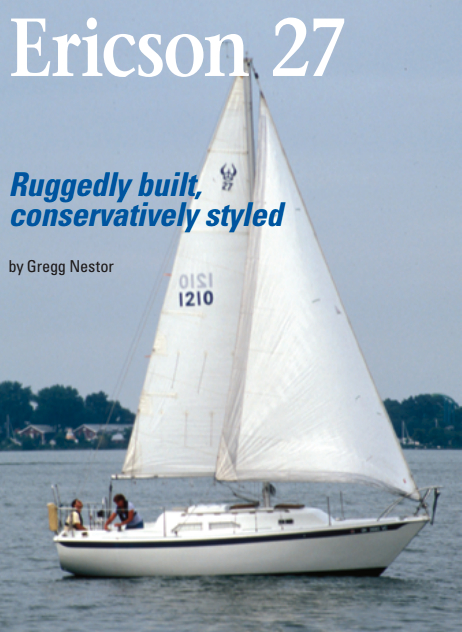
The boat’s design was typical of the 1970s, yet it is still attractive today. The Ericson 27 has a flat sheer; the wide sheer stripe was a stylistic element also used by other builders. The moderate overhangs are the result of its fairly sharp entry and straight counter transom. For its length, the boat has a relatively high freeboard; however, the cambered coachroof minimizes the visual impact of this “awkwardness.” Also, the lines of the coachroof blend pleasingly into the stemhead, adding to the overall harmony of the design.
In mid-1974 the Ericson 27 received a makeover. This included a redesigned deck as well as an upgraded interior. Regardless of the year of manufacture, the Ericson 27 was fitted with a rig of moderate height, a shallow-draft fin keel, and a spade rudder.
Construction
Construction of the Ericson 27 is typical for its era. The hull and deck are hand-laid fiberglass and polyester resin composites. The hull is solid, while the deck, cockpit, and coach house are a sandwich composed of two layers of fiberglass with an end-grain balsa core. This gives these parts additional stiffness and also creates good insulation against sound and engine heat. The mounting bases for the primary winches are also of sandwich construction; however, marine-grade plywood is used in place of balsa as the core. Like most production boat builders, Ericson Yachts used a molded headliner and fiberglass pan that determine the placement of cabin features such as berths.
The hull-to-deck joint is an outward flange that’s chemically bonded, mechanically fastened, and then covered with a protective two-piece rubrail.
The swept-back fin keel draws 3 feet 11 inches and incorporates 2,900 pounds of encapsulated lead ballast. A spade rudder is mounted on a 2 3⁄8-inch-diameter stainless-steel shaft that rotates on bronze bearings with grease fittings. Its one-piece construction is made of a high-density polyurethane foam core covered with fi berglass.
When compared to other production builders, Ericson Yachts enjoyed a reputation for good quality and fi nish.
Deck features
Except for a pair of outboard cleats and a small deck pipe leading to a chain locker in the forepeak, the Ericson 27’s foredeck is clear of obstructions. Normally this would yield a large work platform on which to make sail changes and deploy/retrieve anchors. Not so. The boat’s relatively sharp entry results in a narrow foredeck.
The sidedecks are a comfortable 14 inches wide and are bordered by a toerail and single lifelines that terminate at stainless-steel pulpits. Aggressive non-skid, outboard chainplates, and a pair of cabintop teak handrails measuring over 6 1⁄2 feet aid in fore-and-aft maneuverability.
Forward on the cabin trunk is a pair of small portlights. Only the starboard one, serving the head, opens. The other is fixed, as are the four larger portlights farther aft. On top there are a sea hood and, depending upon the year of production, one or two opening hatches (one situated forward and possibly a second one aft of the mast).
Early Eriscon 27s featured a straight cockpit with tiller steering, an outboard engine for auxiliary propulsion, and a single overhead hatch. Around 1974, the entire boat was upgraded and the deck mold redesigned. This included a new T-shaped cockpit with wheel steering, an inboard engine, and a second overhead hatch.
Anemos, the review boat, is a 1978 model and it benefi ts from Ericson’s mid-production upgrade. Its T-shaped cockpit is physically split by an athwartship fiberglass bridge that conceals the attachment point for the emergency tiller and on which the traveler is mounted. The forward portion of the cockpit is without a bridge deck and easily accommodates four adults. Beneath the port cockpit seat is a deep sail locker that also houses the aluminum fuel tank. Aft of the 28-inch wheel and binnacle with engine controls is the helmsman’s station, beneath which is access to the lazarette. Low and to port is the engine control panel, while aft and to starboard is the manual bilge pump. Directly behind the helm is the chainplate for the backstay and, farther aft, the centerline swim ladder.
Belowdecks
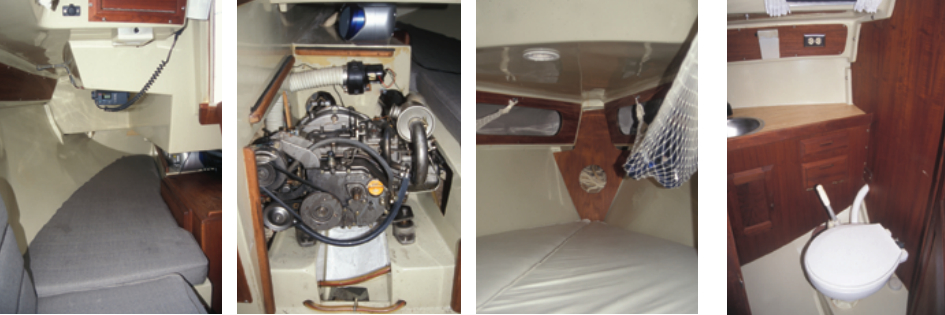
Like the foredeck above it, the Ericson 27’s V-berth is very narrow. Outboard are stowage cubbies and beneath is a pair of lockers. The forward locker is for gear, while the aft one houses the potable water and holding tanks. There are no access ports serving this compartment; a simple oval opening in the forward bulkhead offers the only access. Even though the forward hatch straddles this bulkhead, above the V-berth and the head, the cabin is quite dark and lacks good ventilation.
Following aft and to port of the V-berth is a hanging locker with a bureau top. To starboard is a generously sized head compartment. It contains a stainless-steel sink with manual cold water and a fore-and-aft facing toilet. This configuration makes using the facilities a lot more comfortable than athwartship toilets, especially when the boat is heeled. The opening portlight and part of the forward hatch provide ventilation and natural illumination. A solid two-panel door provides privacy. In an attempt to encourage air movement, both the forward bulkhead and the door to the head terminate a few inches from the overhead.
The saloon features the traditional opposing settee/berth arrangement with bulkhead-mounted drop-leaf table. There are fiddled bookshelves outboard, with stowage beneath and behind all settees/berths. Both the house and starting batteries are located beneath the starboard settee. The port settee is 6 feet long, while the starboard settee and the quarter berth each measure 6 feet 3 inches. Five fixed portlights and an overhead hatch provide light and air. Wooden grabrails run the length of the saloon.
The L-shaped galley is to port and includes a single stainless-steel sink with manual cold water (foot pump), a two-burner alcohol cooktop with cutting board cover, and an icebox that drains to the bilge. For stowage of provisions and galleyware, there are several drawers, a shelf, a built-in dish rack, and a locker with sliding doors.
Depending upon the year of production, the Ericson 27’s interior is either mahogany or teak veneer on marine-grade plywood. The mahogany will most likely be oiled; the teak, varnished. Regardless of species, both finishes are above average. Headroom is 6 feet 1 inch, and the sole is non-skid fiberglass with mahogany or teak access panels.
The rig
The Ericson 27 is a masthead sloop with deck-stepped mast that has an air draft of 36 feet 4 inches (38 feet 2 inches, if fitted with the tall rig). Belowdecks, there is a solid wood compression post. Rigging is a pair of cap shrouds, incorporating a single pair of spreaders, fore and aft lower shrouds, a headstay, and a backstay. On earlier boats that featured tillers, a split backstay was installed; however, after the 1974 redesign, Ericson switched to a single backstay. All halyards are sheaved externally and may either be stainless steel with braided Dacron tails (early models) or all-rope braided Dacron (post-1974). A pair of single-speed Barlow #16s or equivalent halyard winches is mounted on the mast. Anemos is fitted with a pair of Lewmar #8s.
A mainsail and a 120-percent lapper were standard. Optional sails included a working jib in addition to 150-percent and 170-percent genoas. The mainsail came with a single set of reef points and jiffy reefing. On earlier boats, the main was sheeted mid-boom to a traveler mounted over the companionway. This configuration was later abandoned for a cockpit-mounted traveler and end-boom sheeting, which is much more desirable.
Depending upon the size of the headsail, its sheets can be led aft through fairleads on one of two sets of tracks. Sheets of small sails follow aft to short sidedeck-mounted tracks, while those of larger genoas are led to much longer toerail-mounted tracks. The sheets terminate at coaming-mounted primary winches and cleats. On Anemos, the primaries are the single-speed Lewmar #8s.
Under way
As evidenced under way by its heavy displacement-to-length ratio and its short rig, the Ericson is much more of a cruiser than a racer. In an attempt to enhance its performance, a tall rig was developed. Unfortunately, this extra 2 feet made no significant improvement and negatively impacted the boat’s stability. Only a very few boats were delivered with the taller mast. When the breeze freshens, the boat tends to develop significant weather helm. Those boats with wheel steering are much more enjoyable to steer than those equipped with tillers.
While originally designed for an outboard motor, more than 80 percent were delivered with inboard engines. Over its nine years of production, Ericson used a variety of engines and manufacturers. These included the venerable Atomic 4 gas engine and Westerbeke, Volvo, and Yanmar diesels. Anemos’s auxiliary is a Yanmar YSM8. This is a single-cylinder, 8-hp, raw-water-cooled diesel engine. Access to the engine for routine maintenance is very good. When under power, the combination of the boat’s off-center prop shaft and angled rudder shaft requires the helmsman to pay constant attention.
Things to check out
Regardless of the year of production, the Ericson 27 is a well-built boat. As such, when searching the used boat market, problems encountered tend to be cosmetic rather than structural. Common complaints include inadequate icebox insulation, leaking portlights, a single backstay that interferes with the helmsman, and gate valves on through-hulls.
With more than 1,300 hulls delivered, there’s always a selection of used boats available. Boats that have benefited from the 1974 redesign are more desirable. They have wheel steering, an upgraded interior, and a reconfigured deck that includes a second hatch for improved ventilation, plus a more efficient cockpit. Of course, routine maintenance and periodic upgrades also impact desirability and price.
Conclusion
The Ericson 27 is a ruggedly built and conservatively styled cruising boat. Its moderate size and reasonable amenities make it a good candidate for a cruising couple to consider. It’s not a speedster and it does have its drawbacks, but if properly maintained and outfitted, it will hold its value. Prices for earlier models range from $7,500 to $12,000, while post-1974 boats are priced at $8,000 to $15,000.
Gregg Nestor, a contributing editor with Good Old Boat, developed a keen interest in sailing while growing up on the southern shore of Lake Erie. His third book, currently at the publisher, has a working title of To Windward at 55: The Trailer Sailer Owner’s Manual. When not writing about sailing, Gregg and his wife, Joyce, cruise aboard Raconteur, their Pearson 28-2.
Thank you to Sailrite Enterprises, Inc., for providing free access to back issues of Good Old Boat through intellectual property rights. Sailrite.com