A compact IOR racer/cruiser from the early 1970s
Issue 62 : Sept/Oct 2008
In January 1971 a fire broke out in a Grand River, Ohio, factory while the owners were at the New York Boat Show. The blaze destroyed the hull-lamination building and most of the tooling at the Douglas & McLeod Plastic Corporation. Before the fire, the McLeods, Ray Sr. and Jr., had been considering selling their larger auxiliary boat business to concentrate on small- boat production. Without sufficient capital to rebuild, they decided to sell the company to their partner, Charlie Britton.
Charlie moved the company to the opposite side of Grand River in Fairport Harbor. Before the decade ended, his company had been renamed Tartan Marine. As part of the sales agreement, the McLeods retained ownership of the name Douglas & McLeod Inc. and concentrated on building Thistles, Highlanders, and other small sailboats.
Design
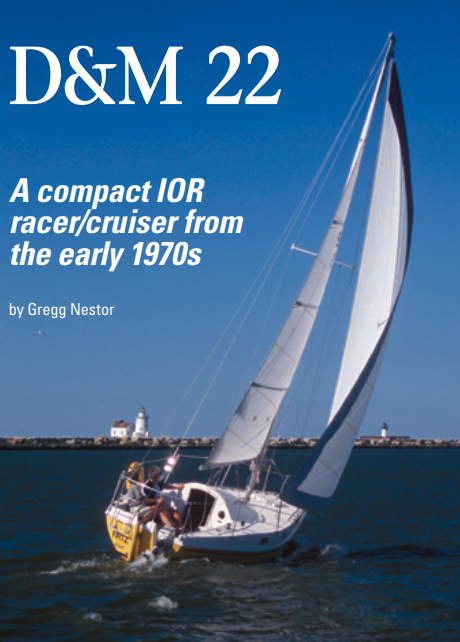
In the late 1960s, the International Offshore Rule (IOR) replaced the Cruising Club of America (CCA) rating rule. Anticipating that the immediate future of sailboat design would be determined by the new IOR, the McLeods commissioned Sparkman & Stephens to design one of the first boats to this new rule’s specifications. (By the way, Olin Stephens was instrumental in developing the IOR. Who better to do the design work?) In 1972, the D&M 22 was introduced with a rating of 18. All told, 135 boats were built. Ray Sr. died soon after the first boat was launched.
The design of the D&M 22 was entirely influenced by the IOR. As the boat’s original sales brochure states, “Shape is everything.” The boat’s most distinctive features include a sweeping sheerline, wide beam, a bubbletop cab- in over a raised deck, a clean spacious foredeck, and a pinched bow. Beneath the water, a lead-ballasted fin keel is attached to the boat’s fairly flat bottom, and an outboard rudder extends approximately 6 inches below the keel. The rudder is transom-mounted and partially attached to a protective skeg. In the event of a grounding, the rudder does not kick up; it is designed instead to slide up on a long pintle rod. By removing the outboard rudder, the boat is trailerable. Of the 135 boats built, 134 were tiller-steered; one was fitted with a wheel.
The first three to four boats were centerboard models. However, they didn’t perform as anticipated. Soon afterward, a representative from Sparkman & Stephens conducted a sea trial, and modifications were made. The centerboard cavity was filled with ballast and the design was modified to add 2 inches at the top of the keel. The resulting fin configuration became the only keel offered. (To distinguish a centerboard version from a fin-keel model, look for a deck pipe just aft of the mast, where the centerboard pendant exits.)
Construction
The hull and deck of the D&M 22 are constructed like a sandwich, with balsa wood between layers of fiberglass. While all horizontal deck surfaces are cored with end-grain balsa, the hull’s coring begins a few inches below the sheer and extends to just below the waterline. Combined with eight to 10 layers of hand-laid fiberglass, this laminate not only makes the hull strong and stiff, it also imparts a significant degree of sound and thermal insulation.
The hull-to-deck joint is an outward-facing flange that is glued together, mechanically fastened with bolts, and glassed over on the inside. A vinyl rubrail is fitted over the flange to disguise the joint and provide it with a degree of protection.
An interior pan, which terminates at the hull-to-deck joint, is bonded to the hull and adds additional structural integrity. The bubble cabintop and the lack of a sliding companionway hatch together contribute to deck strength. No overhead liner is used to add strength; this saves unwanted weight.
Deck features
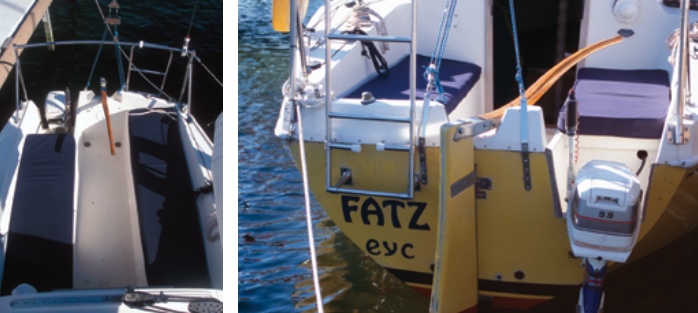
The combination of the boat’s bubbletop cabin, lack of a sliding hatch, and a raised deck makes for an expansive and clutter-free area. The deck hardware, forward hatch, headsail tracks, and shrouds that would normally be obstructions on a boat of this size seem almost insignificant and do not negatively impact this large non-skid surface. Sail changes, anchoring, and fore-and-aft movement are easily accomplished. The wide-stance stainless-steel bow pulpit, single lifelines, and cabintop handrails contribute to safety on deck.
The cockpit, with its aft-sloping sole and pair of 2-inch drains, comfortably seats five adults. While the port cockpit seat is 6 feet long, the starboard seat measures just 4 feet 7 inches; the balance is taken up by a molded-in outboard-motor well. Beneath the starboard seat is a full-length locker with stowage for an auxiliary fuel tank. The coamings (actually the raised deck) are reasonably high and slope aft to a stern rail, which is the terminus for the single lifelines. Our review boat was fitted on the port side with an optional, transom-mounted, swing-up swim ladder.
The companionway bulkhead features an arch-shaped opening, which measures 37 inches tall and 19 inches at its widest. Even without a bridge deck to climb over, this opening takes a bit of time to get used to; it takes a conscious effort to climb through. The companionway hatchboards, like the forward hatch, are made of fiberglass. To help with ventilation when the companionway is secured, a vent is molded into the upper hatchboard.
While the forward hatch and cockpit companionway provide ventilation, six fixed portlights located above the sheerline in the raised deck offer light in the cabin. Exterior wood is kept to a minimum: a pair of teak handrails and companionway trim.
Belowdecks
The raised deck and 8-foot 5-inch beam provide space for more accommodations than other boats of this size and even a few that are 20 percent longer. Beneath the bubbletop there’s headroom of 5 feet 6 inches.
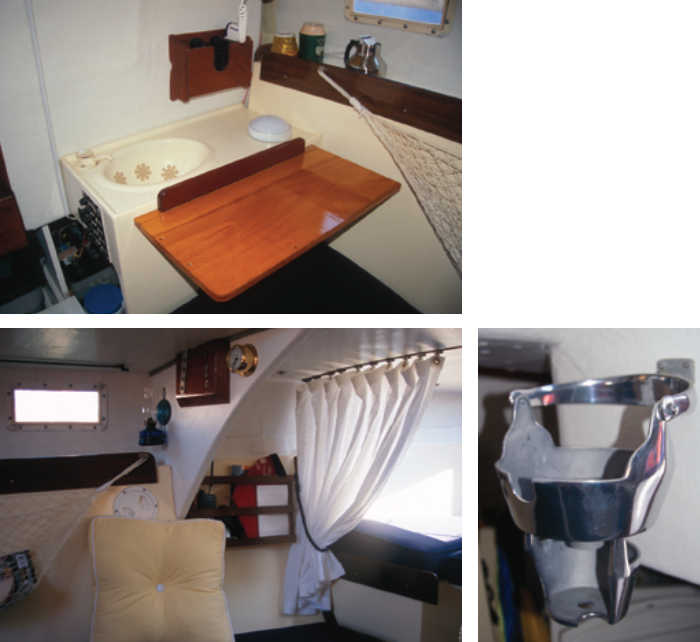
Standard accommodations include a V-berth and insert with large stowage bins and space for a portable toilet beneath. Aft and to port are an open-air hanging locker and stowage. Additional stowage is directly across on the starboard side. The bulkhead separating the V-berth from the main cabin is marine-grade plywood veneered with teak. The review boat had this bulk-head removed and a privacy curtain installed in its place.
The main cabin area comprises opposing settee berths with stowage beneath and fiddled shelves outboard. All berths, including the V-berth, are 6 feet 3 inches long. The aisle separating the settees is 32 inches wide and provides ample space for the drop-leaf pedestal table.
A gimbaled, single-burner alcohol stove is mounted to the aft bulkhead to port. To starboard is a molded-in galley unit that includes a fiberglass sink with hand pump, counter space, and flip-up wooden counter extension. Water is supplied from a portable jug. The sink drain exits the hull above the waterline at the transom. There are no through-hull fittings below the waterline.
The single companionway step slides forward to afford access to a cooler and the battery. The 12-volt electrical panel is mounted to the side of the galley unit. There is no quarter berth. In its place is a stowage area that continues underneath the cockpit sole. Access to this cavernous space is excellent, but it could easily put the boat out of trim if it were overstuffed with gear.
The interior surfaces are either finished in gelcoat or painted. Except for a rectangular section of wood, the sole is non-skid gelcoat. All wood trim is hand-rubbed teak.
The rig
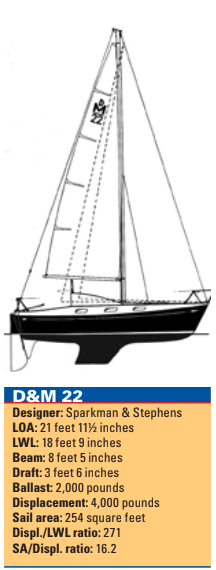
The D&M 22 is a high-aspect-ratio, masthead sloop with a sail area (main and 100 percent foretriangle) of 254 square feet. The anodized aluminum mast is deck-stepped on a hinged tabernacle. A pair of cap shrouds and spreaders, a pair of lower shrouds, a baby stay, forestay, and a split backstay all support the 30-foot 6-inch spar. A compression post stands beneath the tabernacle, and directly to port and starboard are large knees and support blocks to which the stainless-steel chainplates are attached.
Both halyards are external and fashioned from stainless-steel wire with Dacron rope tails. There are no winches on the mast to provide mechanical advantage for the halyards; two sets of 4:1 tackle are provided to tension the sails. Conversion to low-stretch, all-rope halyards with winches would be an improvement. The baby stay has a similar arrangement.
Headsail sheets are led through blocks on tracks and terminate at single-speed winches. These are British-made, stainless-steel, bottom-action winches. The mainsail is sheeted at mid-boom and attached to a traveler over the companionway. Additional sail controls include an adjustable topping lift, outhaul, jiffy reefing, and vang. All standard hardware is adequate, and all deck hardware is through-bolted, with the majority backed with fender washers.
Under way
The D&M 22 is fun to sail. Its wide beam and 50 percent ballast-to-displacement ratio make for a stiff boat. It’s sensitive and responsive to the helm, thanks to the tiller steering and the combination of a deep rudder and fin keel. The IOR encouraged large headsails and small mainsails. Having been designed to the rule, the D&M 22 has exactly that and, as such, it performs best on a broad or beam reach.
The boat nevertheless acquits itself quite nicely upwind. A spinnaker will improve performance off the wind, though the helm will need constant attention. This is generally the case with IOR-type hull forms.
There is but one D&M 22 listed with U.S. Sailing; it has a PHRF number of 234 seconds per mile. For comparison, a Catalina 22 swing keel is 270, a fixed fin-keel Tanzer 22 rates 246, and an O’Day 222, 258. So, for a 22-footer, the D&M 22 is fairly fast.
Things to check out
The D&M 22 is a fairly uncomplicated boat that was built to almost bullet-proof standards. However, a few areas require close examination. The deck is balsa-cored, which is always a potential problem on older boats. Areas to check for possible water seepage and subsequent delamination include the mooring cleats, chainplates, baby stay deck strap, and headsail tracks. The fixed portlights may also leak and require replacement and/or resealing. Because the rudder extends below the keel, examine it carefully for signs of damage due to grounding. A previous incident of this type could have caused the rudder to become saturated with water.
Conclusion
This IOR quarter-tonner packs a lot of space in just 22 feet. Its systems are uncomplicated, it’s easy to sail, and its construction is sound. While its looks are different, its pedigree is impeccable. The best places to locate a D&M 22 are the Great Lakes and the Eastern Seaboard, especially New England. These boats don’t show up on the market too often, but those that do generally sell for less than $10,000, with actual asking prices dependent on condition.
Gregg Nestor, a contributing editor with Good Old Boat, developed a keen interest in sailing while growing up on the southern shore of Lake Erie. His third book, currently at the publisher, has a working title of To Windward at 55: The Trailer Sailer Owner’s Manual. When not writing about sailing, Gregg and his wife, Joyce, cruise aboard Raconteur, their Pearson 28-2.
Thank you to Sailrite Enterprises, Inc., for providing free access to back issues of Good Old Boat through intellectual property rights. Sailrite.com