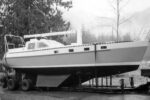
She’s just as fit for bluewater cruising as for club racing
Issue 64 : Jan/Feb 2009
Olin Stephens pioneered the fast keel/centerboard (k/cb) ocean racer in the 1950s, beginning with the famous Finisterre, with her winning ways. Given that ancestry, the Sparkman & Stephens-designed Tartan 37 had to be both a competitive and a civilized cruiser/racer in her day. As always, Tartan built her to unusually good standards, with a balsa-cored hull for strength and lightness, enabling the 37 to carry a very impressive 48 percent ballast ratio in her centerboard version and 47 percent in the deep-fin option.
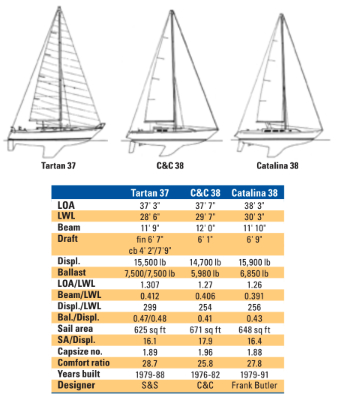
In essence, the 37 has 6 inches more beam than Finisterre, 3 inches more draft and, although she is 3,000 pounds lighter, she carries over 1,200 pounds more ballast. Obviously, the Tartan 37 was designed to be a very powerful yacht indeed, whether in centerboard or deep-fin form. It may seem odd that the 37 carries less sail area than her famous sister, but she carries it in a tall and very efficient sloop rig instead of a low-aspect-ratio yawl rig. To sum it up, the Tartan 37 is a very much-improved design compared to earlier k/cb yachts. So, how would she fare against some of her contemporaries?
I selected the C&C 38 and the Catalina 38 for comparison, as I could not find a k/cb yacht of that era in the same league as the S&S design. The shark-finned C&C 38, like the Tartan, is also balsa-cored. However, C&C chose to use the weight savings to reduce ballast by more than 1,000 pounds and the displacement by 800 pounds. With a foot more waterline, this results in a much lower ratio of displacement to waterline length and a more easily driven hull. C&C also gave their baby about 45 square feet more sail area and, as a result, she has the highest ratio of sail area to displacement of the three yachts discussed here. This would make her a real threat in lighter air and would have really paid off in club racing in her home grounds of Lake Ontario, as well as in similar light-air waters.
Carries less ballast
The Catalina 38 is the largest of the three yachts shown here, with a bit longer waterline and a few pounds more avoirdupois. She does carry less ballast than the Tartan, perhaps because her hull is not cored, but the difference is not significant. The Catalina is also a little heavier than the Tartan but carries a bit more sail, so, overall, her figures stack right up to the others, as you can see.
I would give the Catalina the edge in moderate conditions, and the well-canvassed C&C the edge in lighter air. Still, the heavily ballasted Tartan 37 should stand out when the breeze really stiffens and should still be very competitive in lesser breezes. She is a thoroughbred in every respect.
However, so much depends on the variables of weather, sails, equipment, crew, and skipper that all three yachts will provide their owners with all the excitement anyone could ask for in club racing. Of course, the Tartan really competes against herself with deep-fin and centerboard versions. The two should be quite evenly matched, though, with the centerboarder taking lighter air and downwind honors and her finned sister showing her mettle upwind in stronger breezes.
Capable yachts
Still, except in club racing, these three yachts are not truly competitive today and are most likely to be sought after for their cruising, rather than racing, abilities. In that case, each of the three — four, if you include both versions of the Tartan — are comfortable, seaworthy, and weatherly yachts, quite capable of making extensive offshore voyages. The k/cb version of the Tartan would be at home in the shoaler waters of Florida, the Bahamas, and the Gulf, but she is also a yacht that can handle a circumnavigation, given the proper equipment, condition, and crew. Indeed, both Tartan 37s, k/cb or deep-fin, are thoroughbreds able to take their crews anywhere in the world and bring them home again.
Ted Brewer is a contributing editor with Good Old Boat and one of North America’s best-known yacht designers. He also is the man who designed scores of good old boats . . . the ones still sailing after all these years.
Thank you to Sailrite Enterprises, Inc., for providing free access to back issues of Good Old Boat through intellectual property rights. Sailrite.com