This fast, versatile, trailersailer is easy to launch, rig, and maintain
Issue 29 : Mar/Apr 2003
Rob Anderson is one of those larger-than-life, overgrown kids who’s always up to his neck in some type of Major Project. Large, as in 6 feet, 4 inches and 285 pounds.
Large, as in taking on a fixer-upper project that turned out to be a circa-1930, 12-Meter America’s Cup sloop. Large, as in competing in the 1984 Olympic sailing trials in a Finn, and the Star World Championships against many of the best sailors in the world.
So it was no surprise when he told me he’d abandoned life as the administrator of a sailing program at the University of California and relocated to Lewiston, Idaho.
“I’m a stay-at-home dad now,” he said, announcing the move and the birth of a son, Karsten. Rob assumed responsibility for the stewardship of his son while his wife, Devon, slaves away at an executive position at a nearby university . . . not that being a stay-at-home dad is a part-time job.
“But there’s no water there, Rob,” I told him.
“Sure there is. The Snake River and lots of inland lakes,” he replied. (This from the same guy I’d sailed with on an Admiral’s Cup boat!) “And I bought a trailerable San Juan 21. We’ve been sailing it all over Oregon, Washington, Idaho, and on Flathead Lake in Montana.”
Some quick math led me to the conclusion that Rob’s body was almost half the length of the deck, and his weight about the same as that of the retractable keel.
“I’m now a ‘movable weight module,’ ” he quipped.
Handicap problem
I’d never considered Rob to be a poster child for trailerable boats, but his logic makes sense. From a competitive standpoint, he said, “I was tired of IMS, IOR, and PHRF racing. I wanted a trailerable, one-design boat, and the SJ 21 fleet is the largest in this area. It’s not uncommon to see 12 to 15 boats attending a week- end regatta.” These, as I soon learned, are composed of equal parts of sailing and socializing. “And we camp in it,” he added.
Since the boats are portable, owners don’t become bored sailing the same patch of blue. The boats are easy to rig, require little maintenance, and serve as family entertainment centers. Rob tows the sloop with a pickup that has 170,000 miles on the odometer. And this trailerable is much easier on a checkbook than a 12-Meter was.
“There’s a ton of information on the San Juan 21 website. Most of the racing is done with white sails, so singlehanding is a snap. If we’re all going the same speed, who cares if there’s no spinnaker?” he said.
What’s not to like?
Some background
The San Juan 21 and her sisters were built by a company that expanded from obscure roots in the Pacific Northwest to become a national presence in the sailboat-building industry.
Like many boats of the era, the San Juan’s modest origins were in a garage. Robert Clark worked in the auto industry in the northeast, and his wife, Cora, was a nurse. When not designing prototypes for fixtures on automobiles (dashboards, for example), he built Lightnings and Thistles and was among the first to use fiberglass.
In 1960, the couple moved with their sons — Don, Dennis, and David — to Renton, Washington, to form Clark Boats and pursue their dream. Cora’s salary put bread on the table while Robert struggled to survive using his sons as a form of slave labor. Not to be confused with a real production facility, the “factory” was a shed.
Because boatyards become magnets of a sort, Robert soon attracted 15 do-it-yourselfers assembling homebuilt vessels. Robert eventually began building OK and Optimist dinghies in a joint effort with Axel Olsen, an immigrant bricklayer from Denmark who apprenticed with Paul Elvstrom. He also built International 14s, Thistles, 505s, Stars for Olympian Bill Buchan, and 150 Lightnings that the U.S. Marine Corps bought for use by soldiers on R and R.
“People were always bringing projects to us,” Dennis recalls. Along the way, Robert learned construction methods that would come in handy when the company began building bigger boats.
Head of production
When Don completed his degree work at the University of Washington, he became the firm’s designer and head of production. Among his early designs was a modified International 14 that became the Sea Lark. Dennis filled the slot as sailmaker and manager of tooling, and David was in charge of marketing.
With its reputation spreading beyond the Pacific Northwest, the Clark business flourished to the extent that, in 1969, Robert and Cora moved to North Carolina to set up a second production facility.
Somewhat suspicious of their motives, Dennis says, “I think our parents needed a new adventure.”
In the ensuing years Don designed performance-oriented pocket cruisers ranging in size from 21 to 34 feet. The company introduced the San Juan 24, a Bruce Kirby design that was an immediate winner on the racecourse. Clark Boats also built the Kirby Four.
Before the industry suffered a contraction, the company employed 1,500 workers in a 32,000-square-foot facility in Washington, and 150 on the East Coast. After building 6,000 San Juans and 2,000 dinghies, and with economic storms on the horizon, the company was sold in 1986. It eventually went the way of many endangered species.
However, Clark boats are still easy to find on all corners of the Lower 48. Today’s San Juan owners look to Gene Adams, of Port Gardner Sailboats, for parts, service, repairs, and good advice about the company’s products (see resources on Page 8).
Enter the San Juan 21
When Robert and his sons decided late in the 1960s to enter the trailerable sailboat market, Don designed the San Juan 21 Mark I, which was an instant hit.
Of the design, Don says she has a conservative rig carrying 190 square feet of canvas and is “on the fast side of cruising. She has good windward performance and is well-behaved.” She also sails extremely well in light air, as I learned during a two-day regatta in eastern Washington.
Don says, “She has no weather helm,” an observation echoed by owners who prefer more feel on the tiller when windspeed is less than 10 knots.
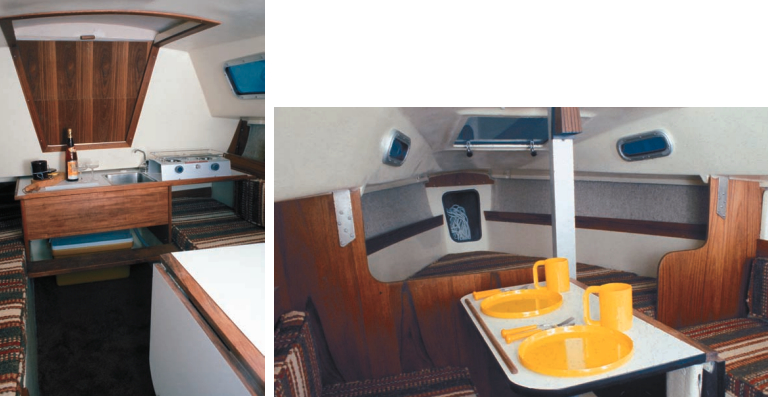
Except for a V-berth adequate for most couples, the San Juan 21 could be described as a “sorta” boat below-decks. Settees and headroom are sorta big enough for four. Quarterberths are sorta OK as cramped sleeping quarters. And a Porta Potti and a one-burner stove make her sorta adequate for indoor camping. She’s about what you’d expect in a 21-foot boat.
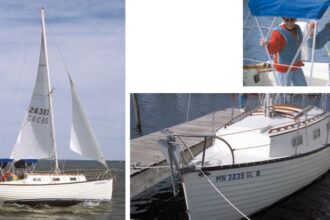
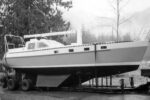
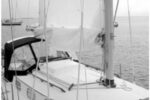
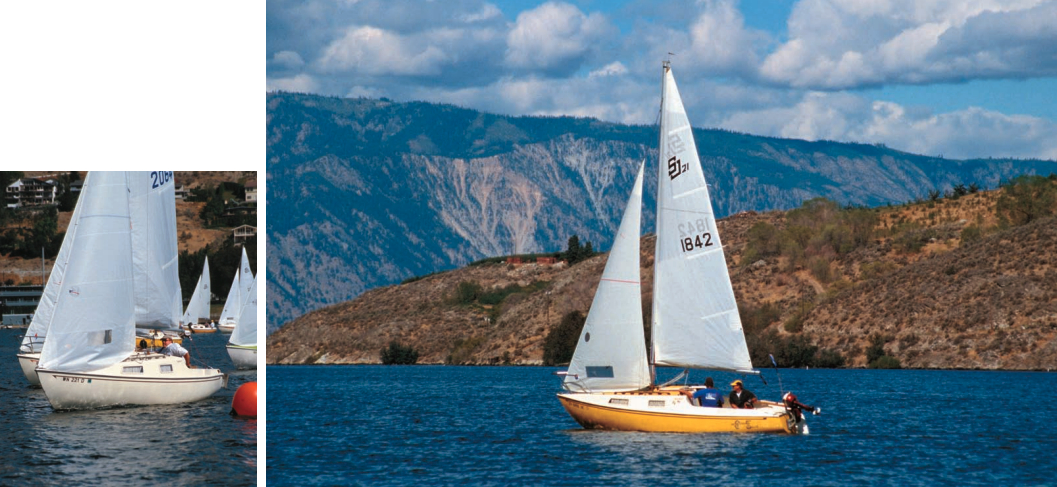
In response to requests for roomier accommodations, Don designed the Mark II. The Mark I has a traditional doghouse layout with an elevated cabintop and a traditional deck forward of the mast (top photo, Page 7). The Mark II has a flush deck from companionway to bow, providing room for sunbathers and easing crew work up forward (center photo, Page 7). The modification increases headroom in the V-berth, and extends the length of the quarterberths.
A Mark I cockpit is 90 inches long on the center-line and 23.5 inches wide with 12-inch-high backrests on 21-inch-wide seats. Belowdecks, the length between the companionway and the V-berth is 43 inches. Headroom starts at 36 inches and steps down to 30 inches.
In comparison, a Mark II cockpit is 78.5 inches on centerline. Seats are 21 inches wide at the companionway, tapering to 18.5 inches aft; backrests are 10.5 inches high. The length between the foot of the companionway and the V-berth is 54 inches, and headroom between the deck and the top of the V-berth is 33 inches at the mast-support column. The quarter-berth length is 80 inches. Other subtle changes were made belowdecks in a Mark III that enjoyed a limited production run. Altogether, more then 3,000 San Juan 21s were built.
Construction
Despite being an early entrant in the world of fiberglass construction, the company enjoyed a reputation for building solid, durable yachts.
Hulls were solid fiberglass with 7⁄16-inch-thick bottoms, and 3⁄16-inch-thick topsides. Dennis Clark says a typical layup schedule called for a layer of high-quality gelcoat that, even on the earliest boats, still shines under a new coat of wax. The skincoat was either cloth or mat plus roving, handlaid to avoid voids, followed by sheets of mat, and “small amounts of chopped mat between the roving.”
The hull-deck joint was an inward-turning flange onto which the deck was laid, bedded in polysulfide, and fastened with screws on 6-inch centers. The solid glass toerail was attached through deck and hull.
The deck layup followed a similar schedule, though it was cored with balsa, or marine plywood where hardware was fastened.
Since these boats are no longer spring chickens, they can be expected to require more preventive maintenance than a NewandFast 21.
First step: check the chainplates for leaks every year. A common complaint is that leaky chainplates allow water to invade the bulkhead, requiring strengthening with fiberglass, or replacement. Deck fasteners always introduce the possibility of water penetrating the balsa, a common problem that may produce soft spots.
Though a high percentage of owners report these problems, they have a rather cavalier attitude. Typical comments are, “I had to (a) replace the bulkhead, or (b) re-bed the chainplates, or (c) remove part of the deck and reglass it, or (d) all of the above.” However, they seem so emotionally attached to their boats that the condition is similar to taking Fido to the vet for shots.
There are some other miscellaneous concerns. Since the transoms were constructed with balsa inserts, they should be checked in areas where motor mounts are installed. You’ll know the keel pivot bolt is loosened or bent when you hear a mysterious thumping while underway.
Spreaders on the earliest boats may crack at the mast because they were parallel, causing excessive loads at the mast.
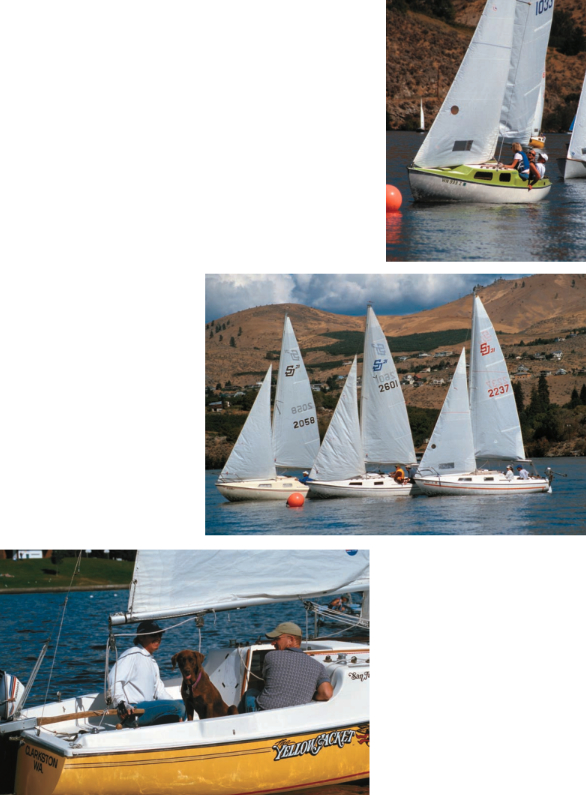
A San Juan 21 Mark I is at top. Compare the foredeck with the Mark II versions in center photo. Yellow Jacket is a Mark II version.
Eye to performance
Since the Clarks shared a passion for racing, all of the company’s boats were designed and outfitted with an eye to the best performance and easy working.
The single-spreader rig supported by stainless-steel standing rigging is easily hoisted by one person. A turnbuckle on the backstay tensions the headstay and improves windward performance. However, to maximize performance, a block and tackle eases the process and adds flexibility. A vang was standard equipment on most boats.
So what’s the key to sailing them?
Gene Adams, who has been sailing and selling San Juan boats since the 1980s, was the 1997 San Juan 21 Western champion and fleet champion four times. He says, “It’s a stump-dumb simple rig that is best when the mast is raked and the backstay tensioned when sailing to weather. The secret to maximum performance is keeping the keel gasket in good shape to avoid turbulence. Keep the bottom clean.” He recommends shortening the backstay and adding a sheet adjuster with 4:1 tackle.
“She sails best heeled 10 to 15 degrees,” he adds.
Rob Anderson says, “Keep it simple. Be patient. It’s easy to sail when the wind blows, but it takes patience to work through the lulls.”
After spending two days hanging out with two fleets at a regatta, I’d say the boats measure a solid 10 on the Fun-O-Meter. Before the event began, 15 owners agreed to sail with white sails only. The race instructions included directions to the home of a local sailor for a post-race barbecue.
On the course, old sails propelled old boats in a tightly packed fleet that rewarded the ability to read the wind more than the acquisition of new gadgetry. And the loudest sounds during the competition were laughter. After the racing, couples converted the boats to fiberglass tents.
As Rob’s old pickup began towing his boat south, it was easy to add to memories of the two of us racing in the Big Boat Series . . . images of Rob, Devon, and Karsten reaching across a lake. Or the Sea of Cortez.
His newest, larger-than-life project looks like another winner.
Thank you to Sailrite Enterprises, Inc., for providing free access to back issues of Good Old Boat through intellectual property rights. Sailrite.com