Compact craft with offshore ambitions
Issue 65 : Mar/Apr 2009
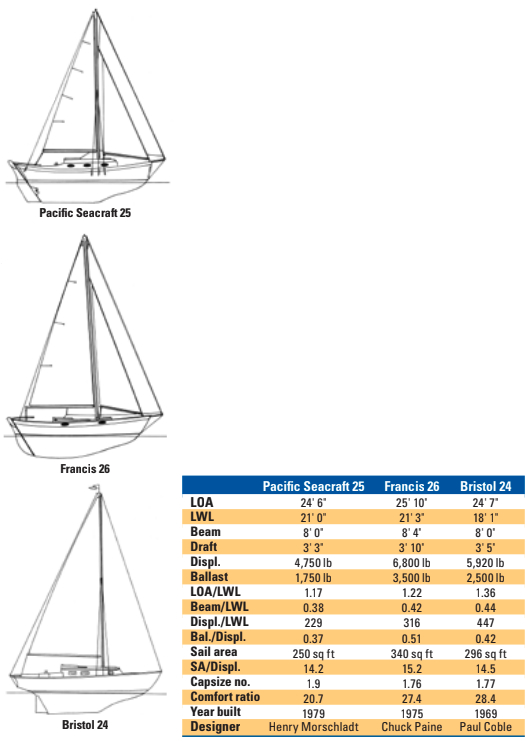
The three boats in this group — the Pacific Seacraft 25, the Bristol 24, and the Francis 26 — represent very different approaches to designing a small cruising yacht. All are full-keel hulls and, though the boats are on the small side for the big waters, it appears their designers had much more than inshore or lake cruising in mind when they started putting lines on paper.
Thanks to their husky displacement, the Francis and Bristol have similar comfort ratios to many yachts 5 to 6 feet longer. Having a lighter displacement, the Pacific Seacraft 25 doesn’t fare so well and will be a bit corkier than the other two, but her comfort ratio is still better than that of the average small cruiser and compares well with at least a couple of 30-footers I’ve reviewed on these pages.
The relative performance of these three is not easy to judge, but none of them will be particularly fast or weatherly. In my opinion, the designers rightly chose to emphasize comfort, steadiness, and seaworthiness at the expense of out-and-out speed and windward ability. These small boats appeal to the more adventurous sailor and may often be far at sea in less than ideal weather conditions. Then, the solid capsize numbers of the Francis and Bristol will be reassuring to the crew and the loss of a fraction of a knot of speed or a degree or two to weather will be quite inconsequential.
Higher capsize factor
A slightly higher capsize screening factor, along with her moderate displacement/length ratio, puts the Pacific Seacraft 25 in the category of an able coastal cruiser, rather than a small oceangoing yacht. While many less able craft have made heroic voyages, I cannot recommend a moderately light 25-footer, even one as capable as the Pacific Seacraft 25, for a major ocean passage. Part of the problem is that the weight added when equipping and loading a relatively light boat for a long voyage could raise the center of gravity, reducing her chances of a quick recovery in a knockdown or capsize.
Both the Pacific Seacraft 25 and the Bristol 24 are somewhat undercanvassed, with sail area/displacement ratios under 15, and I feel that both could handle more sail without a problem. The PS 25, with the lightest displacement of the group, should move along nicely in the softer breezes, although she also has substantial wetted surface due to her long waterline and full keel. Because skin friction is the prime source of resistance at lower speeds, the Bristol 24 should do well in light air as, with her shorter waterline and moderate draft, she probably has the least wetted surface of the three. The Francis’s taller rig, and 44 square feet more sail, might still give her an edge through the zephyrs.
I expect the Pacific Seacraft 25 to perform nicely in a medium breeze. The Francis 26 is definitely the one to beat when the wind pipes up, thanks to her very high ballast ratio and 5-inch deeper draft. Her ballast will be carried lower and that will add to her stability and reduce leeway. The Bristol, with her husky displacement and short waterline, could be the slowest of the three in a stiff breeze but she will pick up waterline length as she heels, so the difference may be slight in the long run. Still, with a lower ballast ratio and 5 inches less draft, she will struggle to hang onto the Francis in a tough windward slog.
I would urge anyone searching for a small boat for extensive coastal cruising or a long bluewater passage to also compare these three small cruisers with the Allegra 24, the Flicka, the Dana 24, and the Falmouth Cutter I reviewed in the November 2006 issue. They all have most of the virtues essential to the serious cruising sailboat and the choice could come down to the quality, the accommodations and, ultimately, the almighty dollar.
Ted Brewer is a contributing editor with Good Old Boat and one of North America’s best-known yacht designers. He has designed scores of good old boats . . . the ones still sailing after all these years.
Thank you to Sailrite Enterprises, Inc., for providing free access to back issues of Good Old Boat through intellectual property rights. Sailrite.com