A cruising dream ends on a Caribbean reef
Issue 70 : Jan/Feb 2010
We were at the eastern end of the Sir Francis Drake Channel in the Virgin Islands and dusk was descending quickly. Ahead of the boat rose the steep hills of Virgin Gorda and around us was a small handful of cruising boats. We had spent a beautiful day wandering The Baths with friends and now we were simply enjoying another perfect tropical evening.
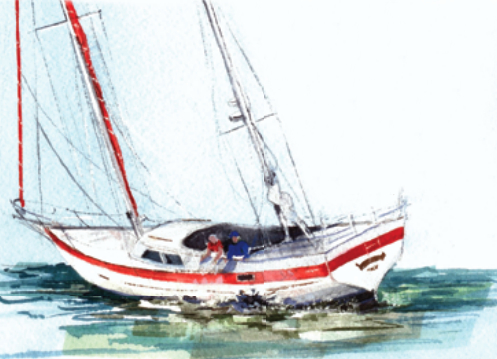
As we enjoyed our sundowners on deck, the low rumble of diesel engines broke the stillness. All the other cruisers and one windjammer rested quietly at anchor, their masts motionless silhouettes that gave no hint of who was under way so close to sunset. Then, from around the point to the north, came a workboat pulling hard against a warp that trailed off the stern. In the growing darkness we could just make out the yellow inflation bags used to float a salvage. Above the bags, a ketch rig, all that was visible above the sunken hull, stood against the inky northeastern sky. We watched in silence as a tragedy slowly slid by.
Talk on the radio that day had been about a boat that had gone aground on the reefs around Necker Island. We knew which boat this had to be. The 40-foot ketch had set out earlier on a passage to the anchorage we now occupied. That passage turned out to be the end of a cruise and a dream for a sailing couple.
The next morning before breakfast we were in the dinghy, headed for the yacht harbor. We walked through the open gate and over to the boat hanging in the travel lift. Viewing it from the starboard side, we could see little indication of the pounding the boat had received — a broken shroud, a limp lifeline — but the hull appeared to be intact. Then we walked around the stern.
The hull on the port side was missing from the forward head to the aft cabin, leaving a jagged hole that opened the entire saloon and galley to our view. On the cabin sole, foul weather gear, books, and magazines were mixed with broken shards of fiberglass hull and interior woodwork. On the starboard side, still in their places, hung undamaged coffee cups. Drawers and cabinet doors were closed as if nothing had happened.
Shock and empathy settled over me as I recalled how late one night a year before I had clawed upwind for an hour to clear a rusty bulkhead on a lee shore. It was a hard lesson in the quality of my nighttime navigation skills in Galveston Bay, a place very familiar to me. I recalled how I felt when the jagged metal bulkhead was just a few yards away and the engine was dead, wondering how I could ask my not-so-athletic wife to time her leap to shore over that rusty knife. What did the sailors on this boat think when they felt that first sickening thud of hull against reef? What was it like watching each wave coming toward them, ready to grind more of their boat into the sea?
A few months later, scuttlebutt suggested the boat had been on autopilot guided by the GPS. But that’s scuttlebutt. Still, every incident like this should serve to remind us we are all fallible, as is the technology we sometimes too readily rely on to keep us safe. While those tiny man-made orbiting “stars” are able to tell us exactly where we are in relation to where they are, the techniques in use when the waters were surveyed and the charts prepared were less precise.
My heart goes out to those sailors whose Caribbean cruise ended abruptly that day. The word on the cruisers’ net was that both escaped unharmed — itself a major victory. I salute them for taking the risk to go cruising in the first place, all the time recognizing in my own experience what little separates those of us who sail. We all have made our navigation errors and, as sailors, we owe much to standing a good watch and the mercy of the sea.
Micheal Mathews began crewing on racing catamarans while in high school. In the early 1990s, Micheal moved to Galveston Bay where he began sailing keelboats. Thanks to good friends, he has been able to sail some good old boats in the Gulf of Mexico, the Bahamas, and the Virgin Islands. Over the past few years Micheal has been sailing and restoring a 1974 C&C 27 Mk II.
Thank you to Sailrite Enterprises, Inc., for providing free access to back issues of Good Old Boat through intellectual property rights. Sailrite.com