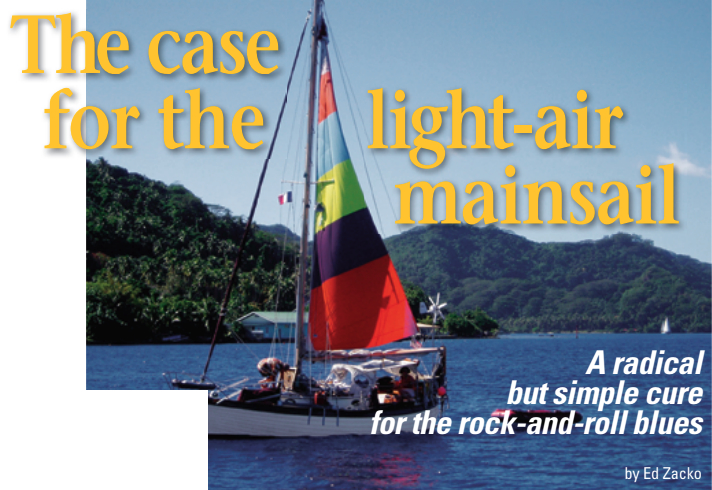
A radical but simple cure for the rock-and-roll blues
Issue 70 : Jan/Feb 2010
“The sails flapped and banged — about the ugliest sound a sailor can hear. Apart from nearly driving me crazy, the conditions were hard on the sail seams.”
– Excerpt from Dove by Robin Lee Graham
Cruising books admonish us to carry clouds of sail for light air. They go on at great length describing large genoas, drifters, and cruising spinnakers. But, other than describing vangs and preventers, they seldom suggest a solution to the mainsail problem.
Countless words have been written about “the violence of calms,” warning that more instances of rigging failure, dismasting, and torn sails occur during calms than in storms.
Sails work efficiently only when full and drawing quietly but it takes surprisingly little swell to start the mainsail slatting. Not only does this stop the sail from working properly, the noise it makes is unnerving and the damage from the slatting is cumulative and insidious. Because the material does not give, a slatting Dacron sail imparts severe shock impacts, on itself and on the rig. Each time that sail snaps, several things happen.
First, when sails slat, the cloth works and jerks on its seams. This working and jerking enlarges the holes around the stitching, wears out the sailcloth, and weakens the thread. The less a sail slats, the longer it lives.
Second, repetitive shock loads are transferred to the standing rigging. Chainplates, mast tangs, turnbuckles, and rigging wire are all affected. Swage fittings and fully battened mainsails are particularly vulnerable to these shocks. Like sails, the standing rigging is designed to withstand constant steady stress rather than sudden violent shock loads. The stainless steel will work-harden over time and break when you least expect it to.
Third, as you’re already in a calm and not moving well, if at all, the slatting makes things worse. In any swell, as the boat begins to roll, the mainsail winds up like a pitcher on the mound. The momentum of the impact, along with the leverage of the boom, causes the boat to roll down farther in the opposite direction. As this process repeats, each cycle further hampers your forward progress.
Fourth, the constant rolling compromises the headsail you’re flying. Large genoas will also slat and bang, imparting tremendous side loads to the forestay at the terminal fittings and contributing further to the problem. Nylon drifters and spinnakers will eliminate this shock but, when working alone without the mainsail, their effectiveness is severely compromised.
As offshore cruisers, we have tried all the known solutions over the years. Sheeting in the full main will not quiet the sail because of its draft. Tying in a double reef will flatten the main, and sheeting it amidships can stop the slatting, but it also eliminates a major portion of the boat’s horse-power. To make any real progress in light air, we need to fly as much sail as possible.
Enter the nylon mainsail
Our introduction to the nylon mainsail came through Dean Wixom, the father of the Nor’Sea 27. Dean carried one on his Nor’Sea 27, Chinook, for several years and loved it. On one of his visits to our home, he elaborated on the merits of this sail. But we argued against it, mainly due to lack of space on board. Frankly, it seemed like a wacky idea. Dean was not offended. He just smiled and went on his way. Subject closed. Or not quite!
On his next visit, Dean arrived at the airport weighed down with several sail bags. He brought all of his light-air sails for us to try on our upcoming Bahamas cruise. We resisted, but Dean persisted until we gave in. Weeks later in the Bahamas, as we sat with little wind, the noise and frustration overcame our reticence and we set the light-air mainsail. After only 10 minutes, we agreed: “We must have this!” Throughout the summer, we played with the rest of Dean’s light-air sails as well, but the nylon mainsail completely absorbed us.
The concept of a light-air mainsail is simple. How could sailors as a group have missed something so logical? Aside from Dean, we know of no other person who has ever had and used one. Strangely, every sailor or cruising writer we’ve talked to has refused to discuss it. Just as we did in the beginning, others tune us out when we broach the subject.
Meet the Mainster
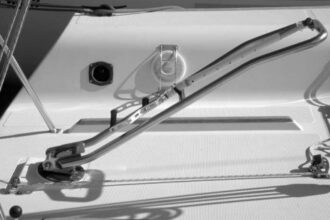
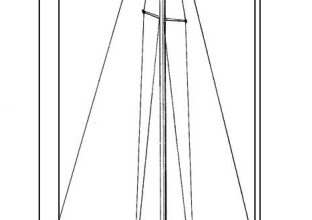
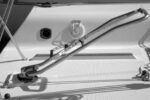
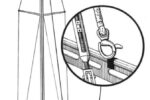
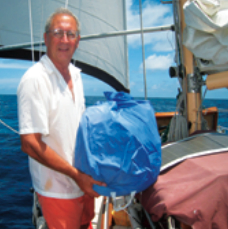
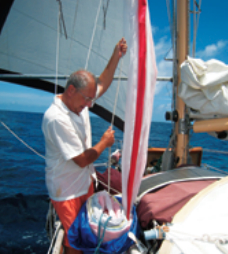
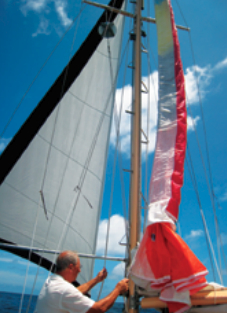
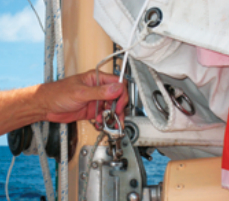
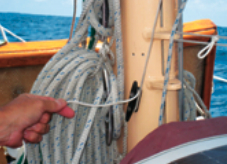
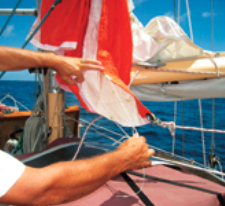
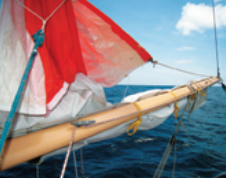
The sail that we’ve affectionately named the Mainster is very simple. The idea, by the way, is open to anyone, but the name belongs to us. Our Mainster is built of 1.5-ounce ripstop spinnaker cloth. It has simple broad-seaming, a wire luff, and drawstrings to shape the luff, foot, and leech. It is set “flying.” That is, it’s attached only at the head, tack, and clew. It can be hoisted with the main halyard or a dedicated spare. The tack is fastened to the boom gooseneck with a snapshackle and the clew is run out along the boom with an outhaul that runs through a cheek block at the end. Everything happens at the base of the mast. The topping lift supports the weight of the boom and allows for some basic sail shape. A vang prevents the boom from hopping around in the swell. Gross trim is accomplished with the mainsheet, fine trim with the outhaul and drawstrings.
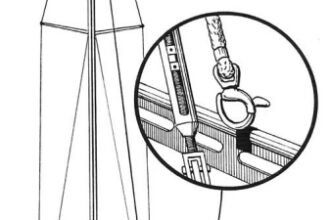
Over our past eight years of cruising, we have refined our system. The main halyard remains attached to the mainsail on the starboard side of the boat while we hoist the Mainster with its own halyard on the port side. My wife, Ellen, has made a spinnaker sock that greatly simplifies the process.We stow the Mainster in its sock in a bag attached to the main hatch, always ready for use. We hoist the Mainster directly from the bag, sometimes even before lowering the main. As the Mainster unrolls, we connect the tack and clew to the snapshackles and simultaneously pull on the sock line and clew outhaul.
Instant silence! As soon as we raise the Mainster, it blankets and silences the working main. Once the Mainster is drawing, we lower and furl the mainsail.
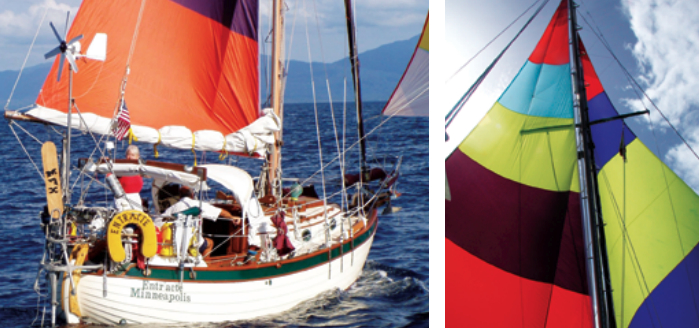
The procedure for dousing the Mainster can take many forms, depending on conditions. In an emergency, the fastest way is to cast off the clew outhaul and pull on the sock downhaul. We don’t recommend this method as the very thin cloth can become fouled on spreaders, shrouds, and mast steps. Fortunately, there is usually sufficient warning to make such a maneuver unnecessary. A better way is to ease the clew a little while pulling on the sock downhaul. We simply let the sail hang enclosed, like a sausage, until the worst passes. At that point, we can either open the sail once more or lower it completely.
As we ease the halyard, we roll the sail from the bottom up. This makes for easy and compact storage and prepares it for the next deployment. The beauty of the Mainster is that it’s a one-person sail. One person can make the change from mainsail to Mainster or the reverse in less than three minutes. Snuffing the sail in an emergency takes less than 20 seconds.
It tacks and jibes silently and takes up almost no space on deck or below. The nylon cloth has a lot of stretch and absorbs the shock of slatting. Instead of the dreaded crash, all we hear is an occasional gentle “phump” with no shock or banging.
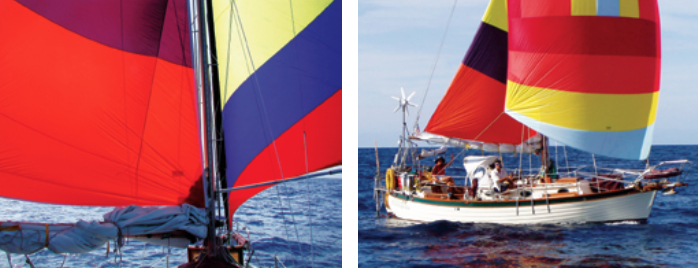
Unlike a spinnaker, a light-air mainsail is constrained by the mast, tack, and boom, so it can’t get out of control as the boat swings in the swell. Another advantage over a spinnaker is that the center of effort remains constant as the boat moves around, so our windvane and autopilot love it.
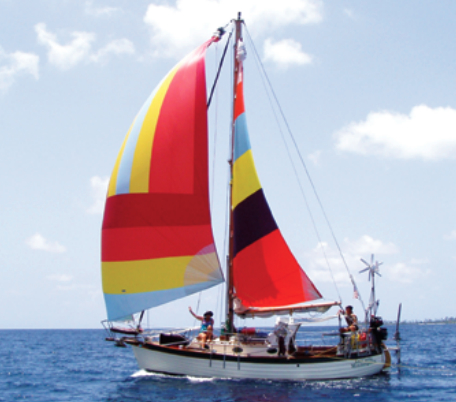
We have no fear of flying the Mainster at night, as it can be doused in seconds. Coupled with our large hanked-on nylon genoa, it brings us as close to a “set it and forget it” light-air rig as we can get. When the wind is on the beam, the combination of the Mainster and cruising spinnaker is dazzling. As I write this, we have been sailing wing-and-wing for two weeks with the Mainster set to port and the drifter poled out to starboard. We have not touched the tiller, sheet, or halyard in 14 days. Yes, we still move about in the swell but both sails are driving. In this light air, we are moving slower than a worm, but we are making progress and it’s quiet.
Drawbacks
There are only two problems with the Mainster. The first leap, it seems after watching other sailors wrestle with the concept, is to accept the idea in the first place. We sailors seem to be slow to accept any radically new idea that has not been heavily advertised and hyped.
Once past that hurdle, the second problem is finding someone who will build one for you. We were turned down flat by seven sailmakers, one with a resounding “No!” as he slammed his clipboard onto the table. Fortunately, Dave Thompson of Eggers Sails in South Amboy, New Jersey, inspected Dean’s sail, listened to our idea and, though skeptical, agreed to build such a sail for us if we would accept all responsibility for the result. No problem there, since we had already spent a summer using one just like it and had no worries. The results were wonderful; we could not be more pleased.
The only complication that we can foresee for some rigs is with the use of lazy-jacks or a Dutchman system. With these systems, you can use a Mainster but you will have to snuff the sail whenever you come about and re-deploy it on the other tack outside the lazy-jacks. Some lazy-jack systems allow you to detach the lines and lead them forward and out of the way. With a little creativity, it would be easy to set up a clew outhaul that would work on either tack outside of these lines.
The Mainster is not a substitute for a working mainsail. It is designed for specific conditions that we encounter all too regularly: a swell together with a breeze so light you can barely feel its presence and much too light to fill your working main. For one thing, you will not be able to point high with any nylon sail. As the sail fills, the stretch of the nylon will cause the draft to move aft and the luff to sag to leeward. These factors are detrimental to windward performance but, at about 50 degrees apparent wind and greater, you will have two sails driving the boat. So, if the mainsail will fill and draw quietly, we use it. If it fails to draw and begins
to slat, we fall off and use the Mainster. Our philosophy is to keep the boat moving as comfortably as possible.
Make your own
This sail is simple enough that you could make one yourself, provided you have the basic skills, inclination, and a machine that will handle V-69 thread.
When you measure, use the topping lift to set the boom at a working height that will allow you to tack and jibe easily. Make certain that your boom will clear any boom gallows, and dinghies stowed on your cabintop.

If we were to make a new Mainster, the only changes we can think of would be to substitute one of the new non-stretch ropes, such as Amsteel or Spectra, for the wire luff and to relocate the foot-line Clamcleat from the clew to the tack. This way, the halyard tension, luff, and foot shape could all be set from one place at the base of the mast.
For eight years, the Mainster has been our first line of defense in the battle of the calms. At the first slap, up it goes. The cloth is rated up to 20 knots and, while we have never tested it to that extreme, when the wind returns we continue to fly it as long as we are comfortable. We often leave a first reef tied in the mainsail. If a squall threatens, we douse the Mainster with the sock, raise the already reefed mainsail, and let the sock hang in the lee of the main until we decide what to do next — very civilized.
The Mainster is perfect for those conditions when the headsail is blanketed by the main and fails to draw. In those conditions, the motion of our boat is much better with the Mainster alone than with a poled-out headsail. We have also enjoyed great success on a reach with the Mainster coupled with our large drifter sheeted to the end of the main boom.
In light air, nylon is king. With a light-air mainsail you can carry maximum sail and, while the swell will not go away, at least be moving in comfort.
Light air is indeed a challenge. Light-air sailing tests your ingenuity and patience, but these last two weeks aboard Entr’acte have been an absolute delight. Even if we had enough fuel to motor the vast distance involved, the sound of the engine would destroy this special experience. It’s true that we are moving only as fast as a baby can crawl, but it is in these calms that the ocean comes alive. There’s an astonishing variety of activity in the sea that we often miss because of the wind, waves, and motion. But when the wind and sea die down, we truly slow down, relax, and witness everything.
Ed Zacko , a drummer, met violinist Ellen while playing in the orchestra of a short-lived Broadway musical. Their own show is still running after 32 years. They built their Nor’Sea 27, Entr’acte, from a bare hull and, since 1980, have crossed the Atlantic to Europe and back four times. Their current voyage has taken them through the Panama Canal and across the Pacific. Follow them at http://www.enezacko.com.
Thank you to Sailrite Enterprises, Inc., for providing free access to back issues of Good Old Boat through intellectual property rights. Sailrite.com