Keep your onboard supply fresh and pure
Issue 74 : Sept/Oct 2010
Keeping the water in a sailboat’s tanks tasting fresh is often a challenge and, if a tank goes bad, the consequences can be outright awful. This is especially a problem when you’re away in a remote location. The cause of the trouble can usually be traced to the original water supply, the condition of your tanks, or how the water is treated. Fortunately, you can take precautions to avoid bad water and solutions are available if it does go bad. They include additives and filters.
Of course, it’s always best if the water is clean to begin with, such as that obtained from a trustworthy marina with a high-quality municipal source. Unfortunately, you cannot take such a supply for granted. Some docks don’t have drinking (potable) water, and some have both potable and non-potable water. Putting water from the wrong supply into your tanks can lead to serious problems.
Even if you trust the source, you may still wish to filter your water before it goes into the tanks. Our cruising friends Judy and Bill Rohde successfully used a 1-micron in-line filter in their hose on their 42-foot Tayana pilothouse cutter, Jubilee, all the way from Lake Superior through the St. Lawrence Seaway and the Canadian Maritimes and down the East Coast to Florida.
I personally don’t have any firsthand experience with pre-filtering water but have found the procedure very useful when taking on diesel, so this precaution may well have some merit. It makes sense to be cautious if you are at all doubtful about the quality of whatever you will be pumping into your tanks, regardless of the fluid type.
Watch the fill hose
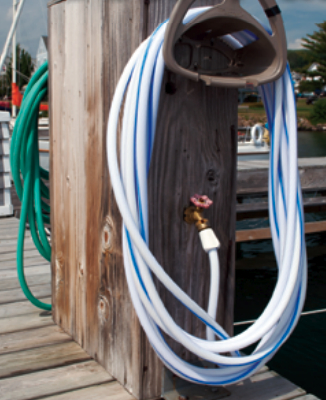
Furthermore, it’s prudent to pay close attention to the condition of your fill hose, which should be kept clean and dry. If you don’t drain it after every use, water that remains inside may become a suitable environment for the growth of mold and other unwanted organisms, which could possibly transfer to your tanks the next time you fill them. I have seen seldom-used fi ll hoses spew forth an ugly milky mixture when water was once again run through them. The water may eventually look clear after about 10 to 15 minutes, but I would feel very uncomfortable using such a hose for filling the tanks aboard our Pearson 36 cutter, Freelance.
I also recommend that you keep your water hose from falling into any harbor. You never know what harmful substances and microorganisms it could pick up in that environment and you certainly would not want your fill hose to become contaminated from such a source.
Besides being careful with the fill hose, you should obviously keep your tanks as clean as possible. Inspecting tanks and wiping them out is an expected chore during spring commissioning and fall decommissioning. It’s reassurance — but no guarantee — that the water will remain fresh during the sailing season.

Cleaning bad tanks
If a tank still goes bad, you will have to clean and sanitize it before you can safely use it again. This is best done at a marina dock that has an ample and clean municipal water supply. First, wipe out the tank the best that its access ports will permit, then shock it with a strong chlorine solution. We have had good results using about one cup of liquid household bleach for each 10 gallons of water.
Pour the bleach in first, then fill the tank with water. The solution, which is definitely not drinkable, should remain in the tank for about eight to ten hours to do its work, after which you drain the tank and flush it thoroughly. This technique seems to do the trick but should only be used sparingly and with great caution — and never with metal tanks. Chlorine solution can be very hard on some of your water system’s components.
It must be stressed that before using any quantity of bleach, you must be fully aware that it is corrosive to metal tanks, as well as to some rubber and plastic parts. One of our friends is convinced that just adding small amounts of bleach eventually damaged the aluminum water tanks in his 41-foot sailboat. For certain, his tanks began to leak and had to be replaced. So, before you pour it into your water, you should always make sure chlorine bleach will not harm any of your onboard systems.
Flush the tank
If using bleach is not a viable option for your boat, you may just have to keep cycling or flushing the tank until you are satisfied with the water quality. Steam cleaning may be another way to sanitize your tanks. However, that is something that would be best left to professional marina personnel who have the necessary equipment and expertise.
Even though the tanks are clean, the water may go bad after an extended period of time, so some sailors choose to add chlorine to keep it drinkable. Chlorine is used by most municipal water systems because, in concentrations that are not harmful to humans, it destroys disease-causing bacteria and viruses. The question is how much to put in.
Regular household bleach, such as Clorox, Purex, and Hilex, normally contains between five and six percent of sodium hypochlorite. Please note that you should never use liquid bleaches that have additives, such as dyes and scents, to disinfect drinking water. Nor should you use powdered bleach or swimming pool chlorine. They contain harmful substances.
The U.S. Environmental Protection Agency recommends adding eight drops of household bleach for each gallon of water. That means one teaspoon of bleach is needed to disinfect eight gallons of water. The mixture should be agitated — which is rarely a problem on a boat — and allowed to stand for about 30 minutes.
Filtered water
It’s also a good idea to run drinking water through a suitable filtration system to further remove unwanted tastes, smells, sediment, chemicals, and other impurities. We have a Seagull IV system by General Ecology on Freelance. It has served us well for many years and we would not want to be without it.
The Seagull IV purification system will effectively remove nearly all chemicals, metals, microbes, bacteria, parasites, cysts, and viruses from the water. It filters with a particle retention range of 0.1 nominal to 0.4 microns absolute. The system seems to give us a quality similar to most bottled water.
The filter is plumbed into our boat’s pressure-water system and has its own faucet by our galley sink. We replace the filter element after running about 1,000 gallons of water through it, which usually means that a single filter will easily last us through our five-month sailing season on Lake Superior.
Other suitable filters on the market include 3M’s WV-B3 and WV-B2 models. They are not just useful for drinking water but also for all other freshwater use on board. Both are rated for 0.2 microns. The WV-B3 model can filter about 15,000 gallons of water, and the WV-B2 7,500 gallons. With that kind of capacity, they are not only suitable as conventional in-line filters but can also be used for water polishing, in which water is regularly pumped through a filter from tank to tank to keep it clean. However, few cruising sailboats use this technique, partly because of the electric power the process consumes.
Boiling it
If all your precautions fail and the water in your tanks still turns bad, you can always boil the water for a minimum of one minute to make it drinkable. That should kill most disease-causing organisms. Unfortunately, the taste of boiled water is less than ideal, but it can be improved by pouring the water back and forth between two containers or by letting it stand for a few hours. You may, of course, also fix the flavor problem with common additives of your choice, such as coffee, tea, and lemonade mixes.
The various actions outlined above may either lessen the potential problems associated with your water supply or outright solve them. I would like to stress that taking the preventive steps, such as installing filters, is usually well worth the relatively small effort. Those of us who, just once, have had the water in their tanks turn foul can tell you what a nuisance — or even hardship — it can be when it happens. It’s much preferable to be proactive, and not to take clean drinking water for granted.
Niels R. Jensen is originally from Copenhagen, Denmark, and is a director for the Great Lakes Cruising Club. He and his wife, Vicki, usually sail their Pearson 36 cutter on Lake Superior. Niels is a journalist by trade and writes for the international boating press.
Thank you to Sailrite Enterprises, Inc., for providing free access to back issues of Good Old Boat through intellectual property rights. Sailrite.com